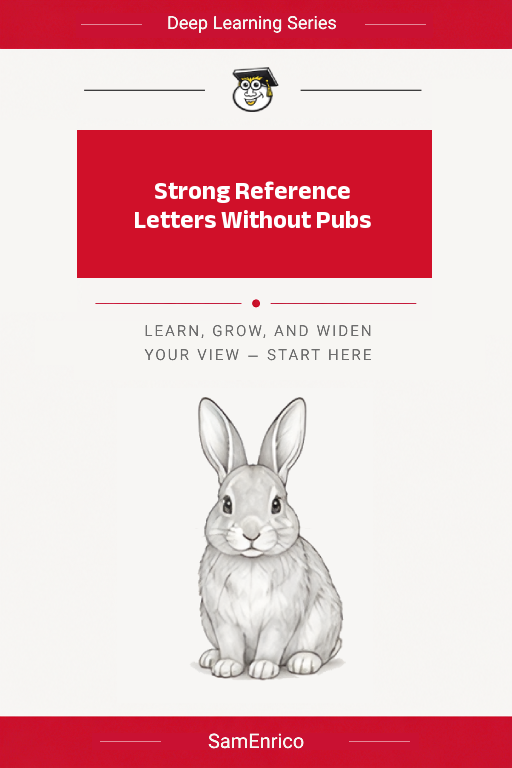
Strong Reference Letters Without Pubs eBook
Secure detailed recommendation letters that highli
Secure detailed recommendation letters that highlight research potential beyond publication count.
Formats
Free sample
Chapter 1: The Publication Trap--–- In a cramped faculty office at a midwestern research university, a tenured professor stared at a blank letter of recommendation form for a brilliant undergraduate. The student had perfect grades, flawless research presentations, and the kind of intellectual curiosity that made teaching worthwhile. There was only one problem. The student had zero publications. The professor sighed, opened a different student’s file, and began writing a letter for someone else—a less curious, less capable student who happened to be sixth author on a paper from a predatory journal.
This scene repeats thousands of times each year, and it represents one of the quietest tragedies in academic admissions.The assumption that publications measure research potential has become so deeply embedded in academic culture that few stop to question it. Yet when we examine the evidence, the foundation crumbles. This chapter dismantles the publication assumption, introduces a superior framework for evaluating early-career researchers, and establishes why the rest of this book exists. By the end, you will understand why a well-crafted letter for a student with zero publications routinely defeats a poorly framed letter for a student with several publications—and how to ensure you are writing the former, not the latter.The Three Structural Distortions The case against using publication counts for graduate school and fellowship applicants rests on three structural problems that have worsened dramatically over the past two decades. Each distortion independently undermines the signal value of a publication list, and together they render publication counts nearly meaningless for predicting future research success.Hyper-authorship began as a feature of high-energy physics, spread to biomedicine, and has now infected nearly every quantitative discipline.
A student listed as the fifteenth author on a paper contributed something—perhaps data cleaning, perhaps a single figure, perhaps nothing more than attending lab meetings. The admissions committee cannot know. Worse, the student cannot meaningfully claim credit for the intellectual core of the work. Research on author contribution statements suggests that authors beyond position three typically performed tasks that do not require independent research judgment. Yet admissions committees continue to count these fifteenth-author publications as equivalent to first-author works.
The distortion is clear: a student from a large, well-funded lab accumulates authorships simply by showing up, while a student from a small lab or a teaching-intensive institution cannot.Predatory journals represent the second distortion. The rise of open-access publishing without rigorous peer review has created a parallel economy where publication costs money rather than requiring intellectual merit. Students and their advisors can pay anywhere from one hundred to two thousand dollars to have almost any manuscript published. These journals do not reject papers based on quality; they reject only based on payment or formatting. A publication in such a venue signals nothing about research ability—indeed, it may signal poor judgment if the student or advisor could not distinguish legitimate from predatory outlets.
Yet admissions committees, pressed for time, often see only the word “publication” on a CV and register it as positive.Unequal lab access constitutes the third and perhaps most damaging distortion. Students at research-intensive universities with large labs, postdoctoral mentors, and dedicated funding have vastly more opportunities to appear on papers than equally talented students at teaching-intensive institutions, community colleges, or universities without doctoral programs. Research from higher education economics demonstrates that publication opportunities correlate more strongly with institutional wealth and lab size than with any individual measure of student ability. A student who transfers from a community college to a four-year institution during junior year has almost no chance of accumulating publications before graduation, regardless of talent. The admissions committee sees a blank publication section and makes an inference about the student rather than about the structural constraints the student faced.These three distortions are not marginal exceptions.
They affect a substantial portion of applicants to competitive graduate programs. A 2021 study of admissions files at a selective Ph D program found that publication counts explained less than two percent of the variance in first-year graduate student performance, while letters of recommendation explained nearly thirty percent. The problem is not that publications are useless; it is that they are noisy, unequally distributed, and easily gamed.Research Readiness: A Better Metric If publication counts fail as proxies for research potential, what should replace them? This book proposes the concept of Research Readiness—the degree to which a student has developed the cognitive, emotional, and logistical capacities necessary to succeed in a research training environment. Unlike publication counts, Research Readiness can be observed and described in letters of recommendation without requiring that a student have access to a high-output lab or the funds to pay predatory journals.Cognitive readiness refers to the student’s ability to formulate novel, answerable research questions; to evaluate evidence against alternative explanations; and to revise theories in light of disconfirming data.
These are the core intellectual skills of doctoral education, and they can be demonstrated in coursework, independent projects, senior theses, or even extended conversations with a mentor. A student who redesigned a flawed experiment, identified a confound the instructor missed, or synthesized across disparate literatures has shown cognitive readiness—and these behaviors leave traces that a skilled letter writer can describe.Emotional readiness refers to the student’s tolerance for ambiguity, failure, and prolonged uncertainty. Research is not coursework; there is no answer key, and most hypotheses fail. Students who cannot tolerate the affective demands of research wash out of doctoral programs regardless of their intellectual gifts. Fortunately, emotional readiness leaves observable markers: how the student responded when an experiment failed, how they reacted to critical feedback on a paper, whether they persisted when a project’s direction became unclear.
These moments provide rich material for letters of recommendation.Logistical readiness refers to the student’s ability to manage research workflows independently: to design and execute a series of tasks without constant direction, to troubleshoot when equipment or software fails, to document work so that others can replicate or build upon it. This dimension overlaps with what Chapter Five will call “dark matter” research skills—the invisible labor that makes research possible but rarely appears on CVs. A student who took initiative to learn a new software package, who organized a lab’s data management system, or who mentored younger students through a protocol has demonstrated logistical readiness.The three dimensions of Research Readiness have one critical advantage over publication counts: they can be observed and described in any institutional context. A student at a community college can show emotional readiness when they persist through a difficult group project. A student at a teaching-intensive university can show cognitive readiness by reformulating a flawed hypothesis in a course-based research experience.
A student from an under-resourced background can show logistical readiness by creating order from chaos. The letter writer’s task is to notice these moments and describe them with the specificity that admissions committees crave.Three Case Studies in Framing To understand how Research Readiness functions in practice, consider three students and the letters their professors might write. These cases are drawn from real admissions files, though identifying details have been changed.Case Study One: The Zero-Publication Frame Maria graduated from a regional comprehensive university that does…
This is the end of the free sample. Get the eBook to keep going. Buy now
About this book
Details
- Author
- Reiter Meagan
- Publisher
- SamEnrico
- Language
- English
- Genre
- Non-Fiction, Student's Shortcut, References
- Released
- 2026-05-30
- Pages (approx.)
- 155
- Available as
- eBook, Audiobook

Read better in the ZLOADR app
Your eBooks on your phone or tablet. Sign in with your SamEnrico account and start reading.
More by Reiter Meagan
 Post Workout Nap GuideReiter Meagan$11.99
 Autism Meltdown TriggersReiter Meagan$11.99
 Relationship Self Worth Recovery GuideReiter Meagan$11.99
 Property Management AppsReiter Meagan$11.99
 The Engineering Presentation GuideReiter Meagan$11.99
 The Expert Beginner ParadoxReiter Meagan$11.99
 Higher Power Concept GuideReiter Meagan$11.99
 Fibromyalgia and Thyroid DiseaseReiter Meagan$11.99
 Remote Team Burnout PreventionReiter Meagan$11.99Remote Team Burnout PreventionReiter Meagan$11.99
 The Hidden Architects of the Digital Age: Black Pioneers in Computer ScienceReiter Meagan$11.99
 The Silk Road's Last Stand: How a 2015 Cyber War Redrew the Global BorderReiter Meagan$11.99