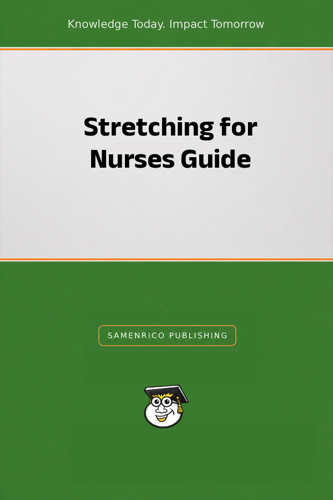
Stretching for Nurses Guide eBook
Relieve back pain from 12 hour shifts on feet.
Relieve back pain from 12 hour shifts on feet.
Formats
Free sample
Chapter 1: The Standing Lie--Every nurse remembers the moment their back first betrayed them. For some, it happens quietly—a dull ache during the fourth hour of a twelve-hour shift that simply never goes away. For others, it is dramatic and humiliating: a sneeze while reaching for a bedpan, a gentle twist to answer a call light, or the simple act of standing up from a charting station. Suddenly, the body seizes. The nurse freezes mid-motion, gripping the nearest rail or counter, unable to straighten their spine.
A colleague asks if they are alright. They lie and say yes. They finish the shift. They drive home in silence. And they wonder what just happened to their body.If you are reading this book, you already know this moment.
You have lived it, perhaps many times. You have also been told, by well-meaning charge nurses, hospital wellness coordinators, and even physical therapists, that your back hurts because you have weak core muscles or poor posture. You have been given photocopied handouts of generic stretches with stick figures. You have been told to "lift with your legs" and "maintain neutral spine" as if those instructions alone could undo the damage of ten thousand patient boosts and midnight charting sessions.The problem is not that this advice is wrong. The problem is that it is incomplete.
It fails to account for a fundamental reality of nursing that no corporate wellness program has ever truly addressed: the unique, relentless, and paradoxical physiology of the twelve-hour shift on feet.This chapter will dismantle one of the most persistent myths in occupational health: the belief that standing is benign. It will explain, in clear and practical terms, why your back hurts in ways that are unique to nursing. And it will introduce you to a concept that will change how you understand every ache, spasm, and radiating pain you have ever felt—the difference between dynamic movement and static loading.The Myth of Benign Standing Ask anyone what is harder on the body, standing or walking, and most will guess walking. Walking burns more calories. Walking makes you breathe harder.
Walking feels like exercise. Standing, by comparison, feels like rest. You are not moving. You are not exerting. You are simply...
there.This intuition is completely wrong.Research in occupational biomechanics has consistently shown that prolonged standing is more damaging to the lumbar spine than walking for the same duration. A 2018 study of hospital workers found that nurses who stood for more than five hours per shift had three times the rate of low back pain complaints compared to those who walked for equivalent periods. A 2021 systematic review of standing occupations concluded that static standing increases intradiscal pressure by forty percent more than dynamic walking at the same heart rate.Why? Because human spines were not designed for stillness.The human spine evolved for variety. Our ancestors walked, climbed, squatted, carried, and rested.
They did not stand motionless for hours in compression stockings while a computer screen slowly loaded the next patient's chart. The intervertebral discs—those gel-filled cushions between your vertebrae—have no direct blood supply. They rely on a process called fluid exchange to receive nutrients and remove waste. This exchange happens when the spine moves. When you bend, twist, or even shift your weight from one foot to the other, the discs are compressed and decompressed, pumping fluid in and out like a bellows.When you stand still, that pump stops working.The Physiology of Static Loading To understand why static standing is so destructive, you must first understand the basic anatomy of your spine.
Between each vertebra sits an intervertebral disc. Each disc has two parts: a tough outer ring called the annulus fibrosus and a soft, gel-like center called the nucleus pulposus. When you are young and healthy, the nucleus is approximately eighty-five percent water. That water content is what gives your spine its shock-absorbing capacity.Every time you stand, gravity compresses your spine. That compression pushes water out of the discs and into the surrounding tissues.
When you lie down, the discs reabsorb water. This daily cycle is normal and healthy. The problem with prolonged standing is that it extends the compression phase far beyond its natural duration while eliminating the decompression phase.After two hours of continuous standing, your lumbar discs have lost approximately fifteen percent of their height. After four hours, that loss approaches twenty-five percent. A disc that has lost a quarter of its height is no longer a shock absorber.
It is a flattened, vulnerable structure with its inner gel pushing against a stressed outer wall. This is the mechanical precursor to a herniation.But disc compression is only half of the story. The other half involves your ligaments.Ligaments are the fibrous bands that connect bone to bone, providing passive stability to your spine. Unlike muscles, which can contract and relax, ligaments have no ability to adjust their tension. They are like rubber bands.
When stretched beyond their resting length, they do not snap back immediately. They creep.Creep is the slow, permanent deformation of connective tissue under constant load. When you stand still for hours, the ligaments supporting your lumbar spine gradually lengthen. This is not a muscle fatigue issue. This is not a strength issue.
This is a material property of human tissue. Every nurse who has ever felt their back "give out" after a long shift has experienced the endpoint of ligamentous creep: a spine that has lost its passive stability, leaving the muscles to bear loads they were never designed to carry alone.Why Nurses Feel Worse at Hour Ten Than Hour Fourteen Here is a paradox that every experienced nurse knows but few can explain: by hour ten of a twelve-hour shift, your back is screaming. By hour fourteen, you are still in pain, but something has changed. The sharp, specific ache has become a dull, diffuse discomfort. You are still hurting, but you are no longer convinced you are about to collapse.This pattern is not your imagination.
It has a physiological explanation rooted in neuromuscular adaptation.During the first eight to ten hours of a shift, your body relies primarily on your muscles to stabilize your spine against the forces of gravity and patient care. Your erector spinae, quadratus lumborum, and multifidus muscles contract continuously, trying to compensate for the disc compression and ligament creep that are happening beneath them. This is exhausting. By hour ten, these muscles have been contracting for nearly a full workday. They are running out of energy.
They are beginning to spasm, not because they are weak, but because they are overworked.Sometime between hour ten and hour twelve, a shift happens. Your nervous system realizes that your muscles cannot maintain this effort indefinitely. It begins to recruit accessory muscles—your hamstrings, your glutes, even your abdominal wall—to share the load. Your movement patterns change. You start leaning on counters more.
You shift your weight more frequently. You begin to move in ways that are mechanically inefficient but metabolically cheaper.By hour fourteen, you have settled into a new, compromised equilibrium. Your pain is still present, but it has changed character because your body…
This is the end of the free sample. Get the eBook to keep going. Buy now
About this book
Details
- Author
- Swafford Weldon
- Publisher
- SamEnrico
- Language
- English
- Genre
- Non-Fiction, Health & Wellness, Nursing
- Released
- 2026-06-09
- Pages (approx.)
- 138
- Available as
- eBook, Audiobook

Read better in the ZLOADR app
Your eBooks on your phone or tablet. Sign in with your SamEnrico account and start reading.
More by Swafford Weldon
 Cram Session Recovery WorkbookSwafford Weldon$11.99
 Physical Abuse Recovery Self WorthSwafford Weldon$11.99
 Chef Comparison on Social MediaSwafford Weldon$11.99
 Metta for Abortion ExperiencesSwafford Weldon$11.99
 The Billionaire's Secret: The Mysterious Death of Alexander PerepilichnyySwafford Weldon$11.99
 Citation Rules for Film StudentsSwafford Weldon$12.99
 Data Visualization for PromotionsSwafford Weldon$12.99
 How to Start a Uranium-Radium-Vanadium Ore Mining BusinessSwafford Weldon$11.99
 Electronics TesterSwafford Weldon$11.99
 Understanding Nasopharyngeal CarcinomaSwafford Weldon$17.99