
Non-FictionHealth & WellnessConstruction
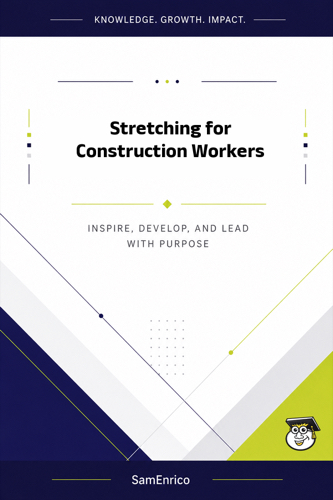
Stretching for Construction Workers eBook
Prevent lifting injuries with hip and back mobilit
by Ruth Louisa
Prevent lifting injuries with hip and back mobility.
Formats
Free sample
Chapter 1: The Most Expensive Tool--–- The alarm goes off at 4:17 AM. It’s dark. It’s cold. Your boots are by the door, caked in yesterday’s dried mud. You swing your legs out of bed, and for a split second, you feel it – that dull, familiar ache in your lower back.
Not sharp enough to stop you. Not loud enough to mention to your wife. Just a quiet reminder that yesterday was hard, and today will be harder. You tell yourself what every construction worker tells himself: “It’s nothing. Just part of the job.”By 5:00 AM, you’re in the truck, coffee in one hand, steering wheel in the other.
By 6:00 AM, you’re lifting, carrying, stooping, climbing, pulling, and twisting. By 10:00 AM, the ache is gone – or maybe you just stopped noticing it. By 3:00 PM, you’re tired but satisfied. By 8:00 PM, you’re on the couch, and that dull ache is back. You don’t stretch.
You don’t ice. You just survive. Tomorrow, you’ll do it all over again.This is not weakness. This is not laziness. This is the single most expensive habit in the construction industry – and it is silently bankrupting your body, your career, and your future.This chapter will show you exactly how much your back is costing you, why the myth of “pain is part of the job” is killing careers, and how the “weekend warrior” trap turns Monday mornings into medical emergencies.
By the end of this chapter, you will never ignore a back twinge again. Not because you’re afraid. Because you finally understand the math.The Numbers No One Talks About Let’s start with a fact that should be written on every hard hat, every tailgate, and every roll-up door on every job site in America. According to the U.S. Bureau of Labor Statistics, the construction industry has a back injury rate nearly 50% higher than all other U.S.
industries combined. Not slightly higher. Not marginally higher. Fifty percent higher. That means if you work in construction, you are statistically one and a half times more likely to suffer a back injury than someone working in manufacturing, warehousing, or even commercial fishing.But statistics are abstract.
Let’s make this real.The National Institute for Occupational Safety and Health (NIOSH) tracks every lost-time injury across the country. Their data shows that lower back injuries account for nearly one in every five workplace injuries in construction. That’s twenty percent of all reported injuries coming from one single part of the body. Not the hands. Not the knees.
Not the shoulders. The lower back.And here is the part that should make you set down your coffee: the American Physical Therapy Association (APTA) reports that once you have one back injury that takes you out of work for more than a week, your risk of a second back injury within the next twelve months increases by 400%. Four hundred percent. You are not “tougher” after a back injury. You are not “broken in.” You are four times more likely to get hurt again.
The first injury creates a cascade of compensation patterns, muscle guarding, and movement fear that primes your spine for failure.The Three Layers of Cost Most people think a back injury costs you a workers’ comp check and a few weeks on the couch. That is like saying a house fire costs you the price of a smoke detector. Let’s break down the real cost of a single back injury – not to scare you, but to arm you with the truth.Layer One: Direct Costs When you blow out your back on a job site, the first thing that happens is paperwork. Then comes the medical machine. A typical lost-time back injury in construction generates an average workers’ compensation claim of $40,000 to $60,000.
That covers the initial doctor visit, the x-rays or MRI (which run $2,000 to $5,000 on their own), physical therapy sessions at $150 per visit, prescription anti-inflammatories, and follow-up appointments. If you need surgery – a lumbar discectomy or fusion – the cost jumps to **$80,000 to $150,000** overnight.But here is what the insurance adjuster won’t tell you: those are just the billed costs. The real direct cost is the time. The average back injury takes 45 to 60 days to return to full duty. That is two months of your life spent in doctors’ waiting rooms, lying on the floor, and watching your savings account shrink.Layer Two: Indirect Costs The indirect costs are where the math gets brutal.
Most construction workers are paid by the hour. Most do not have paid sick leave that covers six weeks. If you are out for two months, you lose two months of wages. For a worker making $30 an hour with a forty-hour week, that is **$9,600 in lost wages** before taxes. For a foreman or skilled tradesperson at $45 an hour, that loss climbs to over $14,000.But the job site does not stop when you stop.
Your crew has to cover your work. That means overtime for your coworkers – at time and a half. That comes out of the project budget. And if your injury requires hiring a temp or a replacement, the company spends thousands on recruiting, training, and the inevitable productivity gap while the new person learns the job.And then there is the cost no one puts on a spreadsheet: the loss of your reputation. In construction, your name is your bond.
If you become known as “the guy who is always hurt,” you stop getting called for the good jobs. You stop being first on the list. You become a liability, not an asset. That is not cruelty. That is capitalism.Layer Three: Human Costs Now we get to the costs that break my heart.
The APTA has tracked the long-term outcomes of workers with chronic back pain, and the numbers are devastating. Depression rates triple among construction workers who have been out of work with a back injury for more than three months. Not double. Triple. You are three times more likely to become clinically depressed when chronic pain isolates you from your crew, your purpose, and your paycheck.Divorce rates among construction workers with chronic back pain are 30% higher than the general population.
Why? Because pain makes you short-tempered. Fatigue makes you withdrawn. The inability to play with your kids, help around the house, or be intimate with your partner creates a slow, quiet distance that many marriages never recover from.And then there is the invisible cost: the loss of identity. You are not “a person with a bad back.” You are a roofer.
A framer. An operator. A concrete finisher. When you cannot do the work that defines you, who are you? That question is the one that keeps injured workers up at 2:00 AM.The Myth of “Pain Is Just Part of the Job”Let me say something that might make some of you angry.
Pain is not part of the job. Full stop. Not the job. Not the trade. Not the life.
Pain is a signal. A warning light on your dashboard. And ignoring it is not toughness – it is stupidity dressed up as masculinity.I have heard every version…
This is the end of the free sample. Get the eBook to keep going. Buy now
About this book
Details
- Author
- Ruth Louisa
- Publisher
- SamEnrico
- Language
- English
- Genre
- Non-Fiction, Health & Wellness, Construction
- Released
- 2026-06-06
- Pages (approx.)
- 125
- Available as
- eBook, Audiobook

Read better in the ZLOADR app
Your eBooks on your phone or tablet. Sign in with your SamEnrico account and start reading.
More by Ruth Louisa
 Loving Kindness for MiscarriageRuth Louisa$11.99
 Attempt Survivor Depression StoryRuth Louisa$11.99
 Witnessing Domestic Violence GuideRuth Louisa$11.99
 The Firefighter Social Media TrapRuth Louisa$11.99
 The Sound of a Generation: How Kraftwerk Reinvented Music in the Digital AgeRuth Louisa$11.99
 Citation Rule Pocket ReferenceRuth Louisa$12.99
 Career Pivot Promotion FrameworkRuth Louisa$12.99
 How to Start a Underwear Knitting Mills BusinessRuth Louisa$11.99
 Understanding Nasopharyngeal Teratoma Dandy–walker Diaphragmatic HerniaRuth Louisa$17.99
 Equipment EngineerRuth Louisa$11.99
You may also like
 Hong Kong Handover 1997Dunn Johnnie$11.99
 Zumba For Postnatal Recovery CourseNeal Christian$11.99
 Zumba for BeginnersLadner Nikia$11.99
 YouTube Comment Mining GuideHumes Pandora$12.99
 Worry Box MeditationCarlin Rudy$11.99
 Workplace Stress MeditationNguyen Lynn$11.99
 Workplace Stress and Sleep RepairHawley Ivory$11.99
 Workplace Perfectionism CureDelaney Jeffry$11.99
 Workplace Injustice Anger GuideWallen Isabelle$11.99
 Work Addiction and Burnout LinkGreenwood Ester$11.99
 Women in Yoga and WellnessBeattie Galina$11.99
 Women in Stand Up ComedyChun Evangeline$11.99