
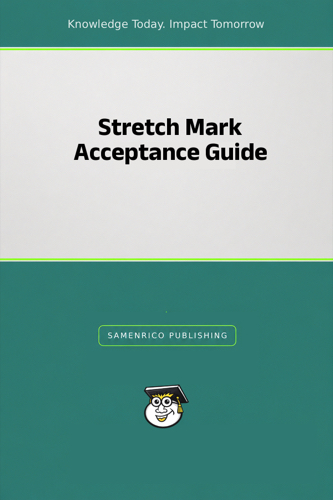
Stretch Mark Acceptance Guide Audiobook
Normalizes tiger stripes and rebuilds self-esteem
by Eng Aretha
Normalizes tiger stripes and rebuilds self-esteem after growth or pregnancy.
Formats
Free sample
Chapter 1: The Purchased Shame...--–- You didn’t hate your stretch marks the first time you saw them. You hated them the first time someone taught you to.Let that land for a moment. Before the magazine, before the mother’s whispered concern, before the boyfriend’s clumsy comment, before the dermatologist’s laser pamphlet—there was simply skin. Yours. Textured in some places, smooth in others, changing as you changed.
And you didn’t think much of it at all. That neutral, pre-language relationship with your own body is still in there somewhere. Buried under years of advertising, well-meaning warnings, and cultural static, but intact. This chapter is about digging it back up.Most people believe their shame about stretch marks is natural, even inevitable. “Of course I hate them,” they say.
“They’re ugly.” But that reaction isn’t hardwired. It was installed. And once you understand the installation process—the history, the marketing, the money, the myth of the flawless canvas—you cannot unsee it. That’s the first real step toward acceptance: recognizing that your shame was not self-generated. It was purchased.The Pre-Industrial Body: When Stretch Marks Were Just Skin Before we talk about how you learned to hate your stretch marks, let’s talk about a time before that lesson existed.
It’s not ancient history. It’s your great-grandmother’s era.Prior to the rise of the modern cosmetics industry—roughly the 1950s to 1970s—stretch marks were viewed as neutral biological events. Women (and men) got them during growth spurts, pregnancy, weight changes, and muscle development. They had no special name in everyday conversation beyond “those lines.” There was no billion-dollar industry devoted to their prevention or removal because there was no widespread fear of them.Consider this: the first commercial stretch mark cream was not developed because doctors discovered a health risk. It was developed because a marketing executive realized that a product designed for scar reduction could be rebranded for a new, larger audience—pregnant women.
And that rebranding required one thing: a problem. If women didn’t already believe their stretch marks were a crisis, the industry would simply teach them to believe it.This is the fundamental mechanism of beauty culture. It identifies a neutral or even common physical trait, frames it as undesirable, then sells you the solution. The solution never fully works (because stretch marks are genetic…
This is the end of the free sample. Get the Audiobook to keep going. Buy now
About this book
Details
- Author
- Eng Aretha
- Publisher
- SamEnrico
- Language
- English
- Genre
- Non-Fiction, Self-Help, Skin Positivity
- Released
- 2026-06-08
- Pages (approx.)
- 115
- Available as
- eBook, Audiobook

Listen in the VoxFlicks app
Audiobooks and audio dramas wherever you go. Sign in with your SamEnrico account and press play.
More by Eng Aretha
 Assertiveness With Roommates GuideEng Aretha$11.99
 EQ For Project ManagersEng Aretha$11.99
 MACRS Depreciation SystemEng Aretha$11.99
 The EQ for Mental Health Professionals GuideEng Aretha$11.99
 Nefertiti's Lost Voice: The Silent Queen of EgyptEng Aretha$11.99
 Marketing and Social Media InternEng Aretha$11.99
 How to Start a On-line Publishing of Statistics and other Information Business (Beginners Guide)Eng Aretha$11.99
 Procurement Reporting and DashboardingEng Aretha$12.99
 Strategy Meeting Energy ManagementEng Aretha$12.99
 Understanding Malignant Hyperthermia Arthrogryposis TorticollisEng Aretha$17.99
You may also like
 Body Image For People With Vitiligo GuideShoemaker Maile$11.99
 Self Esteem For People With Stretch Marks GuideBarrett Gerardo$11.99
 Acne and Skin Esteem GuideLeclair Susann$11.99
 Vitiligo Acceptance WorkbookCain Beatrice$11.99
 Freckle Body Image GuideSpeer Quinton$11.99
 Stretch Mark Acceptance WorkbookPoston Stevie$11.99
 Acne Scar Self-Esteem GuidePierce Rolando$11.99