

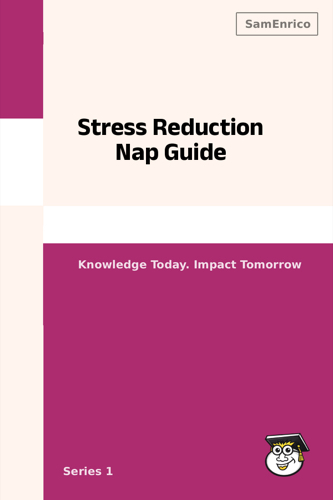
Non-FictionHealth & WellnessStress
Stress Reduction Nap Guide eBook
Lower cortisol levels with brief daytime rest.
Lower cortisol levels with brief daytime rest.
Formats
Free sample
Chapter 1: The Unseen Epidemic--–- By the time you finish reading this sentence, your body will have performed thousands of biochemical reactions. Some of those reactions are keeping you alive. Others are slowly wearing you down. And one specific reaction—a cascade of hormones and neural signals that began the moment you woke up this morning—may be the reason you feel exhausted even though you have not done anything particularly strenuous today.You are not imagining this fatigue. It is not a character flaw, a lack of discipline, or a sign that you need more coffee.
It is biology. And it is happening to millions of people who, like you, have been told that stress is “just part of modern life” and that feeling tired all the time is normal. It is not normal. It is epidemic. And it has a name that you may not have heard before: HPA axis dysregulation.The Hypothalamic-Pituitary-Adrenal axis is your body’s central stress response system.
When it is working correctly, it gives you energy in the morning, helps you focus during the day, and allows you to sleep soundly at night. When it is not working correctly—when it becomes stuck in a state of chronic, low-grade activation—it produces a signature symptom that has become so common we barely notice it anymore: the feeling of being tired and wired at the same time.You know this feeling. It is the 2:00 PM crash that coffee cannot fix. It is the inability to fall asleep because your mind is racing, even though your body is exhausted. It is the irritability that flares up over small things.
It is the brain fog that makes you feel like you are thinking through wet cement. It is the weight that accumulates around your middle despite no change in diet or exercise. It is the sense that you are running on empty, but someone forgot to tell the engine to stop.This book exists because that feeling is not inevitable. It is not a permanent state. And it can be reversed—not by expensive supplements, complicated meditation routines, or quitting your job—but by something so simple and so accessible that you can start today, in whatever room you are reading this, with no equipment and no special skills.The solution is strategic daytime rest.
The science is irrefutable. And the time to start is now.The Hormone That Holds You Hostage Cortisol has been unfairly demonized. Walk into any health food store or scroll through any wellness influencer’s Instagram feed, and you will see cortisol blamed for everything from belly fat to baldness. Supplements promise to “lower cortisol” as if the hormone itself were a toxin to be eliminated. This is dangerously misleading.Cortisol is not your enemy.
Cortisol is your ally. Without cortisol, you would not have the energy to get out of bed. Without cortisol, your immune system would overreact to every minor infection. Without cortisol, your blood pressure would plummet every time you stood up too quickly. Cortisol is so essential that people whose adrenal glands cannot produce enough of it—a condition called Addison’s disease—must take synthetic cortisol multiple times per day just to stay alive.The problem is not cortisol.
The problem is the timing and duration of cortisol release.In a healthy body, cortisol follows a beautiful daily rhythm. It surges in the early morning, peaking around 8:00 AM. This surge—called the Cortisol Awakening Response, or CAR—is what pulls you out of sleep and into wakefulness. It sharpens your attention, mobilizes energy from your liver, and prepares your body for the demands of the day. Throughout the morning and early afternoon, cortisol levels gradually decline, with small bumps in response to challenges like exercise, meetings, or deadlines.
By late evening, cortisol reaches its lowest point, allowing your body to transition into sleep. By midnight, it is a whisper. By 3:00 AM, it is nearly silent.This rhythm is not accidental. It is the result of millions of years of evolution, fine-tuned to match the cycle of daylight and darkness, activity and rest. It is your body’s internal clock—not the one in your phone, but the one in your brain, the suprachiasmatic nucleus, which orchestrates the entire symphony of hormones that regulate your energy, mood, and health.The problem arises when this rhythm breaks.
And in the modern world, this rhythm breaks constantly.The Saber-Toothed Tiger in Your Pocket Your brain evolved in an environment where threats were physical, immediate, and brief. A predator appeared. You ran or fought. The threat ended. Your cortisol spiked and then returned to baseline.
This cycle repeated perhaps a few times per week. The rest of the time, your HPA axis was quiet, allowing your body to rest, repair, and restore.Your brain does not know that you no longer face saber-toothed tigers. Your brain knows what it knows: when it detects a threat, it activates the HPA axis. And in the modern world, threats are everywhere. An email from your boss that starts with “Let’s talk.” A news notification about a political crisis.
A text message from your child’s school. A social media argument. A traffic jam. A deadline. A bill.
A comment from a colleague. A memory of something you said five years ago that still makes you cringe.Each of these triggers a cortisol response. Not the full, screaming, running-for-your-life response that a predator would trigger—but a smaller, subtler response. A bump. A micro-spike.
And because these threats never stop—because your phone is always buzzing, your inbox is always filling, and your to-do list is always growing—those micro-spikes never fully resolve. Your cortisol does not return to baseline. It accumulates. It plateaus. It becomes the new normal.This is the unseen epidemic.
You are not walking around with sky-high cortisol all the time. That would be obvious and debilitating. You are walking around with cortisol that is twenty percent higher than it should be at 2:00 PM. Fifteen percent higher at 6:00 PM. Thirty percent higher at 10:00 PM, when your body is trying to fall asleep.
These are not dramatic numbers. They are not emergency-room levels. But they are enough to change how you feel, how you think, and how your body functions—day after day, month after month, year after year.The Body Keeps the Score What does chronically elevated baseline cortisol feel like? The answer depends on how long it has been going on and how sensitive your body is to hormonal fluctuations. But there is a cluster of symptoms that appear so consistently that doctors and researchers have given them a name: hypercortisolism, or more commonly, HPA axis dysregulation.Here is what your body is trying to tell you when your cortisol baseline is too high:You are tired but cannot sleep.
This is the hallmark symptom. You feel exhausted—genuinely, deeply exhausted—but when you lie down to sleep, your mind races. You stare at the ceiling. You check the clock. You worry about not sleeping.
This happens because cortisol is the antagonist of melatonin. Cortisol wakes you up. Melatonin puts you to sleep. When cortisol is elevated at…
This is the end of the free sample. Get the eBook to keep going. Buy now
About this book
Details
- Author
- Kinney Isadora
- Publisher
- SamEnrico
- Language
- English
- Genre
- Non-Fiction, Health & Wellness, Stress
- Released
- 2026-06-11
- Pages (approx.)
- 144
- Available as
- eBook, Audiobook

Read better in the ZLOADR app
Your eBooks on your phone or tablet. Sign in with your SamEnrico account and start reading.
More by Kinney Isadora
 Zone Two Running FoundationKinney Isadora$11.99
 LBO Return Metrics HandbookKinney Isadora$11.99
 Self Hypnosis for Bill PaymentKinney Isadora$11.99
 Spiritual Anticipatory Grief GuideKinney Isadora$11.99
 Crime Scene Reconstruction ManualKinney Isadora$11.99
 Memory Palace Speed BuildingKinney Isadora$11.99
 Empathy Skills for BeginnersKinney Isadora$11.99
 Steel Storm: The Birth of the Tank at Cambrai (1917)Kinney Isadora$11.99
 Kepler’s Cosmic Harmony: The Music of the Spheres RevealedKinney Isadora$11.99
 Ocelots: Small Spotted CatKinney Isadora$11.99
 How to Produce Curtain Walls and AccessoriesKinney Isadora$11.99
 Alberta Opportunity StreamKinney Isadora$12.99
You may also like
 Hong Kong Handover 1997Dunn Johnnie$11.99
 Zumba For Postnatal Recovery CourseNeal Christian$11.99
 Zumba for BeginnersLadner Nikia$11.99
 YouTube Comment Mining GuideHumes Pandora$12.99
 Worry Box MeditationCarlin Rudy$11.99
 Workplace Stress MeditationNguyen Lynn$11.99
 Workplace Stress and Sleep RepairHawley Ivory$11.99
 Workplace Perfectionism CureDelaney Jeffry$11.99
 Workplace Injustice Anger GuideWallen Isabelle$11.99
 Work Addiction and Burnout LinkGreenwood Ester$11.99
 Women in Yoga and WellnessBeattie Galina$11.99
 Women in Stand Up ComedyChun Evangeline$11.99