
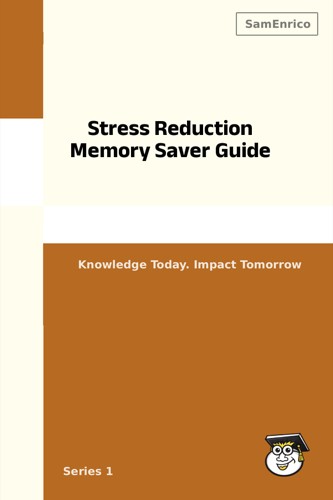
Non-FictionSelf-HelpStress Management
Stress Reduction Memory Saver Guide eBook
Lower cortisol through meditation and relaxation,
Lower cortisol through meditation and relaxation, protecting the hippocampus from stress damage.
Formats
Free sample
Chapter 1: The Leaky Bucket--–- You are standing in your kitchen, phone in hand, keys in the other, and you have absolutely no idea why you walked into this room. Three seconds ago, you had a clear intention. Now it is gone. Vanished. You retrace your steps mentally—the living room, the hallway, the turn past the bathroom—but the thought does not come back.
You feel a familiar prickle of anxiety. Not again. Is this normal? Is this forty? Is this early Alzheimer's?
You shake your head, open the refrigerator, and close it. Nothing. You check your phone for no reason. You walk back to the living room, and the moment you sit down, the memory returns: you needed your sunglasses. They are in the car.
You walked to the kitchen to get the car keys you were already holding.This is not a memory problem. This is a stress problem. And the difference between the two will determine whether you spend the next decade worrying about your brain or doing something effective about it.The Moment Before Forgetting Let us freeze that scene and look under the hood. What just happened in your brain was not a failure of storage—your sunglasses were never "lost" from memory. What happened was a failure of encoding.
Your hippocampus, the seahorse-shaped structure deep in your temporal lobe, was supposed to tag the thought "get sunglasses from car" as important and hold it in short-term memory while your body carried out the action of walking to the kitchen. But something interfered with that process. Something made your hippocampus drop the ball.That something is cortisol.Cortisol is a glucocorticoid hormone produced by your adrenal glands, which sit atop your kidneys like tiny hats. It is essential for life. Without cortisol, you would die of septic shock from a minor infection, your blood pressure would collapse, and you would have no energy to wake up in the morning.
Cortisol is not the enemy. The problem is not cortisol. The problem is too much cortisol for too long—a state that neuroendocrinologist Bruce Mc Ewen named allostatic load.This chapter introduces the central metaphor that will guide this entire book: your brain's stress system is like a bucket.The Bucket Imagine a five-gallon bucket. Now imagine that every stressful event in your day—every email that makes your jaw tighten, every interruption while you are focused, every argument with your partner, every news alert that spikes your heart rate, every sleepless hour staring at the ceiling—adds a cup of water to that bucket.Brief, acute stress is like adding one cup of water and then immediately tipping the bucket over. The water drains.
The bucket is empty again within minutes or hours. This is homeostasis, the natural self-correcting rhythm of a healthy nervous system. Your heart rate rises, then falls. Your cortisol spikes, then returns to baseline. You feel the stress, you respond, you recover.
This is good stress. This is what your ancestors felt when they saw a predator, ran, and then rested.But what happens when you never tip the bucket over? What happens when the water keeps coming—cup after cup, hour after hour, day after day—and you never get a chance to empty it?The bucket overflows. And that overflow is allostatic load.Allostatic load is the physiological wear and tear that accumulates when your stress response systems are activated too frequently or fail to shut off. It is not the stress itself that damages you.
It is the failure to recover from stress. It is the difference between a sprint and a marathon you never agreed to run.The Protector That Becomes a Destroyer To understand how this happens, you need to meet cortisol properly, not as an abstract hormone but as a character in your body's daily drama.Cortisol is released by your adrenal glands in response to a signal from your hypothalamus and pituitary gland—a cascade often called the HPA axis (hypothalamic-pituitary-adrenal). When your brain perceives a threat (real or imagined, physical or psychological), the HPA axis lights up like a fire alarm. Within seconds, cortisol floods your bloodstream.In the short term, cortisol is brilliantly useful. It:Mobilizes glucose from your liver to fuel your muscles and brain Sharpens your focus by narrowing attention to the threat Temporarily suppresses non-essential functions like digestion, reproduction, and immune response Increases your heart rate and blood pressure to deliver oxygen faster Enhances memory consolidation for threatening events (so you remember not to touch that hot stove again)This is the protector.But the protector has a dark side.
When cortisol remains elevated for weeks, months, or years—when the HPA axis never gets the "all clear" signal—that same hormone becomes a neurotoxin. It begins to damage the very brain structures it was designed to protect.The switch happens somewhere around the two-to-three-week mark of continuous elevation. At first, cortisol is just high. Then it becomes chronically high. And chronic high cortisol does three things to your brain, each worse than the last.First, it shrinks the dendrites of neurons in your hippocampus—the branch-like extensions that receive signals from other neurons.
Think of dendrites as the hands of the brain cells, reaching out to touch their neighbors. Cortisol makes those hands pull back. Neurons stop talking to each other as effectively. Memory encoding slows down.Second, it stops neurogenesis—the birth of new neurons—in the dentate gyrus of the hippocampus, which is one of only two regions in the adult brain that can grow new cells. (The other is the olfactory bulb, which handles smell; you can live without a perfect sense of smell, but you cannot live without memory.)Third, if high cortisol persists long enough, it triggers apoptosis—programmed cell death.
Neurons in the hippocampus begin to commit suicide in an orderly, biochemically controlled process. The hippocampus physically shrinks. MRI studies of patients with Cushing's disease (a condition of extreme cortisol overproduction) show measurable hippocampal volume loss of 8-15% compared to healthy controls. The good news, which we will explore in Chapter 5, is that much of this damage is reversible. But first, you need to understand what you are fighting.Why You Forgot the Sunglasses Now let us return to the kitchen.
Why did you forget the sunglasses?The answer is not that your hippocampus is damaged beyond repair. The answer is that your hippocampus was busy.When your cortisol levels are elevated—even moderately, even from the low-grade chronic stress of modern life—your hippocampus shifts its resources away from encoding mundane information (sunglasses, keys, names) and toward threat detection. This is an evolutionary hangover. For your ancestors, remembering where the predator was hiding was more important than remembering where they left their spear. The brain prioritizes survival over convenience.
Always.Cortisol directly inhibits long-term potentiation (LTP), the synaptic process that strengthens connections between neurons when you learn something new. LTP is the biochemical signature of memory formation. When two neurons fire together repeatedly, the connection between them gets stronger—this is the famous "neurons that fire together wire together" principle. Cortisol throws a wrench into that process. It reduces the likelihood that…
This is the end of the free sample. Get the eBook to keep going. Buy now
About this book
Details
- Author
- Washburn Jackqueline
- Publisher
- SamEnrico
- Language
- English
- Genre
- Non-Fiction, Self-Help, Stress Management
- Released
- 2026-06-07
- Pages (approx.)
- 147
- Available as
- eBook, Audiobook

Read better in the ZLOADR app
Your eBooks on your phone or tablet. Sign in with your SamEnrico account and start reading.
More by Washburn Jackqueline
 Project Resource ForecastingWashburn Jackqueline$11.99
 Mangrove Roots GuideWashburn Jackqueline$11.99
 Alcohol Recovery Child CustodyWashburn Jackqueline$11.99
 Lying Down Body Scan MeditationWashburn Jackqueline$11.99
 Loki’s African Gambit: The Trickster’s Cross-Cultural CaperWashburn Jackqueline$11.99
 How to Become a Central-office-operator SupervisorWashburn Jackqueline$11.99
 Restoration Project ManagerWashburn Jackqueline$11.99
 College Essay Mentor in Your EarWashburn Jackqueline$12.99
 ABB Manufacturing SWOTWashburn Jackqueline$12.99
 Understanding Nonmedullary Thyroid Carcinoma, With Cell OxyphiliaWashburn Jackqueline$17.99
You may also like
 Hong Kong Handover 1997Dunn Johnnie$11.99
 Zumba For Postnatal Recovery CourseNeal Christian$11.99
 Zumba for BeginnersLadner Nikia$11.99
 YouTube Comment Mining GuideHumes Pandora$12.99
 Worry Box MeditationCarlin Rudy$11.99
 Workplace Stress MeditationNguyen Lynn$11.99
 Workplace Stress and Sleep RepairHawley Ivory$11.99
 Workplace Perfectionism CureDelaney Jeffry$11.99
 Workplace Injustice Anger GuideWallen Isabelle$11.99
 Work Addiction and Burnout LinkGreenwood Ester$11.99
 Women in Yoga and WellnessBeattie Galina$11.99
 Women in Stand Up ComedyChun Evangeline$11.99