
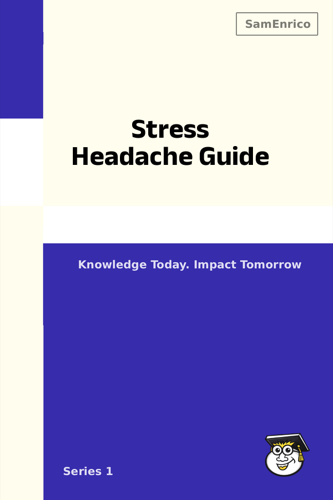
Non-FictionHealth & WellnessStress Headache
Stress Headache Guide eBook
Reduce tension type headaches with relaxation and
by Saenz Hobert
Reduce tension type headaches with relaxation and stress management techniques.
Formats
Free sample
Chapter 1: The Vise Grip...--For thirty-seven years, Margaret believed her headaches were a punishment. Not a divine punishment, exactly, but something close—a biological penalty for the life she had chosen. She was a clinical psychologist, a profession that required her to hold space for other people's pain while systematically ignoring her own. Between sessions, she would close her office door, press her thumbs against her temples, and wait for the vise grip to loosen. It never did.
Not really. She had tried everything: prescription muscle relaxants, Botox injections, acupuncture, chiropractic adjustments, a $400 ergonomic chair, and a pillow shaped like a question mark. Nothing worked for more than a few weeks. Her neurologist, a kind but exhausted man who had clearly run out of ideas, told her that some people just have "overactive pain pathways" and wrote her a refill for a triptan that made her feel like she was underwater. Margaret accepted this explanation because she did not know there was another one.This book exists because there is another one.The tension-type headache (TTH) is the most common neurological condition on earth.
According to the World Health Organization, nearly eighty percent of all adults will experience a tension-type headache at some point in their lives. For forty percent of those people, the headaches will be chronic—meaning they occur on fifteen or more days per month, every month, for years. If you are reading this book, you are likely in that forty percent. You know the sensation: a dull, aching pressure that begins at the base of your skull, creeps upward like rising dough, and settles into a tight band around your forehead. Some people describe it as a vise.
Others say it feels like wearing a helmet that is two sizes too small. A few, more creative than the rest, call it "the feeling of being slowly squeezed by a giant who has forgotten you are there."What you probably do not know is that your headache is not random. It is not a genetic curse. It is not the result of weak willpower or a deficiency in some obscure neurotransmitter. Your headache is a signal—a loud, insistent, biologically expensive message from a nervous system that has been pushed past its breaking point.
And the most important thing you will learn in this entire book is that the signal is not the enemy. The signal is the messenger. The enemy is the thing pushing your system past its breaking point. This chapter will help you identify that enemy, understand how it operates, and begin the process of retraining your brain to respond differently.The Anatomy of a Vise Before we can understand why your headache exists, we must understand what it is. The tension-type headache is a condition of sustained muscular contraction, but not in the way you might think.
You are probably familiar with the sensation of consciously clenching your jaw or hunching your shoulders—that deliberate tightening you do when you are angry or anxious. Tension headaches are different. They arise from a phenomenon called subthreshold contraction, which means your muscles are contracting at a level so low you cannot feel it happening, but so persistent that over hours and days it produces pain, fatigue, and inflammation.The primary muscles involved are three. First, the temporalis muscle, a large fan-shaped sheet on the side of your head that helps you chew. When this muscle contracts unconsciously, it produces the classic "band around the head" sensation.
Second, the suboccipital muscles, a group of four small muscles at the base of your skull that attach to the top two vertebrae. These muscles are exquisitely sensitive to stress because they are packed with mechanoreceptors—nerve endings that detect movement and position. When your suboccipitals tighten, they send a constant stream of "danger" signals to your brain, which interprets those signals as pain. Third, the upper trapezius, the large muscle running from the back of your skull down to your shoulders. This is the muscle that shrugs when you are startled, and in people with chronic tension headaches, it rarely stops shrugging.Here is what most doctors do not tell you: these muscles do not tighten on their own.
They tighten because your brain has decided that you are under threat. The brain is not a passive recipient of information from the body; it is an active interpreter and predictor. Every moment of every day, your brain is scanning your internal and external environment for signs of danger. When it detects a threat—a critical email, a looming deadline, a tense conversation you have been avoiding—it activates the sympathetic nervous system, which prepares your body for fight or flight. Part of that preparation includes redirecting blood flow away from the surface of your body and toward your large muscle groups.
Another part includes increasing muscle tone, so you are ready to spring into action. In small doses, this is adaptive. In large, chronic doses, it is a disaster.Your headache is not happening to you. It is happening for you. Your brain believes it is protecting you by keeping your muscles primed for action.
The problem is that your brain has not updated its threat assessment in a very long time.The Miseducation of Pain You have been taught to fear your headaches, and that fear is making them worse.This is not your fault. It is the result of a cultural and medical narrative that treats pain as an enemy to be eliminated rather than a signal to be understood. When you get a headache, what do you do? You reach for a pill. You lie down.
You cancel plans. You tell yourself, "Not again." And in doing so, you are teaching your brain that headaches are catastrophic events that require immediate, full-scale mobilization. This is the fear-pain cycle, and it is one of the most well-documented phenomena in pain neuroscience.Here is how the cycle works. Step one: you experience a headache. Step two: you interpret that headache as a sign that something is wrong—that you are broken, weak, or sick.
Step three: you feel anxious about the headache, which activates your sympathetic nervous system. Step four: sympathetic activation increases muscle tone, which makes the headache worse. Step five: the worsened headache confirms your original fear that something is terribly wrong. Step six: repeat indefinitely.Pain researchers call this catastrophizing—the tendency to imagine the worst possible outcome of a painful experience. Catastrophizing is not a personality flaw.
It is a learned cognitive pattern, and like all learned patterns, it can be unlearned. Studies show that people who catastrophize about their pain have higher levels of pain intensity, greater disability, and worse treatment outcomes—not because they are weak, but because their brains are amplifying the pain signal out of a misguided attempt to protect them.Think of your brain as having a volume dial for pain. When you catastrophize, you turn the dial up. When you relax, you turn it down. The goal of this book is not to eliminate pain—that is an unrealistic and ultimately unhelpful goal.
The goal is to turn down the dial so that the pain you experience is proportionate to the actual threat…
This is the end of the free sample. Get the eBook to keep going. Buy now
About this book
Details
- Author
- Saenz Hobert
- Publisher
- SamEnrico
- Language
- English
- Genre
- Non-Fiction, Health & Wellness, Stress Headache
- Released
- 2026-06-07
- Pages (approx.)
- 141
- Available as
- eBook, Audiobook

Read better in the ZLOADR app
Your eBooks on your phone or tablet. Sign in with your SamEnrico account and start reading.
More by Saenz Hobert
 Developmental Trauma HealingSaenz Hobert$11.99
 Green Hydrogen GuideSaenz Hobert$11.99
 Rapid Trance Induction HandbookSaenz Hobert$11.99
 Pet Loss For Rescue VolunteersSaenz Hobert$11.99
 The IBS Flare Rescue PlanSaenz Hobert$11.99
 Sam Sheppard Neighbor TestimonySaenz Hobert$11.99
 Borderline Rage ManagementSaenz Hobert$11.99
 Email Inbox Zero BlockingSaenz Hobert$11.99
 The Last Monarch: How a King Walked Away from PowerSaenz Hobert$11.99
 The Octopus Conspiracy: Secrets of the DeepSaenz Hobert$11.99
 The Hollow Ones of Rapa NuiSaenz Hobert$11.99
 Growing VancouveriaSaenz Hobert$11.99
You may also like
 Hong Kong Handover 1997Dunn Johnnie$11.99
 Zumba For Postnatal Recovery CourseNeal Christian$11.99
 Zumba for BeginnersLadner Nikia$11.99
 YouTube Comment Mining GuideHumes Pandora$12.99
 Worry Box MeditationCarlin Rudy$11.99
 Workplace Stress MeditationNguyen Lynn$11.99
 Workplace Stress and Sleep RepairHawley Ivory$11.99
 Workplace Perfectionism CureDelaney Jeffry$11.99
 Workplace Injustice Anger GuideWallen Isabelle$11.99
 Work Addiction and Burnout LinkGreenwood Ester$11.99
 Women in Yoga and WellnessBeattie Galina$11.99
 Women in Stand Up ComedyChun Evangeline$11.99