
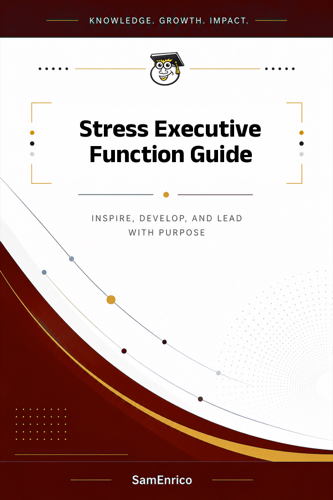
Non-FictionSelf-Help / Cognitive Health
Stress Executive Function Guide eBook
Explains how stress impairs decision-making, focus
by Groves Robt
Explains how stress impairs decision-making, focus, and impulse control with restoration.
Formats
Free sample
Chapter 1: The Hidden Toll...--–- You are not broken. Your brain has simply been chemically dimmed to save energy for a survival threat that does not exist.The email arrives at 9:47 AM on a Tuesday. It is not marked urgent. It does not contain bad news. It is a routine update from a colleague, asking for a status check on a project that is slightly behind schedule.
Nothing in the content is threatening. Yet your heart rate spikes. Your jaw clenches. Your thumbs hover over the keyboard, ready to type a defensive reply. You stop yourself—barely—and close the email.
But the feeling lingers. For the next twenty minutes, you cannot focus on the spreadsheet open in front of you. You refresh your inbox three times. You start a response to a different email, delete it, start again. You feel scattered, irritable, and vaguely ashamed that a simple status request rattled you so much.If this scenario feels familiar, you have likely told yourself one of the following stories: I am losing my edge.
I am not cut out for this level of responsibility. I just need to try harder. I need better time management. I need a vacation. Maybe I am getting too old for this.
Maybe I am not as smart as I thought.All of these stories are wrong.The truth is far simpler, far more mechanical, and far more fixable than you imagine. You are not experiencing a character failure. You are not losing your intelligence. You are not burnt out in some vague, irreversible way. You are experiencing the predictable, measurable, and reversible neurological consequences of chronic stress on the prefrontal cortex—the part of your brain that makes you smart, strategic, and in control.This book is not about relaxation.
It is not about bubble baths, vacations, or "learning to say no." It is about the mechanical restoration of specific brain circuits that have been chemically suppressed by cortisol. It is a 12-week guide to turning the stress response back into a thinking response. And it begins with understanding exactly what is happening inside your skull.The Two Faces of Pressure Most high-performing executives believe they thrive under pressure. This belief is reinforced by culture, by performance reviews, and by the undeniable fact that acute stress can indeed sharpen focus. The problem is not pressure.
The problem is unrelenting pressure without recovery.To understand the difference, you must first understand the HPA Axis—the hypothalamic-pituitary-adrenal axis. This is your body's primary stress response system, a cascade of hormonal communication that evolved over millions of years to save your life in physical emergencies. When your brain perceives a threat, the hypothalamus releases corticotropin-releasing hormone. This signal travels to the pituitary gland, which releases adrenocorticotropic hormone. This travels to the adrenal glands, which release cortisol and norepinephrine into your bloodstream.This cascade takes approximately three seconds.
In that time, your heart rate increases, your blood pressure rises, glucose is diverted to your large muscle groups, and your pupils dilate. Your body is preparing to fight or flee. This is an extraordinary system—when you are actually being chased by a predator.The trade-off is critical: these survival hormones prepare your body for physical action at the direct cost of shutting down long-term strategic thinking. Evolutionarily, you do not need to solve a quadratic equation if a tiger is chasing you. You do not need to write a strategic plan if a rival tribe is attacking.
You need to run. So your brain prioritizes survival over cognition. It is a sensible trade-off—for a few minutes.The problem is that modern executives face psychological threats that do not resolve in minutes. The angry email, the missed target, the difficult conversation, the re-organization announcement—these triggers activate the same HPA axis as a tiger, but you cannot run from them and you cannot fight them. You sit at your desk.
The cortisol remains in your bloodstream. And the prefrontal cortex stays offline.Acute Versus Chronic: The Critical Distinction Acute stress lasts minutes to hours and resolves. You give a high-stakes presentation. Your heart pounds. You finish.
You walk back to your desk, and within thirty minutes, your cortisol returns to baseline. Your prefrontal cortex comes back online. You feel tired but clear-headed. This is not just harmless—it can be beneficial. Acute stress sharpens attention, increases motivation, and can improve performance on cognitive tasks.
The key is the recovery period.Chronic stress lasts weeks to months. The HPA axis is activated so frequently, or for such long durations, that it never fully returns to baseline. Cortisol remains elevated even when you are "resting." You wake up with a racing heart. You scroll through your phone before bed. You feel tired but unable to sleep.
You are stuck in a state of low-grade physiological arousal, and your prefrontal cortex has been offline for so long that you have forgotten what it feels like to think clearly.This is not a metaphor. Neuroimaging studies show reduced metabolic activity in the prefrontal cortex of chronically stressed individuals. The difference is visible on a scan. Your brain is not just tired—it is chemically altered. The neural firing rate has literally decreased.
And the longer you remain in this state, the more your brain adapts to it, strengthening the neural pathways for reactivity and weakening the pathways for reflection.The three telltale signs of chronic cognitive stress are specific and measurable:First, persistent mental fog. You read a paragraph and immediately forget what you just read. You walk into a room and cannot remember why. You lose your train of thought mid-sentence. This is not forgetfulness; it is working memory compression, a direct consequence of reduced PFC activity.Second, overreaction to minor frustrations.
Spilled coffee triggers rage. A delayed response to a text message feels like a personal insult. A routine status update feels like an attack. Your amygdala is hyper-reactive because the PFC is not there to inhibit it.Third, inability to complete familiar tasks. You stare at a simple email for twenty minutes without typing a response.
You know what you need to do, but you cannot seem to do it. This is not procrastination; it is cognitive rigidity, the inability to initiate and sustain goal-directed behavior.If you recognize these signs, you have likely been living with chronic cognitive stress for months or years. You have adapted to it. You have forgotten what it feels like to be sharp. And you have blamed yourself for something that is not your fault.The Prefrontal Cortex: Your Most Vulnerable Asset The prefrontal cortex sits just behind your forehead, occupying approximately ten percent of your brain's volume.
It is the most recently evolved part of the human brain, and it is responsible for everything that distinguishes human decision-making from animal reactivity: impulse control, working memory, cognitive flexibility, planning, prioritization, and self-awareness.It is also the most metabolically expensive tissue in your body. The PFC requires massive amounts of glucose and oxygen to function. Per gram of tissue, it consumes more energy than almost any other organ. This is why it is the first region to suffer under stress. When your body…
This is the end of the free sample. Get the eBook to keep going. Buy now
About this book
Details
- Author
- Groves Robt
- Publisher
- SamEnrico
- Language
- English
- Genre
- Non-Fiction, Self-Help / Cognitive Health
- Released
- 2026-06-06
- Pages (approx.)
- 110
- Available as
- eBook, Audiobook

Read better in the ZLOADR app
Your eBooks on your phone or tablet. Sign in with your SamEnrico account and start reading.
More by Groves Robt
 Emotional Regulation For ExecutivesGroves Robt$11.99
 Peruvian Restaurant GrowthGroves Robt$11.99
 Circuits of Compulsion NeurobiologyGroves Robt$11.99
 Longwu: The Jade Dragon’s CurseGroves Robt$11.99
 Learn to Play the DobroGroves Robt$11.99
 How to Become a Steam-press Tender IiGroves Robt$11.99
 Business Case for Promotion GuideGroves Robt$12.99
 Lead Physics TeacherGroves Robt$11.99
You may also like
 Hong Kong Handover 1997Dunn Johnnie$11.99
 Zumba For Postnatal Recovery CourseNeal Christian$11.99
 Zumba for BeginnersLadner Nikia$11.99
 YouTube Comment Mining GuideHumes Pandora$12.99
 Worry Box MeditationCarlin Rudy$11.99
 Workplace Stress MeditationNguyen Lynn$11.99
 Workplace Stress and Sleep RepairHawley Ivory$11.99
 Workplace Perfectionism CureDelaney Jeffry$11.99
 Workplace Injustice Anger GuideWallen Isabelle$11.99
 Work Addiction and Burnout LinkGreenwood Ester$11.99
 Women in Yoga and WellnessBeattie Galina$11.99
 Women in Stand Up ComedyChun Evangeline$11.99