
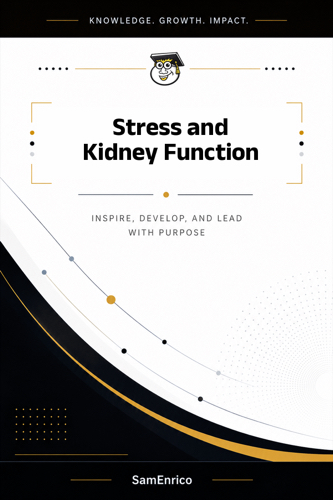
Stress and Kidney Function eBook
Explains how hypertension from stress damages kidn
Explains how hypertension from stress damages kidneys.
Formats
Free sample
Chapter 1: The Silent Epidemic...--Imagine a smoke alarm that only goes off when your house is ninety percent consumed by flames. That is your kidney. No chest pain. No headache. No racing heart.
No warning whatsoever. You cannot feel high blood pressure. You cannot feel protein leaking into your urine. You cannot feel your kidney cells dying one by one. You feel nothing—until suddenly, you cannot breathe, your legs swell like balloons, or a routine blood test reveals that your kidneys have been failing for years.This is the central tragedy of kidney disease.
Unlike the heart, which pounds under stress, or the lungs, which wheeze under strain, the kidneys are silent workers. They have no pain receptors for pressure damage. They do not send distress signals. They simply keep filtering, keep balancing, keep regulating—until they cannot. And by the time they fail, the damage is often irreversible.Now consider this: over thirty-seven million adults in the United States have chronic kidney disease.
That is more than one in seven adults. Ninety percent of those with early-stage disease have no idea they have it. They are walking around with damaged kidneys, completely unaware, while their doctors monitor their cholesterol and their weight and their heart rate—but rarely their urine.And here is the secret that most doctors will not tell you, the secret this entire book is built upon: chronic stress is the invisible accelerant. It is the gasoline poured on a slow-burning fire. It is the reason your kidneys are failing long before anyone thinks to check.The Filter You Never Think About Your kidneys are two bean-shaped organs, each about the size of your fist, located just below your rib cage on either side of your spine.
They are not glamorous. They do not appear in romantic poetry. No one has ever named a sports team after them. But every single minute of every single day, they filter your entire blood supply.Every drop of blood in your body passes through your kidneys approximately twenty to twenty-five times per day. In twenty-four hours, your kidneys process about fifty gallons of blood—enough to fill a bathtub.
They remove toxins, balance electrolytes, regulate blood pressure, produce hormones that control red blood cell production, and maintain the delicate acid-base balance that keeps every cell in your body functioning.They are your body's most sophisticated filtration system, your chemical laboratory, and your pressure control center all in one.And they are failing, silently, in tens of millions of people who have no idea.The statistics are staggering. According to the Centers for Disease Control and Prevention, chronic kidney disease is the ninth leading cause of death in the United States—killing more people each year than breast cancer or prostate cancer. Yet it receives a fraction of the research funding, a fraction of the public awareness, and a fraction of the preventive attention. Why? Because kidney disease is invisible.
It has no constituency. No one marches for kidneys.But there is another reason kidney disease flies under the radar: it is associated with aging, diabetes, and hypertension—conditions that are often viewed as inevitable consequences of modern life. People assume that high blood pressure is just something that happens as you get older. They assume that declining kidney function is just part of aging. These assumptions are false.
They are dangerous. And they are killing people.The Story of Mary: A Warning in Three Acts Let me tell you about Mary. She is not a real person—her name and details have been changed to protect the privacy of the many patients whose stories inform this book. But everything that happened to Mary happened to someone. And it is happening to someone reading these words right now.Act One: The Normal Life Mary was fifty-two years old, a schoolteacher who had spent thirty years in the classroom.
She ate reasonably well. She walked her dog every evening. She did not smoke. She drank alcohol only occasionally. By every conventional measure, she was healthy.Her blood pressure at every annual physical was 118 over 76.
"Perfect," her doctor said. "Keep doing what you are doing."But Mary was tired. Not the normal tired of a long day—the bone-deep exhaustion that made her feel like she was wading through mud. Her ankles swelled by late afternoon. Her urine looked frothy, like a cappuccino, but she assumed that was normal.
And she was stressed. She was always stressed. Grading papers, managing difficult parents, caring for her aging mother, worrying about her son who had just lost his job. The stress was a constant hum in the background of her life, so familiar she no longer noticed it.Her doctor ran the standard blood test. Her creatinine was normal.
Her estimated glomerular filtration rate was normal. "Everything looks great," the doctor said. "Try to reduce your stress."Act Two: The Unnoticed Decline Three years passed. Mary's fatigue worsened. She started waking up three or four times each night to use the bathroom.
Her ankles swelled so much by evening that she could not wear her normal shoes. Her urine remained foamy, but now it was foamy almost every time she went.She mentioned these symptoms to her doctor during her annual physical. The doctor ordered the same blood tests. Again, creatinine and e GFR were normal. "Your kidneys are fine," the doctor said.
"You might just be retaining some fluid. Try elevating your legs and cutting back on salt."No one checked her urine for protein. No one did a twenty-four-hour blood pressure monitor. No one asked about the foam, the night-time urination, the swelling. Those were dismissed as minor inconveniences, not the urgent warning signs they actually were.Act Three: The Collapse One morning, Mary woke up with chest pain so severe she could not catch her breath.
Her husband drove her to the emergency room. Her blood pressure was 210 over 130. Her oxygen saturation was dangerously low. Her lungs were filling with fluid—not from a heart attack, but from kidney failure.The emergency room doctor ran the tests that should have been run years earlier. The urine albumin-to-creatinine ratio was off the charts.
Her estimated glomerular filtration rate had dropped to eighteen percent. Anything below fifteen percent is kidney failure requiring dialysis or transplant. Mary was at eighteen percent—barely hanging on."What happened?" her husband asked. "Her blood pressure was always normal. Her kidney tests were always normal."The nephrologist explained what should have been obvious: Mary's blood pressure was normal at rest—when she was sitting quietly in the exam room, relaxed, breathing normally.
But during the hundreds of small stressors of her daily life—the alarm clock, the traffic, the arguments, the worries, the sleepless nights—her blood pressure spiked to 180 over 110. Those spikes lasted twenty to ninety minutes each. She had no idea. Her doctor had no idea. But her kidneys knew.Every spike tore microscopic holes in the delicate filters of her kidneys.
Every spike killed a few more podocytes—the foot-like cells that form the final filtration barrier. Every spike pushed her further down a path that ended at the dialysis center.Mary started dialysis three weeks…
This is the end of the free sample. Get the eBook to keep going. Buy now
About this book
Details
- Author
- Marcotte Gladis
- Publisher
- SamEnrico
- Language
- English
- Genre
- Non-Fiction, Self-Help, Nephrology
- Released
- 2026-06-06
- Pages (approx.)
- 136
- Available as
- eBook, Audiobook

Read better in the ZLOADR app
Your eBooks on your phone or tablet. Sign in with your SamEnrico account and start reading.
More by Marcotte Gladis
 The Workaholic Energy Management CourseMarcotte Gladis$11.99
 The Body Scan for DancersMarcotte Gladis$11.99
 Kutuzov Russian CommanderMarcotte Gladis$11.99
 The Secret Founders: How a Group of British Aristocrats Built the World's First Global Sports EmpireMarcotte Gladis$11.99
 US At Will Raise TacticsMarcotte Gladis$12.99
 Associate EditorMarcotte Gladis$11.99
 How to Start a Bone Working Business (Beginners Guide)Marcotte Gladis$11.99
 How to Produce Ball Screw Repair ServicesMarcotte Gladis$11.99
You may also like
 Stress And Kidney DiseaseMccune Harland$11.99
 Stress Kidney Health GuideSprague Lauralee$11.99
 Stress Kidney Function GuideGuffey Ines$11.99
 Stress and Kidney Disease ProgressionFong Doria$11.99
 Kidney Disease and FoodNoyes Assunta$11.99
 Food Addiction and Kidney DiseasePruett Pearline$11.99
 The Stress Kidney Function GuideSegura Edison$11.99
 Caregiver Burnout for Kidney DiseaseShumate Lakia$11.99