
Non-FictionHealth & WellnessRecovery
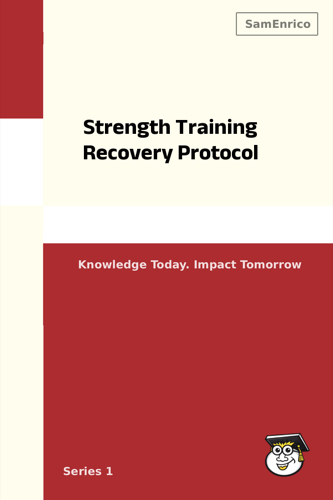
Strength Training Recovery Protocol eBook
Optimize sleep nutrition and active recovery to ma
Optimize sleep nutrition and active recovery to maximize muscle repair and growth.
Formats
Free sample
Chapter 1: The Growth Lie...--Every lifter has felt it. That deep, throbbing ache in your quadriceps two days after a heavy squat session. The satisfying soreness that makes walking down stairs an exercise in humility. You wear it like a badge of honor. You flex in the mirror and smile, because soreness means it worked.
Right?Wrong.This is the most persistent, damaging, and scientifically illiterate belief in all of strength training. The belief that what you feel during and immediately after a workout—the pump, the burn, the fatigue, the soreness—is the measure of a productive session. The belief that if you aren't limping out of the gym, you somehow cheated yourself. The belief that growth happens while you are under the bar.None of this is true.Muscle does not grow in the gym. Muscle grows while you sleep on a mattress, while you digest a meal at your kitchen table, while you sit on your couch watching television.
The gym is where you damage tissue. The hours and days that follow—the 99% of your week spent away from the weight room—are where you build it. This distinction is not semantic. It is the single most important concept in strength training, and misunderstanding it is why most lifters plateau, stagnate, and eventually quit.This chapter dismantles the Growth Lie: the false narrative that intensity, pain, and fatigue are the currencies of progress. In its place, we establish the true physiology of muscle repair, the anabolic pathways that actually matter, and the counterintuitive reality that training less hard often produces more growth.
Welcome to the foundation of the Strength Training Recovery Protocol.The Post-Workout Autopsy: What Actually Happens to Your Muscle Fibers To understand recovery, you must first understand destruction. When you lift a heavy weight through a full range of motion, you are not "building muscle" in real time. You are applying mechanical tension to muscle fibers, specifically the sarcomeres—the microscopic contractile units within each myofibril. Under sufficient load, these sarcomeres experience microscopic tears. Not the catastrophic ruptures of traumatic injury, but micro-tears at the Z-discs, the protein structures that anchor adjacent sarcomeres.This is eccentric loading.
When you lower a weight under control—the descent of a squat, the lowering phase of a bench press, the negative portion of a curl—your muscle fibers are actively lengthening while under tension. This eccentric phase produces significantly more micro-trauma than the concentric (lifting) phase. This is why downhill running causes more soreness than flat running, and why the lowering portion of your deadlift is where the real damage occurs.Immediately following this micro-trauma, your body initiates a cascade of events that looks remarkably similar to the early stages of an immune response to infection. Damaged cell fragments release signaling molecules called cytokines. These cytokines recruit inflammatory cells—neutrophils arrive within hours, followed by macrophages within 24-48 hours.
These cells clear away the damaged protein fragments, digest cellular debris, and release their own signaling molecules that activate satellite cells.Satellite cells are the unsung heroes of muscle growth. These dormant stem cells reside between the basement membrane and the sarcolemma of each muscle fiber. When activated by mechanical tension and subsequent inflammatory signaling, satellite cells spring into action. They proliferate (divide rapidly), then differentiate into myoblasts, then fuse with existing damaged muscle fibers, donating their nuclei to support increased protein synthesis capacity. Each new nucleus increases the fiber's ability to produce contractile proteins.
This is how muscles get bigger and stronger over time.But none of this happens while you are lifting. The micro-tears happen during lifting. The inflammatory cascade begins after lifting. Satellite cell activation peaks 24-72 hours after lifting. The actual synthesis of new contractile proteins—the process that makes muscle larger—occurs in the days following your workout, not during it.This timeline is crucial.
If you train again before this repair process completes, you are not "adding more stimulus." You are interrupting repair. You are tearing down a half-built structure. You are accumulating fatigue faster than you can adapt to it, and the inevitable result is stagnation, regression, and eventually overtraining syndrome.The Anabolic Switch: Understanding the m TOR Pathway Muscle protein synthesis—the actual building of new muscle tissue—is controlled by a complex intracellular signaling pathway with a name that sounds like something from a science fiction novel: the mechanistic target of rapamycin, abbreviated as m TOR. Discovered through research on the immunosuppressive drug rapamycin (hence the name), m TOR is now understood to be the master anabolic switch for the entire body.When m TOR is active, your cells are in "building mode." They synthesize proteins, replicate DNA, grow in size, and resist cell death. When m TOR is suppressed, your cells shift toward catabolism—breakdown, recycling of components, and energy conservation.
For our purposes, m TOR activation in muscle cells is the single most important molecular event for hypertrophy.What activates m TOR? Three primary signals:First, mechanical tension. When you lift a weight that is heavy enough to stretch and contract muscle fibers under load, you physically deform the muscle cell membrane and its internal cytoskeleton. This deformation is detected by mechanosensitive proteins that directly activate m TOR. The signal is immediate and local—the muscle fibers you worked will activate m TOR, while unstressed fibers remain quiescent.Second, amino acids, specifically leucine.
The m TOR pathway has a direct binding site for leucine, an essential branched-chain amino acid. When intracellular leucine concentrations rise sufficiently—roughly corresponding to a meal containing 30-40 grams of high-quality protein—leucine binds directly to m TOR and potentiates its activity. Without adequate leucine, mechanical tension alone produces a blunted anabolic response.Third, growth factors including insulin and IGF-1. These hormones circulate systemically and amplify m TOR activity in response to feeding and mechanical load. Insulin, released when you eat carbohydrates and protein, is a potent anabolic hormone that also suppresses muscle protein breakdown.
IGF-1, produced in the liver in response to growth hormone, directly stimulates satellite cell proliferation.These three signals work synergistically. Mechanical tension primes the pathway. Leucine provides the raw activation signal. Insulin and IGF-1 amplify and sustain the response. Remove any one, and the anabolic response diminishes.
This is why training without adequate nutrition fails, and why eating without training fails. The two are inseparable partners in the dance of muscle growth.But here is where the Growth Lie falls apart most dramatically. The m TOR pathway does not activate during your workout. It activates afterward. Mechanical tension during lifting initiates the signaling cascade, but the peak of m TOR activity occurs approximately 60-120 minutes post-workout, assuming you provide the necessary leucine and insulin signals through proper post-workout nutrition.
The sustained elevation of MPS lasts 24-72 hours, depending on your training status.This means the most important anabolic window is not while the barbell is in your hands. It is while you are drinking a protein shake, eating dinner, and sleeping through the night. The lifter who obsesses over the last rep but ignores post-workout nutrition and sleep is like a farmer who plants seeds and then walks away, never to water or fertilize.The Catabolic Breaker: Cortisol and the Yin-Yang…
This is the end of the free sample. Get the eBook to keep going. Buy now
About this book
Details
- Author
- Lumpkin Retta
- Publisher
- SamEnrico
- Language
- English
- Genre
- Non-Fiction, Health & Wellness, Recovery
- Released
- 2026-06-07
- Pages (approx.)
- 156
- Available as
- eBook, Audiobook

Read better in the ZLOADR app
Your eBooks on your phone or tablet. Sign in with your SamEnrico account and start reading.
More by Lumpkin Retta
 Metta for Neutral PeopleLumpkin Retta$11.99
 Growing Up in a ShelterLumpkin Retta$11.99
 TM for Exam PreparationLumpkin Retta$11.99
 The Nun Who Never SleptLumpkin Retta$11.99
 Hormone Balance GutLumpkin Retta$11.99
 Reorganization StressLumpkin Retta$11.99
 Spanish AA Meeting GuideLumpkin Retta$11.99
 Social Media Shopping DetoxLumpkin Retta$11.99
 The Navigators of the Atlantic: The Age of European DiscoveryLumpkin Retta$11.99
 The Feast of Timbuktu: Scholars, Scribes, and the Golden Age of African LearningLumpkin Retta$11.99
 Ironclad Loyalty: The Untold Story of James Armistead LafayetteLumpkin Retta$11.99
 Understanding Achard SyndromeLumpkin Retta$17.99
You may also like
 Hong Kong Handover 1997Dunn Johnnie$11.99
 Zumba For Postnatal Recovery CourseNeal Christian$11.99
 Zumba for BeginnersLadner Nikia$11.99
 YouTube Comment Mining GuideHumes Pandora$12.99
 Worry Box MeditationCarlin Rudy$11.99
 Workplace Stress MeditationNguyen Lynn$11.99
 Workplace Stress and Sleep RepairHawley Ivory$11.99
 Workplace Perfectionism CureDelaney Jeffry$11.99
 Workplace Injustice Anger GuideWallen Isabelle$11.99
 Work Addiction and Burnout LinkGreenwood Ester$11.99
 Women in Yoga and WellnessBeattie Galina$11.99
 Women in Stand Up ComedyChun Evangeline$11.99