
Non-FictionHealth & WellnessPostpartum
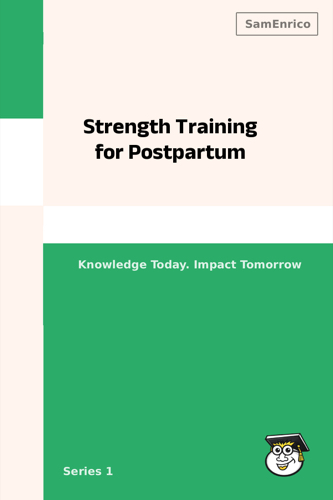
Strength Training for Postpartum eBook
Safely rebuild core and overall strength after pre
by Blank Dolly
Safely rebuild core and overall strength after pregnancy with gradual resistance protocols.
Formats
Free sample
Chapter 1: The Six-Week Lie--–- The first time I peed my pants as an adult, I was standing in my kitchen at 7:30 on a Tuesday morning. My daughter was three months old. I was wearing my husband’s sweatshirt, hadn’t showered in two days, and I had just sneezed — a single, unremarkable sneeze — while holding a mug of coffee that was no longer warm. The leak wasn't dramatic. It wasn't a flood.
But it was unmistakable: a small, hot betrayal that ran down my inner thigh before I could clench my way out of it.I stood there frozen, coffee mug in hand, and did what any rational new mother would do. I cried. Not because I was in pain. Not because I was embarrassed — although I was. I cried because I had done everything right.
I had waited the prescribed six weeks. I had done my Kegels in the waiting room at the pediatrician’s office. I had scrolled through Instagram reels of celebrity moms doing planks at four weeks postpartum with captions like “#bounceback” and “#backtome.” I had believed the lie.The lie is simple, pervasive, and medically dangerous: that at six weeks postpartum, your body is “healed.” That the postpartum checkup is a finish line. That if you still leak, still hurt, still feel like your insides might fall out when you run for the bus, something is wrong with you.This book exists because that lie nearly broke me. And because, after training hundreds of postpartum women as a strength coach and pelvic health advocate, I have learned that the six-week mark is not a finish line.
It is a starting block — and most of us are given the wrong shoes.The Invention of the Six-Week Rule Let me be clear about something most doctors don't have time to tell you in a fifteen-minute postpartum visit. The six-week clearance was never designed to mean “you are fully healed and ready for high-intensity exercise.” It was designed to mean “your uterus has returned to its approximate pre-pregnancy size and your bleeding has likely stopped.”That’s it.The six-week postpartum visit originated as a practical check for infection, uterine involution (the shrinking of the uterus from the size of a watermelon back to a pear), and surgical healing in the case of C-sections or episiotomies. It was never, in any medical textbook, intended to be a green light for burpees, heavy deadlifts, or marathon training.But somewhere along the way — amplified by social media, celebrity culture, and a fitness industry that profits from your insecurity — the six-week mark became a cultural finish line. “Cleared at six weeks” now means “get back to your pre-baby body.” It means “stop making excuses.” It means “if you’re still struggling, you’re not trying hard enough.”This is not just unkind. It is medically illiterate.The Real Timeline You Were Never Told Let me give you the timeline that changed everything for me and for the thousands of women I’ve coached since.Weeks 0–6: The Open Wound Phase Your uterus has a placental attachment site the size of a dinner plate.
That wound is raw, healing, and vulnerable to infection. Your connective tissue — ligaments, fascia, the linea alba (the midline connective tissue between your abdominal muscles) — is still flooded with relaxin, a hormone that loosens joints to accommodate pregnancy. Relaxin does not magically disappear at birth. It remains elevated for three to five months postpartum, longer if you are breastfeeding. During this time, your joints are more lax, your connective tissue is more stretchy, and your risk of injury is significantly higher.Weeks 6–12: The Neural Reconnection Phase Your muscles are not weak — they are disconnected.
The brain-body pathway to your deep core (transversus abdominis) and pelvic floor has been disrupted by pregnancy, birth, and the demands of newborn care. This phase is about waking those pathways back up with low-load, high-repetition activation work. Not heavy lifting. Not running. Breathing.Weeks 12–24: The Load Tolerance Phase This is where strength actually begins.
But even here, your connective tissue is still remodeling. The collagen in your pelvic floor fascia takes four to six months to regain tensile strength. This is not opinion. It is histology — the study of tissue healing. A C-section scar takes even longer: twelve to sixteen weeks before it can tolerate significant load without risking fascial adhesions.Six Months and Beyond: The Performance Phase This is where you can safely return to running, jumping, heavy lifting, and high-intensity interval training — if you have passed the appropriate milestones along the way.
And if you haven’t, that’s fine too. There is no trophy for rushing.I tell you this not to scare you but to free you. You are not behind. You are not broken. You have been measuring yourself against a calendar that was never designed for you.Why Celebrity “Bounce Backs” Are a Lie Let’s talk about the elephant in the room — or rather, the celebrity on your feed.You have seen them.
The actress who posted a gym selfie at three weeks postpartum with her abs already visible. The reality star who ran a half marathon at four months. The influencer who sells detox tea and claims she lost the baby weight in “just six weeks.”I am going to tell you something that the fitness industry will not: almost all of these images are misleading, and many are outright deceptive.The Hidden Variables You Don’t See First, genetics. Some women — a very small percentage — have extraordinary connective tissue resilience and pelvic floor tone. They are outliers.
They are not a reasonable standard for comparison, any more than Le Bron James is a reasonable standard for your weekend pickup basketball game.Second, resources. The celebrity “bounce back” is often supported by a team that most of us cannot afford: a personal trainer who comes to the house, a pelvic floor physical therapist, a nutritionist, a chef, a night nanny (so the mother actually sleeps), and sometimes a nanny for older children. When you have someone else doing the grocery shopping, meal prep, overnight feeds, and childcare, you have significantly more energy to devote to exercise.Third, photography. The gym selfie at three weeks postpartum may have been taken at the end of a workout — but you don’t see the leaking, the pain, or the prolapse symptoms that woman may be experiencing but not showing. You also don’t see the lighting, the angles, the filters, or the fact that she may have been holding her breath and flexing her obliques in a way that is actively harmful to a healing Diastasis Recti.Fourth, and most importantly: you do not see the long-term consequences.
I have coached women who “bounced back” quickly after their first baby — only to develop pelvic organ prolapse after their second because they never truly healed the underlying connective tissue damage. I have coached women who ran marathons at six months postpartum and now cannot jump on a trampoline with their children without leaking. The “bounce back” is often a mirage. The real recovery happens slowly, invisibly, and without Instagram likes.The Comparison Trap Exercise Before we go any further…
This is the end of the free sample. Get the eBook to keep going. Buy now
About this book
Details
- Author
- Blank Dolly
- Publisher
- SamEnrico
- Language
- English
- Genre
- Non-Fiction, Health & Wellness, Postpartum
- Released
- 2026-06-06
- Pages (approx.)
- 137
- Available as
- eBook, Audiobook

Read better in the ZLOADR app
Your eBooks on your phone or tablet. Sign in with your SamEnrico account and start reading.
More by Blank Dolly
 Recall Classification Appeal ProcessBlank Dolly$11.99
 AI Presentation CertificationBlank Dolly$11.99
 Arm Levitation Self Trance MethodBlank Dolly$11.99
 The Beginner's Nature SoundscapeBlank Dolly$11.99
 Plus Size Self Esteem GuideBlank Dolly$11.99
 Lithuanian Laser Technology LeadershipBlank Dolly$11.99
 Green Beret SOG OperatorBlank Dolly$11.99
 Wendy Davis FilibusterBlank Dolly$11.99
 The Shadow War of the Golden Freemen: Poland’s Secret Cold War Against the SovietsBlank Dolly$11.99
 The Last Stand of the 1992 Dream TeamBlank Dolly$11.99
 The Alchemist's Apothecary: Secrets of the Medici's Golden ElixirBlank Dolly$11.99
 The Complete Guide to the Cinch DietBlank Dolly$11.99
You may also like
 Hong Kong Handover 1997Dunn Johnnie$11.99
 Zumba For Postnatal Recovery CourseNeal Christian$11.99
 Zumba for BeginnersLadner Nikia$11.99
 YouTube Comment Mining GuideHumes Pandora$12.99
 Worry Box MeditationCarlin Rudy$11.99
 Workplace Stress MeditationNguyen Lynn$11.99
 Workplace Stress and Sleep RepairHawley Ivory$11.99
 Workplace Perfectionism CureDelaney Jeffry$11.99
 Workplace Injustice Anger GuideWallen Isabelle$11.99
 Work Addiction and Burnout LinkGreenwood Ester$11.99
 Women in Yoga and WellnessBeattie Galina$11.99
 Women in Stand Up ComedyChun Evangeline$11.99