
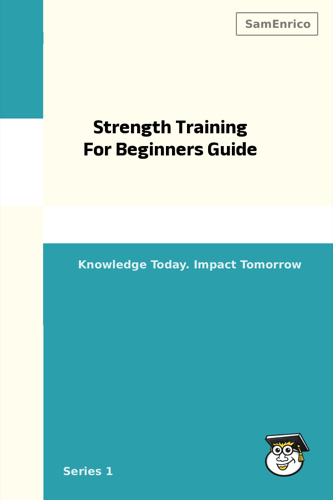
Non-FictionHealth & WellnessWeightliftingFitness
Strength Training For Beginners Guide eBook
Learn proper squat, deadlift, and press form with
Learn proper squat, deadlift, and press form with progressive overload fundamentals for new lifters.
Formats
Free sample
Chapter 1: The Unspoken Lie--–- Every fitness advertisement you have ever seen is built on a lie. Not a malicious lie, necessarily, but a lie nonetheless. The lie is this: that you can achieve a strong, capable, impressive body through convenience, shortcuts, and thirty-minute workouts performed three times a week on machines that isolate your "problem areas." The lie is sold in glossy magazines, in Instagram reels of chiseled influencers using strange cable attachments, and in the marketing copy of every commercial gym that fills its floor with chrome-plated contraptions designed to make you feel like you are training while carefully preventing you from ever actually straining.This lie persists because it is comfortable. It tells you that you do not need to suffer. It tells you that you can get stronger without getting uncomfortable, that you can build muscle without learning difficult skills, that you can transform your body without ever confronting the deep, primal fear that arises when a heavy barbell is across your back and you must decide whether to stand up or give up.This book is the antidote to that lie.Before you learn a single technical cue about squat depth or deadlift grip, you must understand something that no machine, no app, and no thirty-minute workout can provide: a reason to train that is stronger than your desire to quit.
Most beginners fail not because they lack willpower, but because they lack a compelling "why." They start with vague goals—"get in shape," "lose weight," "tone up"—and when the initial enthusiasm fades (usually around week three), those vague goals evaporate like morning fog. Without a concrete, measurable, deeply personal reason to keep adding weight to the bar, you will quit. It is not a question of character; it is a question of physics. Motivation is a finite resource, and you will burn through it.This chapter builds you an engine that runs on something more reliable than motivation. It builds you a philosophy.The Collapse of Vague Goals Let us conduct a thought experiment.
Imagine two beginners walk into a gym on January 2nd. The first beginner, let us call her Sarah, has a goal: "I want to lose twenty pounds and get more toned." She has no plan beyond showing up and doing whatever the trainer at the front desk suggests. She spends forty minutes on the elliptical, does three sets of bicep curls with pink dumbbells, and leaves feeling mildly sweaty but not particularly challenged. She repeats this pattern three times a week for a month. By February, she has lost four pounds, but she is bored.
The elliptical is mind-numbing. She sees no visible change in her arms. She stops going.The second beginner, let us call him Marcus, has a different goal: "I want to squat 315 pounds for five reps." Marcus does not know how to squat yet. He does not know what 315 pounds feels like. But he has a specific number, a specific lift, and a specific rep count.
When he walks into the gym, every decision is guided by that goal. He cannot waste time on the elliptical because it does not make his squat stronger. He cannot use pink dumbbells because they do not load his legs enough. He follows a program, adds weight every session, and when he fails a rep, he knows exactly what failure means: he is not yet strong enough to squat 315. That knowledge does not discourage him; it informs him.
He adjusts his recovery, fixes his form, and tries again.Six months later, Sarah has quit. Marcus squats 275 for five and is closing in on his goal. The difference is not genetics. The difference is not willpower. The difference is goal specificity.Research in sports psychology consistently demonstrates that specific, measurable, challenging goals produce better outcomes than vague, process-oriented goals.
A goal of "get stronger" is useless because it cannot be falsified. How do you know when you have achieved it? You do not. A goal of "squat 225 pounds for five reps" is falsifiable. Either you can do it or you cannot.
And when you cannot, you know exactly what to work on.This book will give you specific goals. By the end of the novice program described in Chapter 8, you will be able to squat approximately 1.5 times your bodyweight, deadlift approximately 1.75 times your bodyweight, and press approximately 0.75 times your bodyweight. These are not arbitrary numbers. They are the result of decades of coaching thousands of beginners. They are achievable.
But they are not easy. And that is the point.Training Versus Exercising: The Distinction That Changes Everything One of the most important distinctions you will learn in this book is the difference between training and exercising. On the surface, they look identical. In both cases, you go to a gym, you lift things, you sweat, and you go home. But beneath the surface, they are fundamentally different activities with fundamentally different outcomes.Exercising is activity performed for the sake of immediate gratification.
You exercise to feel the burn, to break a sweat, to get your heart rate up, to feel like you accomplished something today. Exercising is reactive. You show up, you do whatever occurs to you or whatever the fitness influencer on your phone recommended, and you leave. There is no long-term plan. There is no progressive overload.
There is no measurement. Exercising is the equivalent of driving without a destination. You might enjoy the scenery, but you will never arrive anywhere meaningful.Training is activity performed according to a planned, progressive, measurable program designed to produce specific adaptations over time. Training is proactive. You do not train because you feel like it; you train because you have a scheduled session, and that session has specific weights, specific sets, specific reps, and specific rest periods.
Training is recorded. You know exactly what you squatted last Monday, so you know exactly what you must squat today to achieve progressive overload. Training is patient. You understand that the workout you are doing right now is not about today. It is about six months from now.
It is about the person you are becoming.Most people who join gyms are exercisers. They wander. They try this machine and that class. They make no meaningful progress because they are not applying the principle of progressive overload (Chapter 2). They are not following a program (Chapter 8).
They are not measuring their results (Chapter 7). They are exercising, and exercising produces exactly what it promises: the feeling of having exercised. It does not produce strength.This book is for people who want to train.Strength as the Master Attribute Why strength? Why not endurance, flexibility, power, or any of the other physical attributes that fitness enthusiasts obsess over? The answer is simple: strength is the foundation upon which all other physical capacities are built.Consider endurance.
To run a marathon, you need cardiovascular fitness, yes. But you also need the structural integrity to absorb thousands of foot strikes without injury. You need strong bones, strong connective tissues, and strong muscles to stabilize your joints. A weak runner is an injured runner. Every running coach worth their salt knows that the single best thing a recreational runner can…
This is the end of the free sample. Get the eBook to keep going. Buy now
About this book
Details
- Author
- Batiste Ardith
- Publisher
- SamEnrico
- Language
- English
- Genre
- Non-Fiction, Health & Wellness, Weightlifting, Fitness
- Released
- 2026-06-08
- Pages (approx.)
- 141
- Available as
- eBook, Audiobook

Read better in the ZLOADR app
Your eBooks on your phone or tablet. Sign in with your SamEnrico account and start reading.
More by Batiste Ardith
 The Pharmacogenetics for PainBatiste Ardith$11.99
 The Apple Orchard RestBatiste Ardith$11.99
 Binge Eating Lapse PlanBatiste Ardith$11.99
 Alcoholic Parent Death GriefBatiste Ardith$11.99
 The Troll King’s Tower: A Nordic Folklore SkyscraperBatiste Ardith$11.99
 The Poisoned Chalice: The Death of Alexander the GreatBatiste Ardith$11.99
 How to Start a Printing Machines (sheet Fed office Type offset) Business (Beginners Guide)Batiste Ardith$11.99
 Monetary Policy ExcelBatiste Ardith$12.99
 Understanding GlomerulonephritisBatiste Ardith$17.99
 Investment Operations SpecialistBatiste Ardith$11.99
You may also like
 Hong Kong Handover 1997Dunn Johnnie$11.99
 Zumba For Postnatal Recovery CourseNeal Christian$11.99
 Zumba for BeginnersLadner Nikia$11.99
 YouTube Comment Mining GuideHumes Pandora$12.99
 Worry Box MeditationCarlin Rudy$11.99
 Workplace Stress MeditationNguyen Lynn$11.99
 Workplace Stress and Sleep RepairHawley Ivory$11.99
 Workplace Perfectionism CureDelaney Jeffry$11.99
 Workplace Injustice Anger GuideWallen Isabelle$11.99
 Work Addiction and Burnout LinkGreenwood Ester$11.99
 Women in Yoga and WellnessBeattie Galina$11.99
 Women in Stand Up ComedyChun Evangeline$11.99