
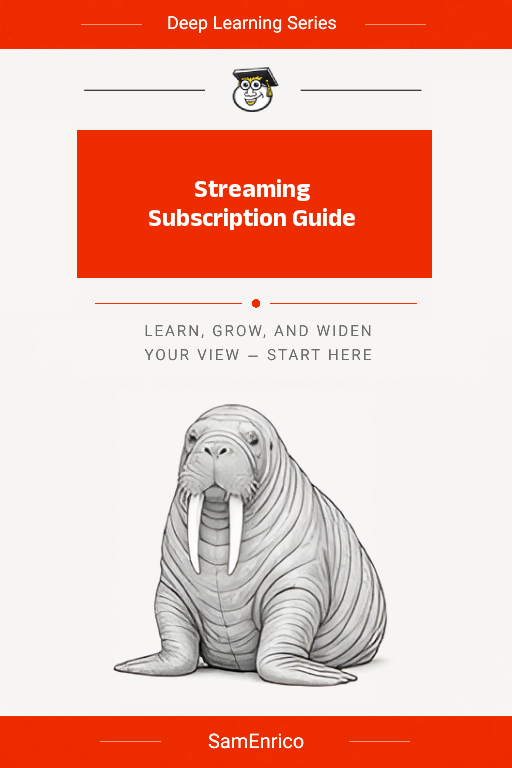
Non-FictionStrategic AtlasStreaming Pricing
Streaming Subscription Guide eBook
Analyze monthly vs. annual plans, ad-supported tie
Analyze monthly vs. annual plans, ad-supported tiers, and bundle pricing across Netflix, Disney+, and Max.
Formats
Free sample
Chapter 1: The Subscription Grave...--The average American household now spends $1,200 per year on streaming subscriptions. They watch approximately 12 percent of what they pay for. The remaining 88 percent disappears into a void of forgotten payments, unwatched libraries, and automated renewals that feel as inevitable as gravity.You are not alone in this. You are not irresponsible or careless. You are a rational human being trapped inside a system that was engineered to exploit the natural gaps in your attention.
The streaming industry has spent over a decade perfecting the art of extracting money from subscribers who fully intend to cancel—but somehow never quite get around to it.This chapter is not about pricing tiers or bundle math or the difference between 4K and HD. Those come later. This chapter is about something more fundamental: the quiet, creeping realization that you have no idea how much you are actually spending on streaming each month. And the even more unsettling truth that the platforms know this about you better than you know it yourself.Let us begin with a simple exercise. Do not check your bank account.
Do not open any apps. Just guess: how many streaming subscriptions are you currently paying for? Write the number down. Now add a second number: how many of those do you actively use at least once per week?For the average reader, the first number is between four and seven. The second number is between one and three.
The gap between those two numbers is what this book calls the "Subscription Grave"—the space where forgotten payments go to die while still being very much alive on your credit card statement.The Myth of the Five-Dollar Problem The streaming industry has mastered a specific psychological trick that behavioral economists call "payment decoupling." When you pay for a service annually, you feel the pain of the payment once. When you pay monthly, you feel it twelve times. But when the monthly payment is small enough—say, 9.99or9.99 or 9.99or14.99 or even $19.99—the pain of each individual payment is barely perceptible. It registers as a blip, a line item, a rounding error.Ten such blips, however, add up to real money.This is the genius of the streaming business model. No single subscription feels expensive enough to warrant the effort of cancellation.
But the aggregate of all your subscriptions—the ones you remember, the ones you forgot, the ones you inherited from a former roommate, the ones tied to a credit card you no longer carry—easily exceeds the cost of a premium cable bundle.And yet, cancellation feels like a chore. It feels like admitting defeat. It feels like you are losing access to something you might want next week, even though you have not wanted it for the past six months.This is not an accident.The Engineering of Inertia The streaming platforms employ teams of behavioral scientists, user experience researchers, and retention specialists whose sole job is to make cancellation just difficult enough that you give up before completing it. They do not want to make cancellation impossible—that would be illegal and would generate customer service nightmares. They want to make it annoying.
They want to make it emotionally unpleasant. They want to insert just enough friction that your future self, the one who will deal with the cancellation, never quite gets around to it.Consider the standard cancellation flow that most platforms use. You click "Cancel Subscription." The platform does not cancel you immediately. Instead, it shows you a screen that asks, "Are you sure?" Then it shows you a second screen that lists everything you will lose: "You will no longer have access to [popular show], [popular movie], and [exclusive content]." Then it shows you a third screen offering you a discounted rate to stay: "How about 50 percent off for the next three months?"By the time you reach the fourth screen, your cognitive load is exhausted. You have been asked to make the same decision three times, each time with new emotional pressure.
Many people give up. They click "Keep Subscription" and tell themselves they will try again next month.This is not a flaw in the interface. This is the interface working exactly as designed.The Sunk Cost Fallacy in Living Rooms Beyond the engineering of inertia, there is a deeper psychological force at work: the sunk cost fallacy. This is the cognitive bias that causes humans to continue investing in something simply because they have already invested in it, even when continued investment is irrational.Here is how it manifests in streaming. You started watching a ten-episode series on Netflix three months ago.
You watched the first three episodes, got distracted, and never returned. But the service is still in your "Continue Watching" row, reminding you every time you open the app that you have unfinished business. You keep the subscription not because you plan to watch the remaining seven episodes, but because canceling feels like admitting you wasted the time you already spent.The same logic applies to annual commitments. You bought a year of Disney+ because the annual discount seemed like a smart financial move. Six months in, you have barely used it.
But you cannot cancel because you already paid for the full year. So the subscription sits there, unused but un-cancelable, a monument to a decision you made when your future viewing habits seemed more ambitious than they turned out to be.The platforms understand this perfectly. They structure their pricing to encourage annual commitments precisely because annual commitments create a lock-in effect. Even if you stop watching, you continue paying—not because you want to, but because you already have.The Forgetting Curve Perhaps the most powerful force keeping your subscriptions alive is simple, unglamorous forgetfulness. The human brain is not designed to track recurring expenses.
It is designed to notice novelty, threat, and reward. A monthly auto-payment is none of those things. It is a predictable, low-salience event that your brain categorizes as "not worth remembering."This is why the "set it and forget it" model is so profitable. You set up the payment once, when your motivation to subscribe is high and your attention to detail is sharp. Then you forget about it.
The payment continues indefinitely, month after month, year after year, until some external event—a credit card expiration, a bank statement review, a moment of financial panic—forces you to notice it.And when you finally notice it, you face a second problem: the accumulation of "subscription debt." Not literal debt, but the emotional weight of realizing you have been paying for something you do not use. That realization is unpleasant. It feels wasteful. It feels stupid. And because it feels stupid, many people avoid confronting it.
They continue paying to avoid the discomfort of acknowledging that they have been paying for no reason.This is called the Ostrich Effect. You bury your head in the sand to avoid bad news. The platforms rely on it.The Fragmentation Trap Twenty years ago, if you wanted television, you called one company—your local cable provider or satellite service. They sent you one bill. You paid one amount.
You received one hundred to five hundred channels. You watched what you watched. You ignored what you ignored. The waste…
This is the end of the free sample. Get the eBook to keep going. Buy now
About this book
Details
- Author
- Siler Marcela
- Publisher
- SamEnrico
- Language
- English
- Genre
- Non-Fiction, Strategic Atlas, Streaming Pricing
- Released
- 2026-05-30
- Pages (approx.)
- 146
- Available as
- eBook, Audiobook

Read better in the ZLOADR app
Your eBooks on your phone or tablet. Sign in with your SamEnrico account and start reading.
More by Siler Marcela
 The Teen Strength Spotter GuideSiler Marcela$11.99
 Manic Episode Management HandbookSiler Marcela$11.99
 Phishing Attack Vectors UpdateSiler Marcela$11.99
 The High Functioning Alcoholic RecoverySiler Marcela$11.99
 Senufo Poro Society ArtSiler Marcela$11.99
 The Star Chart of the Nile: Astronomy and Love in Ancient EgyptSiler Marcela$11.99
 Understanding PorphyriaSiler Marcela$17.99
 Chest of Drawers CraftSiler Marcela$11.99
 HARO Local Media StrategySiler Marcela$12.99
 A Beginners Guide to Equestrianism (Volume 1)Siler Marcela$11.99
You may also like
 Hong Kong Handover 1997Dunn Johnnie$11.99
 Zumba For Postnatal Recovery CourseNeal Christian$11.99
 Zumba for BeginnersLadner Nikia$11.99
 YouTube Comment Mining GuideHumes Pandora$12.99
 Worry Box MeditationCarlin Rudy$11.99
 Workplace Stress MeditationNguyen Lynn$11.99
 Workplace Stress and Sleep RepairHawley Ivory$11.99
 Workplace Perfectionism CureDelaney Jeffry$11.99
 Workplace Injustice Anger GuideWallen Isabelle$11.99
 Work Addiction and Burnout LinkGreenwood Ester$11.99
 Women in Yoga and WellnessBeattie Galina$11.99
 Women in Stand Up ComedyChun Evangeline$11.99