
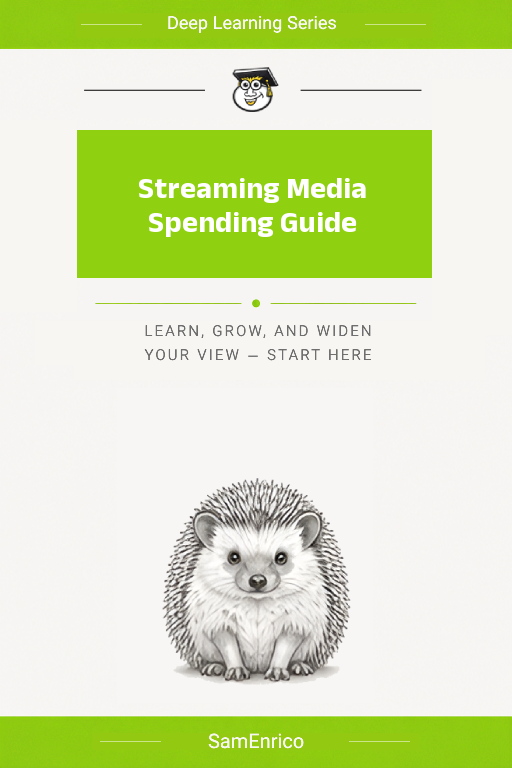
Non-FictionForecast & OutlookStreaming Spending
Streaming Media Spending Guide eBook
Analyze SVOD, AVOD, and live sports subscription t
by Mallory Oda
Analyze SVOD, AVOD, and live sports subscription trends, churn rates, and password sharing impacts.
Formats
Free sample
Chapter 1: The Utility Trap--When did you stop noticing the monthly charges?Think back. You probably signed up for Netflix in 2013 or 2014, when it was seven ninety-nine and felt like stealing. Then came Hulu. Then Disney+ launched at a promotional rate, and you thought, Why not? It’s just six bucks.
Then Peacock offered a free year to Comcast customers. Then Paramount+ had a Super Bowl deal. Then Apple TV+ came free with your i Phone purchase.And here’s the trap: you never canceled any of them.The average American household now pays between sixty-one and ninety dollars per month on streaming subscriptions. That is not a typo. According to Deloitte’s 2024 Digital Media Trends survey, the typical household subscribes to four to six streaming services simultaneously, and the average monthly spend has more than doubled since 2019.
A separate study by Pw C found that nearly forty percent of consumers underestimate their monthly streaming spending by at least fifty percent. You think you are paying forty dollars. Your bank statement says eighty-five.This chapter exists because that gap between perception and reality is not an accident. It is by design.Welcome to the Utility Trap—the moment when streaming stops feeling like a choice and starts feeling like electricity, water, or internet access. Something you just pay every month without thinking.
Something that quietly rises in price while you look away. Something you cannot imagine canceling, even though you cannot remember the last time you opened the app.But here is the critical distinction that most financial advice gets wrong, and that this entire book is built upon: not all streaming services are utilities. Some are. Most are not. And until you learn to tell the difference, you will keep paying for services you do not use, because they have successfully tricked you into treating them as essential.The story of how we got here begins with a golden era that none of us recognized at the time.The Golden Era That Fooled Everyone In 2013, Netflix was a DVD rental company that happened to stream movies over the internet.
Blockbuster was dead. Cable bills were pushing one hundred fifty dollars per month. And Netflix offered a simple proposition: seven dollars and ninety-nine cents per month, no commercials, unlimited viewing, share your password with everyone you loved.It felt like a revolution. In many ways, it was.The streaming model solved three massive consumer problems at once. First, it eliminated the cable bundle—you no longer had to pay for ninety channels you never watched just to get the three you wanted.
Second, it destroyed the broadcast schedule—you watched what you wanted, when you wanted. Third, it was ridiculously cheap compared to the one hundred twenty to one hundred fifty dollars per month that the average cable subscriber was paying.Between 2013 and 2018, the streaming market was in what venture capitalists call the "land grab" phase. Every company prioritized subscriber growth over profit. Netflix borrowed billions to produce original content. Amazon gave Prime Video away as a free add-on to their shipping service.
Hulu survived on advertising and studio subsidies. Disney+ launched at six dollars and ninety-nine cents per month, a price that almost certainly lost money on every subscriber.And consumers benefited enormously.During this period, the average household could subscribe to Netflix, Hulu, Amazon Prime Video, and Disney+ for less than thirty dollars per month combined. Password sharing was not just tolerated—it was encouraged. Netflix famously tweeted in 2017, "Love is sharing a password." The streaming services wanted your login credentials to spread because every new user was a potential future paying customer.But here is what no one told you: the land grab was never going to last.The Profit Extraction Era Sometime around 2022, the math flipped.Netflix’s subscriber growth stalled for the first time in a decade. Wall Street stopped rewarding companies for adding users and started demanding profitability.
The era of cheap borrowing ended as interest rates rose. And every streaming service looked at their balance sheet and realized the same terrifying truth: they were losing billions of dollars.The land grab was over. The profit extraction era had begun.This shift has four specific consequences that directly impact your wallet. Understanding each one is the first step toward escaping the Utility Trap.First consequence: price hikes are now predictable and frequent.Between 2020 and 2024, Netflix raised its standard plan price from twelve dollars and ninety-nine cents to fifteen dollars and forty-nine cents—a nineteen percent increase. Disney+ raised prices three times in four years, from six dollars and ninety-nine cents to thirteen dollars and ninety-nine cents for the ad-free tier—a one hundred percent increase.
Peacock, Paramount+, Max, and Apple TV+ all followed the same pattern: small increases every twelve to eighteen months, never large enough to trigger mass cancellations, but devastating when multiplied across four or five services.Notice the strategy. The increases are never thirty or forty percent at once. That would shock you into canceling. Instead, they raise prices by two or three dollars, wait a year, raise again, wait again. Behavioral economists call this "drip pricing"—the slow leak that you never notice until your bill has doubled.Second consequence: the ad-free tier is becoming a luxury product.Every major streaming service now offers a lower-priced, ad-supported tier alongside a more expensive ad-free option.
On the surface, this seems like consumer choice. But look closer. The ad-supported tiers are priced at what the ad-free tiers used to cost. And the ad-free tiers are rising much faster than inflation.Netflix’s ad-free standard plan went from twelve ninety-nine to fifteen forty-nine in three years. Their ad-supported plan launched at six ninety-nine and stayed there.
The message is clear: if you want no commercials, you will pay a premium that keeps growing. If you tolerate ads, your price stays relatively stable. Over a five-year period, the gap between ad-supported and ad-free is likely to exceed ten dollars per month for every major service.Third consequence: password sharing is being criminalized.Netflix estimated that one hundred million households worldwide were sharing passwords without paying. That was not a bug; it was a feature of the land grab era. But in the profit extraction era, that one hundred million households became a seven hundred ninety-nine million dollar revenue opportunity (seven dollars and ninety-nine cents per month per extra member).In 2023, Netflix rolled out its "household" detection system.
Using IP addresses, device IDs, and account activity patterns, the algorithm identifies accounts being used in multiple physical locations. The result: six million new paid subscribers in the first quarter after the crackdown. Disney+, Max, and Apple TV+ quickly followed with their own detection systems.The days of sharing your password with your college-aged child, your elderly parent, or your vacation home renters are ending. Every service will eventually charge you extra for every screen outside your primary residence.Fourth consequence: live sports are being weaponized against your wallet.Live sports are the last DVR-proof content. You cannot binge the Super Bowl three months later.
You cannot wait for the season to end to watch the World Series. If you want to see your team play, you must…
This is the end of the free sample. Get the eBook to keep going. Buy now
About this book
Details
- Author
- Mallory Oda
- Publisher
- SamEnrico
- Language
- English
- Genre
- Non-Fiction, Forecast & Outlook, Streaming Spending
- Released
- 2026-06-01
- Pages (approx.)
- 160
- Available as
- eBook, Audiobook

Read better in the ZLOADR app
Your eBooks on your phone or tablet. Sign in with your SamEnrico account and start reading.
More by Mallory Oda
 Giving and Receiving FeedbackMallory Oda$11.99
 Weapon Violence Dream Symbols GuideMallory Oda$11.99
 Water Phobia GuideMallory Oda$11.99
 The Virtual AA Meeting GuideMallory Oda$11.99
 Meth Relapse Digital Tracking AppMallory Oda$11.99
 Nefertem: The Lotus-Born Healer of the SunMallory Oda$11.99
 Buff Duck BreedingMallory Oda$11.99
 Freelance Grant Writer Side HustleMallory Oda$12.99
 Understanding Infantile Spinal Muscular AtrophyMallory Oda$17.99
 How to Become a Jewel-bearing FacerMallory Oda$11.99
You may also like
 Hong Kong Handover 1997Dunn Johnnie$11.99
 Zumba For Postnatal Recovery CourseNeal Christian$11.99
 Zumba for BeginnersLadner Nikia$11.99
 YouTube Comment Mining GuideHumes Pandora$12.99
 Worry Box MeditationCarlin Rudy$11.99
 Workplace Stress MeditationNguyen Lynn$11.99
 Workplace Stress and Sleep RepairHawley Ivory$11.99
 Workplace Perfectionism CureDelaney Jeffry$11.99
 Workplace Injustice Anger GuideWallen Isabelle$11.99
 Work Addiction and Burnout LinkGreenwood Ester$11.99
 Women in Yoga and WellnessBeattie Galina$11.99
 Women in Stand Up ComedyChun Evangeline$11.99