

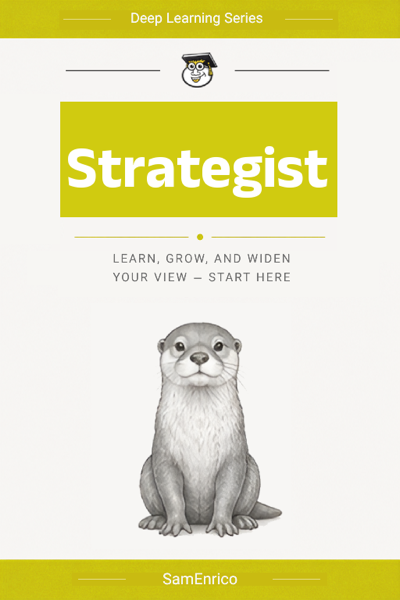
Non-FictionInformativeEducational
Strategist eBook
A Coursebook on Strategist
A Coursebook on Strategist
Formats
Free sample
Chapter 1: The General’s Question...--–- The first time someone called me a strategist, I was sitting in a windowless conference room on the forty-seventh floor of a Manhattan skyscraper. I had just presented a ninety-slide deck—meticulously researched, beautifully formatted, and thoroughly useless. My client, a retired four-star general who had somehow ended up running a logistics company, looked at the deck for exactly seven seconds. Then he slid it back across the polished mahogany table and asked a question that has haunted me ever since.“That’s all very pretty,” he said. “But what game are we playing?
And should we change it?”I had no answer. I had spent six weeks analyzing market share, optimizing supply chains, benchmarking competitors, and projecting financial returns. I had done everything a good consultant is supposed to do. But I had never stopped to ask the one question that actually mattered: Was the game itself worth playing? And if it was, was I even playing the right game?That general, whose name I will not use because he would probably be embarrassed by the attention, taught me something that no business school ever did.
He taught me that strategy is not about plans. Strategy is not about goals. Strategy is not even about winning—at least, not in the narrow sense of beating the competitor next to you. Strategy is about choosing which game to play, knowing that your choice will determine not only whether you win or lose, but what winning even means.This book is the result of that lesson. It is a coursebook on becoming a strategist—not in the pompous, title-on-a-business-card sense, but in the genuine, daily-practice sense.
Over the next twelve chapters, you will learn to think like a general, analyze like a consultant, lead like a founder, and steward like a sage. But before any of that, you need to understand what a strategist actually is—and more importantly, what a strategist is not.The Great Confusion: Manager, Leader, or Strategist?Let us begin with an act of demolition. The business world has spent decades confusing three distinct roles: the manager, the leader, and the strategist. These roles are often conflated, especially in corporate job descriptions where everyone from a team lead to a chief executive claims to “do strategy.” But the confusion is not merely semantic. It is dangerous.The manager optimizes within a given system.
A manager takes the rules as fixed, the game as defined, and the resources as allocated. The manager’s job is to get from point A to point B as efficiently as possible. Managers love spreadsheets, milestones, and quarterly targets. They are invaluable. Without good management, the best strategy in the world collapses into chaos.
But management alone cannot tell you whether point B is the right destination in the first place.The leader inspires people to move in a direction. Leadership is about emotion, motivation, and meaning. A leader paints a vision, rallies the troops, and absorbs risk on behalf of others. Leaders are essential. Without leadership, strategy becomes a soulless calculation that no one believes in.
But leadership without strategic discipline becomes cheerleading—high on energy, low on results.The strategist sits in a different chair altogether. The strategist asks whether the game itself is worth playing. The strategist questions the rules, challenges assumptions, and recognizes when the board is about to change. Where the manager optimizes and the leader motivates, the strategist frames—that is, the strategist decides what problem needs solving before anyone solves it.Consider an analogy from chess. The manager calculates the best move given the current position.
The leader convinces the team to stay focused and motivated through a long endgame. The strategist asks whether the team should be playing chess at all, or whether the real game is poker, or basketball, or something entirely new. That is the strategist’s domain: not better play within a game, but the choice of which game to play.The Etymology of Strategy: From Strategos to the Boardroom The word “strategy” comes from the Greek strategos, which literally means “army leader” (stratos = army, agos = leader). In ancient Athens, ten strategoi were elected each year to command the military and make decisions about war and peace. These were not planners sitting safely behind walls.
They were generals standing on hillsides, watching enemy formations shift, making decisions with incomplete information, and knowing that their choices would cost lives.The etymology matters because it reveals something fundamental that modern business language has obscured. The original strategists operated under three conditions that define strategic thinking to this day.First, they operated under radical uncertainty. They did not know what the enemy would do. They did not know the weather. They did not know if reinforcements would arrive.
They made decisions not with perfect information but with judgment.Second, they faced adaptive opponents. The enemy was not a static obstacle. The enemy watched, learned, and reacted. Any move the strategist made would be countered, parried, or exploited. This is why strategy is fundamentally different from optimization: in optimization, the environment is indifferent; in strategy, the environment pushes back.Third, they understood that the game itself could change.
A general might march toward a battlefield only to discover that the battlefield had moved. Alliances shifted. Technology changed. What worked yesterday was a trap today.These three conditions—radical uncertainty, adaptive opponents, and mutable games—are not relics of ancient warfare. They describe the world of every executive, entrepreneur, and leader reading this book.
The only difference is the stakes: ancient generals risked lives; modern executives risk careers and capital. But the structure of the problem is identical.And yet, most business education trains people to ignore these conditions. MBAs learn to analyze, plan, and execute as if the world were predictable, opponents passive, and games fixed. That is not strategy. That is accounting with better graphics.The Super-Manager Myth: Why Execution Alone Is Not Enough There is a pervasive myth in business that I call the Super-Manager Myth.
It goes like this: if you just execute better than everyone else—if you are more efficient, more disciplined, more data-driven—you will win. The myth has many variations. In some versions, it is about operational excellence. In others, it is about culture. But the core belief is always the same: strategy is secondary; execution is everything.This myth is seductive because it is partially true.
Poor execution kills good strategies every day. But the converse is more important: brilliant execution of a bad strategy is worse than useless. It is actively destructive. It accelerates your movement in the wrong direction.Consider two companies. Company A has an average strategy and excellent execution.
Company B has an excellent strategy and average execution. Which wins? It depends on context, but the safest answer is: neither, because the question is framed incorrectly. The real question is whether the strategy is right for the game being played. And the game itself never stops changing.The Super-Manager Myth persists because it flatters the powerful.
It suggests that success is merely a matter of effort and discipline—that anyone can win if they just work harder and…
This is the end of the free sample. Get the eBook to keep going. Buy now
About this book
Details
- Author
- Saylor Vivien
- Publisher
- SamEnrico
- Language
- English
- Genre
- Non-Fiction, Informative, Educational
- Released
- 2026-06-02
- Pages (approx.)
- 152
- Available as
- eBook, Audiobook

Read better in the ZLOADR app
Your eBooks on your phone or tablet. Sign in with your SamEnrico account and start reading.
More by Saylor Vivien
 The Musician Stretch RoutineSaylor Vivien$11.99
 Remote Work Distraction TrackerSaylor Vivien$11.99
 Dealing With Artistic RejectionSaylor Vivien$11.99
 Vegan Food Combining Myths WorkbookSaylor Vivien$11.99
 Franchising Your Local Brand Across Borders Marketing PlaybookSaylor Vivien$11.99
 The Quiet Architect: How Bill Walsh Built a Dynasty Beyond the FieldSaylor Vivien$11.99
 Into the Depths of the Red Planet: The Forgotten Speleologists of the 19th CenturySaylor Vivien$11.99
 IP Assignment Recordal FeesSaylor Vivien$12.99
 Discount Script GuideSaylor Vivien$12.99
 Understanding Cryptomicrotia Brachydactyly Syndrome Excess FingersSaylor Vivien$17.99
 A Beginners Guide to Bang! (Volume 1)Saylor Vivien$11.99
You may also like
 Hong Kong Handover 1997Dunn Johnnie$11.99
 Zumba For Postnatal Recovery CourseNeal Christian$11.99
 Zumba for BeginnersLadner Nikia$11.99
 YouTube Comment Mining GuideHumes Pandora$12.99
 Worry Box MeditationCarlin Rudy$11.99
 Workplace Stress MeditationNguyen Lynn$11.99
 Workplace Stress and Sleep RepairHawley Ivory$11.99
 Workplace Perfectionism CureDelaney Jeffry$11.99
 Workplace Injustice Anger GuideWallen Isabelle$11.99
 Work Addiction and Burnout LinkGreenwood Ester$11.99
 Women in Yoga and WellnessBeattie Galina$11.99
 Women in Stand Up ComedyChun Evangeline$11.99