
Non-FictionSelf-HelpElimination
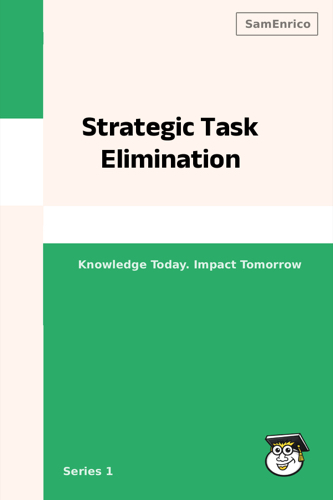
Strategic Task Elimination eBook
Identify and delete tasks that are neither urgent
Identify and delete tasks that are neither urgent nor important completely.
Formats
Free sample
Chapter 1: The Cult of Busyness--–- On a Tuesday afternoon in Manhattan, a senior editor named Sarah found herself crying in a supply closet. Not because she had been fired. Not because of a family emergency. She was crying because she had just spent three hours formatting a report that no one would read, attending a meeting that could have been an email, and reorganizing a shared drive that no one used. After each of these tasks, she had felt productive.
After all, she was busy. Her calendar was full. Her to-do list had seventeen items, and she had checked off six of them. By any conventional measure, Sarah was winning at work. And yet, as she sat on a box of printer paper, surrounded by the smell of toner and despair, she realized something that would take the rest of this book to fully unpack: busyness and effectiveness are not the same thing.
In fact, they are often opposites.Sarah’s breakdown in the supply closet is not a story about burnout. It is a story about the central lie of modern productivity. The lie says this: if your calendar is full, you are important. If you are exhausted, you are valuable. If you have no empty space in your day, you are doing something right.
This lie has been sold to us by hustle culture gurus, corporate overlords who profit from our exhaustion, and a part of our own psychology that confuses motion with progress. The result is a global epidemic of performative busyness—the frantic, anxious, and ultimately empty activity of doing things that do not matter, simply to avoid the terrifying question: What if I stopped?This book is called Strategic Task Elimination, and it begins with a heresy: most of what you do every day should not be done at all. Not faster. Not better. Not delegated.
Not automated. Deleted. Completely and permanently erased from your to-do list, your calendar, and your life. The skill of doing things is taught everywhere—in schools, in management seminars, in self-help books that promise to make you more efficient. The skill of not doing things—the ability to look at a task, a meeting, a report, a request, and say “this does not need to exist”—is almost never taught.
And yet, it is the single most valuable skill of the twenty-first century.Why? Because we live in an age of infinite demand. There will always be another email, another meeting invitation, another Slack message, another “quick request,” another opportunity, another obligation, another fire to put out. The supply of tasks is endless. Your time is not.
The only way to win this game is not to play it better. It is to change the game entirely: stop trying to do everything, and start eliminating almost everything.The Productivity Paradox: Why Doing More Makes You Less Effective Let us begin with a paradox that will haunt every page of this book. For the past fifty years, productivity advice has focused on one thing: output per unit of time. How can you write faster? How can you answer emails in two seconds instead of two minutes?
How can you multitask your way to glory? The implicit assumption is that more output is always better. But this assumption collapses the moment you realize that most output is worthless.Imagine two workers. Worker A completes fifty tasks in a day. Worker B completes three tasks in a day.
Who is more productive? The obvious answer is Worker A. But what if Worker A’s fifty tasks are all trivial—organizing files, replying to non-urgent emails, attending status meetings, formatting documents that no one will read—while Worker B’s three tasks are things that actually move the business forward: closing a major deal, solving a critical technical problem, or designing a new product feature? Suddenly, Worker B is not just more productive; Worker B is infinitely more valuable. And yet, almost every productivity system in existence would reward Worker A.
Because we measure what is easy to measure (volume of tasks completed) rather than what matters (strategic impact).This is the Productivity Paradox: the more you optimize for doing things faster, the more efficiently you produce useless work. Efficiency is a trap when applied to the wrong tasks. You do not need to answer email faster. You need to delete 80% of your email. You do not need to shorten your meetings.
You need to cancel most of them. You do not need better time management. You need better task elimination.The modern workplace is a machine designed to produce what management scholars call “busywork” —activities that feel like work, look like work, and exhaust you like work, but produce no meaningful result. Busywork is the cocaine of the corporate world. It gives you a short-term hit of accomplishment (I checked something off!) while slowly destroying your ability to focus on what actually matters.
And the drug is everywhere: the quarterly report that no one reads, the weekly meeting that could have been an email, the performance review system that takes twenty hours to complete and changes nothing, the email thread with seventeen people CC’d, the “quick sync” that lasts an hour.If you want to escape this trap, you must stop asking “How can I do this faster?” and start asking a much harder, much more frightening question: “What if I didn’t do this at all?”The Eisenhower Matrix: Your Compass for Elimination To answer that question, we need a map. For over half a century, the most durable tool for strategic prioritization has been the Eisenhower Matrix, named after President Dwight D. Eisenhower, who once said, “I have two kinds of problems: the urgent and the important. The urgent are not important, and the important are never urgent.” Whether Eisenhower actually said this is debated by historians. What is not debated is the power of the framework that bears his name.The matrix is simple.
It divides every task, project, or request into four quadrants based on two dimensions: urgency (how soon does this feel like it needs to happen?) and importance (how much does this actually matter to my long-term goals?).Quadrant 1: Important and Urgent. These are crises, deadlines, and fires. A server is down. A client is about to leave. A report is due tomorrow.
Most people think this is where they should spend their time. They are wrong. If you live in Q1, you are constantly reacting, constantly stressed, and constantly putting out fires that you should have prevented. The goal is to minimize Q1 by doing more of Q2.Quadrant 2: Important but Not Urgent. This is the magic quadrant.
Strategic planning. Relationship building. Deep work. Exercise. Learning a new skill.
Rest. These things matter enormously, but they never feel urgent because no one is yelling at you to do them. The most effective people on earth spend most of their time here. They proactively build the future instead of reactively fighting the present.Quadrant 3: Urgent but Not Important. This is the thief of time.
Most emails. Most meetings. Most “quick questions.” Most interruptions. These tasks feel urgent—your phone buzzes, someone is waiting for an…
This is the end of the free sample. Get the eBook to keep going. Buy now
About this book
Details
- Author
- Gallant Carmela
- Publisher
- SamEnrico
- Language
- English
- Genre
- Non-Fiction, Self-Help, Elimination
- Released
- 2026-06-10
- Pages (approx.)
- 148
- Available as
- eBook, Audiobook

Read better in the ZLOADR app
Your eBooks on your phone or tablet. Sign in with your SamEnrico account and start reading.
More by Gallant Carmela
 Richard Ramirez Final StatementGallant Carmela$11.99
 Email and Meeting WorkbookGallant Carmela$11.99
 Ronald Reagan Great CommunicatorGallant Carmela$11.99
 Public Speaking Hypnosis WorkbookGallant Carmela$11.99
 The Last Broadcast: When the BBC Fell SilentGallant Carmela$11.99
 The Last Broadcast: The 1998 Radio Silence That Shocked the WorldGallant Carmela$11.99
 Understanding Cystinuria-lysinuriaGallant Carmela$17.99
 Recycling Equipment Tax CreditGallant Carmela$12.99
 Q1 Marketing One PagerGallant Carmela$12.99
 Compostable Products EducatorGallant Carmela$11.99
 A Beginners Guide to Balkline and straight rail (Volume 1)Gallant Carmela$11.99
You may also like
 Hong Kong Handover 1997Dunn Johnnie$11.99
 Zumba For Postnatal Recovery CourseNeal Christian$11.99
 Zumba for BeginnersLadner Nikia$11.99
 YouTube Comment Mining GuideHumes Pandora$12.99
 Worry Box MeditationCarlin Rudy$11.99
 Workplace Stress MeditationNguyen Lynn$11.99
 Workplace Stress and Sleep RepairHawley Ivory$11.99
 Workplace Perfectionism CureDelaney Jeffry$11.99
 Workplace Injustice Anger GuideWallen Isabelle$11.99
 Work Addiction and Burnout LinkGreenwood Ester$11.99
 Women in Yoga and WellnessBeattie Galina$11.99
 Women in Stand Up ComedyChun Evangeline$11.99