
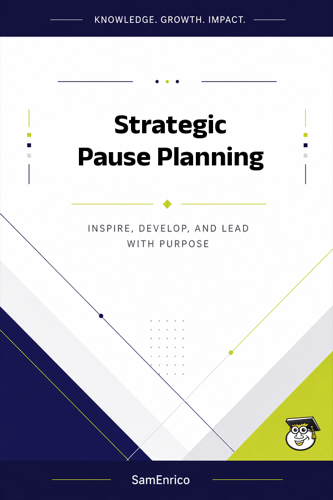
Non-FictionMental WealthPacing
Strategic Pause Planning eBook
Mark three planned silent pauses in your talk to b
Mark three planned silent pauses in your talk to breathe and reset.
Formats
Free sample
Chapter 1: The Breathing Paradox--–- Most people believe that speaking is the primary act of communication. They are wrong. Listening is the primary act. But before listening, before speaking, before any message can be transmitted or received, there is something more fundamental that every living speaker and listener shares: the breath. And yet, for all its universality, breath is the most neglected tool in the communicator’s arsenal.
We breathe to stay alive, but we rarely breathe to communicate. That oversight is the single greatest missed opportunity in public speaking, and it is the foundation upon which every strategic pause is built.This chapter is not about pausing. Not yet. Before you can master the art of the strategic silence, you must first understand the engine that powers it: your breath. The pause is not an empty void.
It is a container. And what you put inside that container—specifically, how you breathe within it—determines whether the pause lands as awkward silence or commanding presence. The difference between a nervous speaker who happens to stop talking and a confident speaker who deploys a strategic pause is entirely a matter of physiology. The former holds their breath, panics, and rushes to fill the void. The latter breathes deliberately, resets their nervous system, and emerges from the pause stronger than when they entered it.This chapter will teach you the hidden science of breath as it applies to public speaking, the physiological mechanics of the “pause breath,” and why most speakers accidentally sabotage themselves the moment they try to pause.
By the end, you will understand why the pause is not a break from communication but the most potent communicative act you possess—and you will have the biological tools to prove it to yourself in less than sixty seconds.The Mistake Every Nervous Speaker Makes Imagine you are standing at a podium. Three hundred faces look back at you. The lights are warm, maybe too warm. Your heart rate has climbed from a resting 72 beats per minute to 110. Your palms have begun to generate the kind of moisture usually reserved for tropical rainforests.
You open your mouth to speak, and nothing comes out. Or worse, something comes out—a thin, reedy version of your voice, pitched higher than normal, faster than intended, and littered with “um,” “ah,” and “so.”What just happened? Most people blame their nerves. Some blame lack of preparation. A few even blame the audience.
But the root cause is simpler and more mechanical than any of these. You forgot to breathe. Not literally—you didn’t pass out. But you shifted from diaphragmatic breathing (slow, deep, calming) to thoracic breathing (shallow, rapid, panicked). This shift happens automatically under stress because your sympathetic nervous system—the “fight or flight” response—prioritizes rapid oxygen exchange over deep relaxation.
In caveman terms, your body thinks a saber-toothed tiger is in the room, so it is preparing you to run, not to give a keynote address.Here is the cruel irony: the very act of trying to pause triggers this stress response in untrained speakers. When you tell yourself, “I will pause for three seconds after this sentence,” your brain interprets the coming silence as a threat. Silence, in evolutionary terms, meant danger. Predators are quiet. Prey makes noise.
Your ancient brain would rather you make any sound—even a nonsensical filler word—than fall silent in a potentially hostile environment. This is why your mouth produces “um” when you meant to produce nothing. The “um” is not a habit. It is a survival instinct gone rogue.The solution is not to fight this instinct. The solution is to hack it by changing what you do during the silence.
When you breathe diaphragmatically during a pause, you send a signal to your vagus nerve—the longest nerve in your autonomic nervous system—that you are safe. Deep, slow breathing activates the parasympathetic nervous system, the “rest and digest” branch that lowers heart rate, reduces cortisol, and returns your cognitive functions to full capacity. In other words, the pause becomes a biological reset button. But this only works if you know how to breathe.The Two Breaths: Thoracic vs. Diaphragmatic Before we go further, place one hand on your chest and one hand on your belly.
Take a normal breath. Just breathe the way you always breathe. Which hand moved more? For approximately 80 percent of adults under stress, the chest hand moves more. This is thoracic breathing.
It is shallow, rapid, and inefficient. It uses only the upper lobes of your lungs, exchanges less oxygen per breath, and keeps your sympathetic nervous system engaged. Thoracic breathing is what you do when you are startled, anxious, or running for a bus. It is not what you want to do on stage.Now try something different. Keep your hands where they are.
Exhale completely—push every last bit of air out of your lungs. Then, without raising your shoulders, inhale slowly through your nose and imagine filling your belly like a balloon. Your belly hand should rise. Your chest hand should remain relatively still. This is diaphragmatic breathing.
Your diaphragm—a dome-shaped muscle beneath your lungs—contracts and moves downward, creating negative pressure that pulls air deep into the lower lobes of your lungs, where oxygen exchange is most efficient. This type of breathing triggers the vagus nerve, lowers heart rate, reduces blood pressure, and signals safety to your brain.The difference between these two breathing patterns is not subtle. Studies in psychophysiology have shown that diaphragmatic breathing, practiced for as little as five minutes, can reduce cortisol levels by 20 to 30 percent. It increases heart rate variability (HRV), a metric associated with emotional regulation and cognitive flexibility. Speakers with higher HRV recover more quickly from mistakes, adapt more readily to audience feedback, and report lower levels of stage fright.
In other words, diaphragmatic breathing does not just make you feel calmer. It makes you a better speaker.But here is where most public speaking advice gets it wrong. Standard guidance will tell you to “take a deep breath before you speak.” That is good advice, as far as it goes. But it misses the critical timing element. The breath does not belong before the pause.
The breath belongs inside the pause. When you pause strategically, you are not stopping communication. You are breathing on purpose. And that purposeful breath is itself a form of communication—one that your audience reads unconsciously as confidence, control, and authority.The 2:1 Breath Code Not all diaphragmatic breathing is created equal. The specific ratio of inhale to exhale matters enormously for public speaking.
Neuroscientific research on respiratory sinus arrhythmia (the natural variation in heart rate that occurs with breathing) has identified an optimal pattern for calming the nervous system: the exhale should be approximately twice as long as the inhale.This is the 2:1 Breath Code.Here is how it works. Inhale for a count of two seconds through your nose. Then exhale for a count of four seconds through your mouth or nose (nose is preferred for silence, mouth for deliberate audible sighs that signal relaxation). The extended exhale activates the parasympathetic nervous system more strongly than the inhale…
This is the end of the free sample. Get the eBook to keep going. Buy now
About this book
Details
- Author
- Browning Chantal
- Publisher
- SamEnrico
- Language
- English
- Genre
- Non-Fiction, Mental Wealth, Pacing
- Released
- 2026-06-10
- Pages (approx.)
- 148
- Available as
- eBook, Audiobook

Read better in the ZLOADR app
Your eBooks on your phone or tablet. Sign in with your SamEnrico account and start reading.
More by Browning Chantal
 Remote Voice and Tone GuideBrowning Chantal$11.99
 Twitter Mention Validation SeekBrowning Chantal$11.99
 Senior Debt Rate RegistryBrowning Chantal$11.99
 The Iron Titans: How Bessemer and Siemens Built the Modern WorldBrowning Chantal$11.99
 How to Produce a CeilingBrowning Chantal$11.99
 Overnight Produce AssociateBrowning Chantal$11.99
 Retail Store Climate Resilience CoverageBrowning Chantal$12.99
 How to Start a Loom Made of Wood Business (Beginners Guide)Browning Chantal$11.99
You may also like
 Hong Kong Handover 1997Dunn Johnnie$11.99
 Zumba For Postnatal Recovery CourseNeal Christian$11.99
 Zumba for BeginnersLadner Nikia$11.99
 YouTube Comment Mining GuideHumes Pandora$12.99
 Worry Box MeditationCarlin Rudy$11.99
 Workplace Stress MeditationNguyen Lynn$11.99
 Workplace Stress and Sleep RepairHawley Ivory$11.99
 Workplace Perfectionism CureDelaney Jeffry$11.99
 Workplace Injustice Anger GuideWallen Isabelle$11.99
 Work Addiction and Burnout LinkGreenwood Ester$11.99
 Women in Yoga and WellnessBeattie Galina$11.99
 Women in Stand Up ComedyChun Evangeline$11.99