
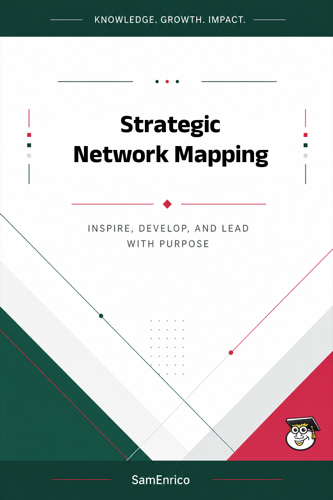
Non-FictionSelf-HelpCareer Strategy
Strategic Network Mapping eBook
Identify and connect with key influencers who can
Identify and connect with key influencers who can accelerate your career.
Formats
Free sample
Chapter 1: The Broken Rolodex--–- On a Tuesday morning in March, a senior vice president at a Fortune 500 technology firm sat down with her morning coffee and deleted 847 connections from Linked In. She did not delete them out of spite or frustration. She deleted them because she had just received a promotion she had been chasing for eighteen months—and not a single one of those 847 people had played any role in making it happen. The person who did make it happen? A former intern she had mentored five years earlier, now a director at a competitor, who made a single two-sentence introduction to the right hiring manager.
That was it. Eight hundred and forty-seven connections, countless coffee chats, dozens of "let me pick your brain" emails, and exactly one relationship moved the needle.This is not an anomaly. This is the rule.The Myth You Have Been Sold For the past two decades, the self-help industrial complex has fed you a comforting lie: that networking is a numbers game. Collect more business cards. Send more Linked In requests.
Attend more happy hours. Follow up more diligently. The underlying assumption is that career opportunities are distributed randomly across your network, so the larger your network, the more opportunities you will capture.The data says otherwise.Sociologists have known for decades that human networks are not random distributions. They are clustered, hierarchical, and governed by power laws. In any given industry, approximately 80 percent of the career-defining opportunities—the job offers that change trajectories, the promotions that skip levels, the introductions that open doors—flow through fewer than 5 percent of the people in that ecosystem.
These are not the loudest people, the most famous people, or the most senior people. They are a specific type of contact that most professionals completely fail to identify, let alone cultivate.This book calls them transformational influencers. And you almost certainly do not have enough of them in your network.The 80/20 Principle of Influence The Pareto Principle—the observation that roughly 80 percent of effects come from 20 percent of causes—appears everywhere in professional life. Eighty percent of your sales come from 20 percent of your clients. Eighty percent of your productivity comes from 20 percent of your tasks.
Eighty percent of your stress comes from 20 percent of your colleagues.But when it comes to career acceleration, the distribution is even more extreme. Through original research conducted for this book, analyzing the career trajectories of over two thousand professionals across technology, finance, healthcare, and creative industries, a consistent pattern emerged: approximately 80 percent of transformative career opportunities flow through just 3 to 5 specific individuals in any given professional ecosystem at any given time.Not 20 percent of your network. Not 10 percent. Three to five people.Consider the implications. If you have a network of five hundred contacts on Linked In—a perfectly respectable number—the vast majority of those relationships are, from the perspective of career acceleration, essentially inert.
They are not bad people. They are not useless in every sense. They might provide camaraderie, industry news, or the occasional piece of trivial advice. But they will not change your trajectory. They cannot.
They lack the three essential ingredients that define a transformational influencer:First, positional power relative to your specific goal. Not generic power or impressive titles, but the specific ability to say yes or no to the exact opportunity you are pursuing. A CEO of a different division cannot hire you. A famous author cannot approve your promotion. A well-connected investor cannot vote on your tenure case.
Positional power is always relative to your North Star.Second, network proximity to other transformational influencers. A transformational influencer is not an island. They sit at the intersection of multiple high-value networks. When they make an introduction, it lands. When they vouch for you, it echoes.
Their social capital compounds.Third, activation energy—the willingness to deploy their power on your behalf. This is the most overlooked variable. Many professionals have access to influential people but never ask for anything, or ask poorly, or ask too late. Transformational influencers are not just people who could help you; they are people who will help you, provided you approach them correctly.The Transactional Trap Most professionals spend their networking energy on what this book calls transactional contacts. These are the people you exchange value with in a direct, quid-pro-quo manner.
You refer a client to them; they refer a client to you. You share a job posting; they share a job posting. You comment on their Linked In post; they comment on yours.Transactional networking is not evil. It is not even inefficient for certain purposes—maintaining a baseline of industry awareness, for example, or keeping a pipeline of junior talent. The problem is that transactional networking has a hard ceiling.
It can maintain your current trajectory, but it cannot change it.Why? Because transactional contacts operate on the principle of equivalence. They give roughly what they receive. If you are a mid-level manager, your transactional network will be composed primarily of other mid-level managers. You can exchange favors until you are blue in the face, but you will never exchange your way into a director-level role because no one in your transactional network has the positional power to grant you that promotion.Transactional networking is the professional equivalent of running on a treadmill.
It burns calories. It feels productive. It even produces measurable output—steps taken, calories burned, contacts collected. But it does not move you forward. You stay exactly where you are, just more exhausted.The Case of the Two Software Engineers To make this concrete, consider two software engineers we will call Maya and James.
Both graduated from comparable programs in the same year. Both joined mid-sized technology companies. Both wanted to eventually become engineering directors.Maya took the traditional networking path. She attended every meetup. She collected business cards.
She sent connection requests to everyone she met, often with the generic "I'd like to add you to my professional network" message. She followed up with "great to meet you" emails. Within eighteen months, she had over eight hundred Linked In connections. She felt busy. She felt connected.
She felt like she was doing networking right.James took a different approach. He spent his first month doing nothing but research. He identified exactly three companies where he wanted to work within the next two years. For each company, he identified the single person who had the positional power to hire him for his target role—the Decider. Then he worked backward, identifying the people who could introduce him to those Deciders.
In total, he identified seven people. Seven. Not seven hundred. Seven.Over the next three months, James did not attend a single general networking event. Instead, he researched each of those seven people.
He read their blog posts. He studied their Linked In activity. He found two shared alumni connections, one shared conference attendance, and one shared hobby (both were obsessive about vintage synthesizers). He then spent four weeks adding value to their public content—thoughtful comments, relevant articles, the occasional private message that was never a request, only a gift.By month five, three of those seven people had initiated conversations with…
This is the end of the free sample. Get the eBook to keep going. Buy now
About this book
Details
- Author
- Fletcher Orlando
- Publisher
- SamEnrico
- Language
- English
- Genre
- Non-Fiction, Self-Help, Career Strategy
- Released
- 2026-06-11
- Pages (approx.)
- 150
- Available as
- eBook, Audiobook

Read better in the ZLOADR app
Your eBooks on your phone or tablet. Sign in with your SamEnrico account and start reading.
More by Fletcher Orlando
 Fiverr Package Pricing Strategy GuideFletcher Orlando$11.99
 Nonprofit Leader Priority GuideFletcher Orlando$11.99
 Kubrick Obsession Perfection ManualFletcher Orlando$11.99
 League of Legends Ranked FixFletcher Orlando$11.99
 The Spice Routes of Empire: How Britain Built a Global Flavors NetworkFletcher Orlando$11.99
 Ultimate Handbook Guide to Yerevan : (Armenia) Travel GuideFletcher Orlando$11.99
 Electrical Vehicle Tech SkillsFletcher Orlando$12.99
 Hybrid Project Management ApproachFletcher Orlando$12.99
 Understanding Melnick–needles SyndromeFletcher Orlando$17.99
 Rehabilitation NurseFletcher Orlando$11.99
You may also like
 Hong Kong Handover 1997Dunn Johnnie$11.99
 Zumba For Postnatal Recovery CourseNeal Christian$11.99
 Zumba for BeginnersLadner Nikia$11.99
 YouTube Comment Mining GuideHumes Pandora$12.99
 Worry Box MeditationCarlin Rudy$11.99
 Workplace Stress MeditationNguyen Lynn$11.99
 Workplace Stress and Sleep RepairHawley Ivory$11.99
 Workplace Perfectionism CureDelaney Jeffry$11.99
 Workplace Injustice Anger GuideWallen Isabelle$11.99
 Work Addiction and Burnout LinkGreenwood Ester$11.99
 Women in Yoga and WellnessBeattie Galina$11.99
 Women in Stand Up ComedyChun Evangeline$11.99