
Non-FictionBiographyStreaming Era
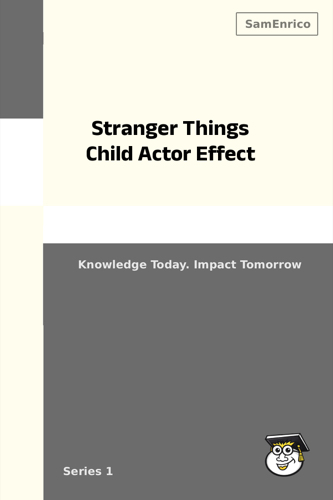
Stranger Things Child Actor Effect eBook
Analyzes how modern streaming fame intensifies pre
Analyzes how modern streaming fame intensifies pressure on young actors compared to previous eras.
Formats
Free sample
Chapter 1: The Vanishing Buffer--The first time Noah Schnapp realized his life had changed forever, he wasn't standing on a red carpet or accepting an award. He was at summer camp, blissfully unaware that Stranger Things had premiered on Netflix three days earlier. When he finally checked his phone, blinking at the sunlight and the swarm of notifications, the world had decided who he was without him present for the vote.That was 2016. He was eleven years old.Nearly a decade later, sitting for an interview with USA Today as the final season of Stranger Things prepared to air, Schnapp reflected on what that moment actually cost him. "I was constantly saying the wrong things or being embarrassed by not taking certain things seriously that I should've, and then that lives on forever," he said.
"People grow and learn, and to do that publicly is not easy."-1-5He admitted something that would have been career suicide for a child star of the 1990s: he needed therapy. Not just wanted it—needed it. And more than that, he argued that therapy should be mandatory for child actors, describing life in the entertainment industry as "an abnormal life" requiring "some type of support system outside of your parents."-8"I always tell my parents, 'I could never live in LA. I think I would get lost,'" he said.-1This confession—raw, vulnerable, and utterly unprecedented in its transparency—marks the dividing line between the child stars of the twentieth century and the Stranger Things generation. One group suffered in silence, their breakdowns chronicled in tabloids as cautionary tales.
The other group is naming the poison while they're still drinking it.But Schnapp's revelation only lands as powerfully as it does because of the context that surrounds it. He grew up in a different Hollywood than the one that produced Judy Garland, Britney Spears, or even his immediate predecessors at Nickelodeon and Disney. He grew up in the streaming era, where fame no longer builds slowly over seven seasons of weekly episodes but detonates overnight. Where a child can go from unknown to global sex symbol between Friday night and Monday morning. Where every awkward interview quote is clipped, memed, and archived permanently on servers that will outlive everyone reading this book.And he grew up with something else: allies.The Summer Camp Anomaly The story of Schnapp at summer camp is not merely an entertaining anecdote.
It is a perfect metaphor for the structural transformation that has redefined child stardom. In the network television era—say, 1994, when the cast of Friends debuted to modest ratings and built their fame brick by brick over months—an actor had time to acclimate. There were weekly check-ins with the public. There was gradual recognition at airports. There was a slow, almost merciful build toward the realization that your face now belonged to strangers.In 2016, Netflix dropped all eight episodes of Stranger Things on a Friday.
By Monday, the cast had been memed, analyzed, thirsted over, and meme-analyzed again. The show amassed over one billion viewing minutes in its first week. Eleven-year-old Millie Bobby Brown, twelve-year-old Finn Wolfhard, and eleven-year-old Schnapp woke up famous in a way that previous generations of child stars could not have conceptualized.This is the "summer camp anomaly"—the terrifying experience of having your life rewritten while you're not looking. And it is the defining psychological condition of the streaming-era child actor.What This Book Is The Stranger Things Child Actor Effect is an investigation into how the convergence of three forces—streaming velocity, social media intimacy, and regulatory failure—has created an unprecedented crisis for young performers. It is not merely a book about Stranger Things, though that show serves as the case study because its cast has been more transparent about their struggles than any previous generation of child stars.
It is a book about the system that produced them, the laws that failed to protect them, and the DIY survival strategies they've improvised in the absence of institutional support.It is also, unavoidably, a book about money.The Myth of the Child Star Fortune Consider Alyson Stoner. You may not recognize the name immediately, but you have seen their work. Stoner danced alongside Missy Elliott at age five. They appeared in Cheaper by the Dozen and Camp Rock. They built a career spanning nearly two decades, working steadily in an industry where most flame out before puberty.-6In their early twenties, after almost twenty years in show business, Stoner checked their bank account expecting to see over a million dollars.There was nothing.
Zero dollars.-6"I was mostly in denial at first," Stoner told Fox News Digital. "I was afraid for my future. I wondered after all this time, if I can be duped once, will I be taken advantage of again? Do I have the competence, the life skills to find my way outside the industry?"-6This is not a story about a child star who blew their money on luxury cars and bad investments. Stoner describes themselves as "absolutely frugal." The money didn't disappear because of their spending habits.
It disappeared because of the structural realities of the entertainment industry, which they describe as "largely unpaid labor."It cost between $10,000 and $20,000 annually just to maintain Stoner's career—audition fees, headshots, agents, managers, publicists, travel, wardrobe. These expenses came off the top before Stoner saw a cent. Meanwhile, their mother, a "career bookkeeper," had been paying herself a monthly salary since Stoner was a child, plus taking "one-off payments" of several thousand dollars over the years.-6 Their business team had mismanaged finances, splurging on lavish gifts. Fifteen years of labor turned into "a crumbling house of cards."Stoner ultimately decided against legal action, writing that they "can't burn a bridge with my mother."-6 That sentence—that quiet, devastating sentence—contains multitudes. It speaks to the impossible position of child performers, whose family members are simultaneously their protectors and their financial managers, their emotional support systems and the people signing off on expenses that drain their futures."A lot of folks are unaware that it can cost between $10,000 and $20,000 for different expenses," Stoner said.
"Many artists are losing money while spending a lot of time and energy and resources auditioning, only to be rejected a majority of the time."-6The Coogan Act: A Revolution with Fatal Gaps The law that was supposed to prevent this scenario is called the Coogan Act, and it has become the central artifact of child actor protection in America—beloved, cited, and tragically insufficient.The story begins with Jackie Coogan, the child star of Charlie Chaplin's The Kid. In the 1920s, Coogan earned millions of dollars. He was one of the biggest stars in the world. When he reached adulthood, he discovered that his mother and stepfather had spent virtually everything. He had nothing.Outrage over Coogan's exploitation led to the passage of the California Child Actor's Bill in 1939, known universally as the Coogan Act.
The law mandated that 15% of a child actor's earnings be set aside in a blocked trust account, inaccessible until the child reached adulthood.-6For nearly a century, the Coogan…
This is the end of the free sample. Get the eBook to keep going. Buy now
About this book
Details
- Author
- Murry Cristopher
- Publisher
- SamEnrico
- Language
- English
- Genre
- Non-Fiction, Biography, Streaming Era
- Released
- 2026-06-07
- Pages (approx.)
- 125
- Available as
- eBook, Audiobook

Read better in the ZLOADR app
Your eBooks on your phone or tablet. Sign in with your SamEnrico account and start reading.
More by Murry Cristopher
 Cooling Breath Sensation PracticeMurry Cristopher$11.99
 PNE in Group SettingsMurry Cristopher$11.99
 Steve Jobs iPod Click WheelMurry Cristopher$11.99
 The Relocation Stress Couples GuideMurry Cristopher$11.99
 The Silent Storm: The Anglo-Dutch Submarine Wars of 1983Murry Cristopher$11.99
 How to Start a Butt Welding Fittings Made of Steel Business (Beginners Guide)Murry Cristopher$11.99
 SEA Long Term Opportunities GuideMurry Cristopher$12.99
 Post Payment Follow Up HandbookMurry Cristopher$12.99
 Enterprise Solutions ArchitectMurry Cristopher$11.99
 Understanding Lisker–Garcia–Ramos SyndromeMurry Cristopher$17.99
You may also like
 Hong Kong Handover 1997Dunn Johnnie$11.99
 Zumba For Postnatal Recovery CourseNeal Christian$11.99
 Zumba for BeginnersLadner Nikia$11.99
 YouTube Comment Mining GuideHumes Pandora$12.99
 Worry Box MeditationCarlin Rudy$11.99
 Workplace Stress MeditationNguyen Lynn$11.99
 Workplace Stress and Sleep RepairHawley Ivory$11.99
 Workplace Perfectionism CureDelaney Jeffry$11.99
 Workplace Injustice Anger GuideWallen Isabelle$11.99
 Work Addiction and Burnout LinkGreenwood Ester$11.99
 Women in Yoga and WellnessBeattie Galina$11.99
 Women in Stand Up ComedyChun Evangeline$11.99