
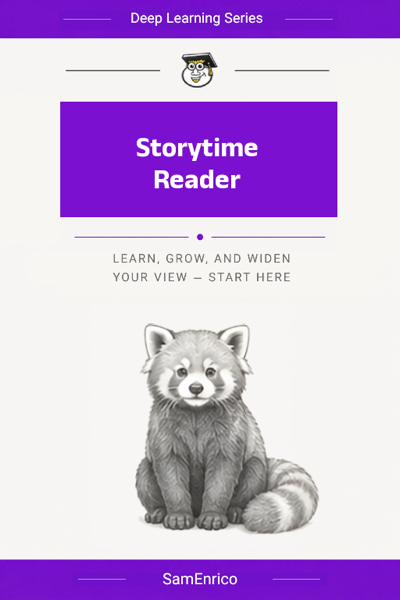
Non-FictionInformativeEducational
Storytime Reader eBook
A Coursebook on Storytime Reader
A Coursebook on Storytime Reader
Formats
Free sample
Chapter 1: The Brain on Fire...–- The first time my daughter ripped a board book in half with her teeth, I thought I had failed as a parent. I was twenty-three years old, sleep-deprived, and thoroughly convinced that somewhere in the house there existed a manual for this—a manual I had somehow not received. The book was Moo, Baa, La La La by Sandra Boynton, and it had been a gift from my own mother, who had inscribed the inside cover with the words “For my granddaughter—may she love reading as much as you did.” Within forty-five seconds of placing the book in my daughter’s hands, she had gummed the corner, torn the final page, and thrown the remains across the carpet with a look of pure, unfiltered triumph. I remember sitting on the floor, holding the soggy, disembodied cardboard flap, and thinking: I am doing this wrong.That moment—the moment of perceived failure—is the reason this book exists.For the next three years, I became obsessed with a single question: What actually happens inside a child’s brain when you read to them? Not the sentimental answer, not the “reading is magical” answer, but the real one.
The neurological one. I read the studies. I interviewed librarians, cognitive psychologists, and pediatricians. I sat in on hundreds of storytimes—at public libraries, preschools, pediatric hospital wards, and homes across three different states. And what I discovered completely upended everything I thought I knew about reading aloud.Here is the truth that the ripped board book taught me: you cannot fail at storytime unless you stop showing up.Everything else—the torn pages, the wiggles, the questions that derail the plot, the same book read fifty times in a row—is not failure.
It is the work. And understanding why that work matters requires us to put aside the warm, fuzzy image of a perfectly quiet child sitting cross-legged with hands folded, and instead look directly at the three-pound universe between their ears.The Three Pillars: What Reading Aloud Actually Builds Before we talk about techniques, voices, or book lists, we need to talk about the brain. Because once you understand what is happening neurologically during a read-aloud, every subsequent chapter in this book will make intuitive sense. You will stop worrying about whether you are “doing it right” and start trusting the process.Reading aloud builds three distinct cognitive capacities, each supported by decades of peer-reviewed research. I call them the Three Pillars of Storytime.Pillar One: Phonological Awareness Phonological awareness is the ability to hear, identify, and manipulate the individual sounds in spoken words.
It is not the same as phonics (which connects sounds to letters). Phonological awareness happens entirely in the ear and the brain, before print is ever introduced.Here is why this matters for reading aloud: every time you read a rhyming book, every time you chant a repetitive phrase, every time you slow down to emphasize the buh sound in “balloon,” you are building the neural pathways that allow a child to hear that cat and hat end with the same sound. This is not a small thing. Phonological awareness in preschool is one of the single strongest predictors of reading success in elementary school—stronger than IQ, stronger than socioeconomic status, stronger than parental education level.The studies are striking. In a 2012 meta-analysis published in Child Development, researchers reviewed sixty-seven studies covering over 10,000 children and found that phonological awareness training—including shared reading of rhyming books—produced significant gains in later reading ability across all demographic groups.
The effect was largest for children who started with the lowest levels of phonological awareness. In other words: reading aloud is an equalizer.But here is what most parents do not realize. Phonological awareness is not built by hearing words alone. It is built by playing with sounds. That means the child who interrupts you to say “Mommy, ‘dinosaur’ starts with the same sound as ‘door’!” is not being disruptive.
They are literally rewiring their brain. The child who asks “What rhymes with ‘purple’?” even though nothing does is not being difficult. They are testing the boundaries of the sound system they are building.This is why Chapter 4 of this book (Baby Steps) emphasizes onomatopoeia and rhyming books. This is why Chapter 5 (Preschool) celebrates call-and-response reading. You are not just keeping a child entertained.
You are building the auditory scaffolding that will support every future act of decoding.Pillar Two: The 30-Million-Word Gap In 1995, researchers Betty Hart and Todd Risley published a study that changed early childhood education forever. They followed forty-two families from diverse socioeconomic backgrounds for two and a half years, recording every word spoken in each home. Their findings were staggering: by age four, children in professional families had heard an average of 45 million words, while children in families on welfare had heard just 13 million words. The difference—32 million words—became known as the 30-million-word gap.Critically, Hart and Risley found that the gap was not just about quantity. It was about quality.
Children in higher-income homes heard far more affirmations (”That’s right,” “Good job,” “Tell me more”) and far fewer prohibitions (”Stop that,” “No,” “Don’t touch”). The ratio of affirmations to prohibitions in professional homes was six to one. In welfare homes, it was two to one.Reading aloud is not a complete solution to this gap—systemic factors matter enormously—but it is one of the most powerful tools available to individual caregivers. A single picture book contains between 200 and 600 unique words. Many of those words—words like enormous, glittering, terrified, whispered—are rare in everyday conversation.
You do not often say to your toddler “Look at that colossal steam shovel.” But you will read it in Mike Mulligan and His Steam Shovel.This is the hidden curriculum of children’s literature. Picture books are vocabulary delivery systems. And because children need to hear a word between six and thirty times before they truly learn it (depending on the child and the complexity of the word), repetition is not a flaw in storytime. It is the mechanism of learning.I want to pause here because this is important. When your child demands The Very Hungry Caterpillar for the seventeenth night in a row, they are not being annoying.
They are being efficient. Their brain is saying: I almost have this. Just a few more repetitions and the neural pathway will be myelinated. Then I can move on. This is the Comfort of the Known—a concept we will return to in Chapters 5 and 6.
The brain craves predictability because predictability allows it to relax into deeper processing. The first time you read a book, the child is just tracking the plot. The fifth time, they are noticing the illustrations. The fifteenth time, they are predicting the rhymes. The thirtieth time, they are learning the vocabulary.
The fiftieth time, they are memorizing the entire text—which is the first stage of learning to read.So when you feel yourself going cross-eyed reading Goodnight Moon for the thousandth time, remember: you are not repeating. You are reinforcing.Pillar Three: Narrative Comprehension and Executive Function The third pillar is the least understood…
This is the end of the free sample. Get the eBook to keep going. Buy now
About this book
Details
- Author
- Hayes Marlene
- Publisher
- SamEnrico
- Language
- English
- Genre
- Non-Fiction, Informative, Educational
- Released
- 2026-06-02
- Pages (approx.)
- 136
- Available as
- eBook, Audiobook

Read better in the ZLOADR app
Your eBooks on your phone or tablet. Sign in with your SamEnrico account and start reading.
More by Hayes Marlene
 The Visualisation for WorthHayes Marlene$11.99
 Alcohol Recovery Meditation GuideHayes Marlene$11.99
 Pregabalin Withdrawal GuideHayes Marlene$11.99
 Green Beret Q CourseHayes Marlene$11.99
 The Daring Voyages of Abubakari II: Mali's Lost ExplorerHayes Marlene$11.99
 How to Produce Cleaner and PolishHayes Marlene$11.99
 Kenya Customer Support TeamsHayes Marlene$12.99
You may also like
 Hong Kong Handover 1997Dunn Johnnie$11.99
 Zumba For Postnatal Recovery CourseNeal Christian$11.99
 Zumba for BeginnersLadner Nikia$11.99
 YouTube Comment Mining GuideHumes Pandora$12.99
 Worry Box MeditationCarlin Rudy$11.99
 Workplace Stress MeditationNguyen Lynn$11.99
 Workplace Stress and Sleep RepairHawley Ivory$11.99
 Workplace Perfectionism CureDelaney Jeffry$11.99
 Workplace Injustice Anger GuideWallen Isabelle$11.99
 Work Addiction and Burnout LinkGreenwood Ester$11.99
 Women in Yoga and WellnessBeattie Galina$11.99
 Women in Stand Up ComedyChun Evangeline$11.99