
Non-FictionInformativeEducational
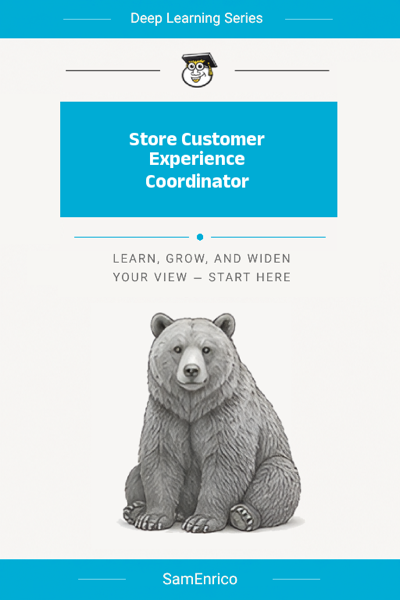
Store Customer Experience Coordinator eBook
A Coursebook on Store Customer Experience Coordina
A Coursebook on Store Customer Experience Coordinator
Formats
Free sample
Chapter 1: The Smile Tax--– The register drawer slammed shut with a finality that made the customer flinch. The cashier, a well-meaning teenager named Marcus, had already looked past her shoulder toward the next person in line. He’d processed the return—three shirts, wrong sizes, purchased online—in under forty-five seconds. By every operational metric, Marcus had excelled. The transaction was efficient, accurate, and compliant with every policy in the thirty-seven-page employee handbook.The customer walked out with her refund receipt in hand.
She also walked out planning never to return.She didn’t complain. She didn’t write a bad review. She didn’t ask for a manager. She simply subtracted that store from her mental list of acceptable places to spend money. In the parking lot, she pulled out her phone and ordered replacement shirts from a competitor.
The entire process—walking in, waiting, returning, leaving, and switching brands—took eleven minutes. Eleven minutes to lose a customer who had spent $1,200 there in the past twelve months.This is not a story about a rude cashier. Marcus was not rude. He followed every rule he’d been given. He said “hello” when she approached.
He asked for her receipt. He scanned the items, processed the refund, and handed her the slip. He did nothing wrong according to the training manual.And that is exactly the problem.The modern retail store is filled with Marcuses—competent, well-intentioned, policy-following employees who are systematically trained to execute transactions rather than build relationships. They are measured on speed, accuracy, and compliance. They are rewarded for efficiency.
They are never taught that the moment a customer completes a transaction is not the end of a relationship but the beginning of a test. And they work in stores whose leaders have quietly, unknowingly, decided that customer acquisition is more important than customer retention—even though acquiring a new customer costs five to twenty-five times more than keeping an existing one.This chapter exists because that math is about to catch up with you.The Quiet Crisis in Every Retail Store Let me tell you about the last time I watched a store lose a customer in real time. I was standing near the customer service desk of a large electronics retailer, ostensibly browsing headphones but actually watching. A woman in her late forties approached the desk holding a laptop. She looked tired—the kind of tired that comes from having already solved three problems that day and not wanting a fourth.The exchange went like this:“Hi, I bought this laptop three weeks ago, and it keeps freezing.
I need to exchange it.”The associate glanced at the laptop, then at the receipt she’d placed on the counter. “Do you have the original box?”“No, I threw it away. I didn’t think I’d need it.”“I can’t process an exchange without the original box.”“Can you check with a manager?”“The policy says original packaging required for exchange within thirty days.”The woman stared at him. He stared back. Neither was being unreasonable.
He was following policy. She was following the reasonable assumption that a $900 laptop should work for more than three weeks.What happened next is the part that gets left out of most customer service training. The woman didn’t argue. She didn’t raise her voice. She picked up the laptop, put it back in her bag, and said, “Okay, thank you.” She walked out.
She drove to a different store thirty minutes away—a Best Buy—where an associate named Diana spent twelve minutes helping her. Diana found that the laptop had a known firmware issue, fixed it on the spot, and asked, “While I’ve got this open, is there anything else you’ve been struggling with?” The woman mentioned that her wireless mouse had been acting up. Diana tested it, confirmed it was defective, and replaced it even though the woman hadn’t asked.The woman has now spent approximately $4,000 at that Best Buy over the following two years. The first store lost not just the laptop sale but every subsequent sale she would have made.Here is the question that keeps retail executives awake at night: how many of those moments are happening in your stores right now, silently, without a single complaint logged in your system?The research is sobering. For every customer who complains, twenty-six remain silent and simply leave.
Of those silent leavers, sixty-five percent will not tell you why. They will not fill out a survey. They will not post a negative review. They will simply disappear into the database of customers who used to exist and now do not. And because most retail analytics are built to track acquisition rather than retention, their absence is recorded as a negative number in a spreadsheet titled “Natural Attrition”—a phrase that medicalizes what is actually a slow-moving business disaster.The 50 Percent Rule There is a statistic that gets cited so often in customer experience circles that it has become wallpaper—visible but unnoticed.
Depending on which study you reference, it sounds something like this: “Fifty percent of customers will switch to a competitor after a single bad experience.” Or “Seventy-three percent will abandon a transaction mid-process.” Or “Eighty percent will leave after multiple bad experiences.”These numbers are not interchangeable, and citing them without context does more harm than good. Let me clarify the actual research so you never misstate this in a meeting.The 2015 American Express Customer Service Barometer, one of the most rigorous studies ever conducted on this topic (n=17,000 consumers across fourteen countries), found that seventy-three percent of customers said they would abandon a transaction mid-process if they encountered a problem that required speaking to a human. That is different from switching brands permanently. It means they would hang up, close the browser, or walk out of the store—in that moment—and try somewhere else for that specific purchase.The more relevant statistic for a Store Customer Experience Coordinator comes from the 2020 Zendesk Customer Experience Trends Report (n=90,000). Fifty percent of customers will switch to a competing brand after a single bad experience.
After multiple bad experiences, that number rises to eighty percent. And here is the detail that matters most: those customers do not switch to the cheapest competitor or the most convenient competitor. They switch to the competitor that they believe will cause them less emotional friction.That last phrase—emotional friction—is the entire reason this job exists.What Your Store Actually Sells If you asked the average store manager what their store sells, they would point to the shelves. “We sell electronics,” they would say. “We sell clothing.
We sell groceries. We sell home goods.” This answer is not wrong, but it is incomplete in a way that explains why so many retail stores are struggling.Your store sells two things. The first is the product—the physical object that the customer takes home. The second is the experience of obtaining that product. And while the product is largely commoditized (your shoes are not that different from the shoes across the street, and your return policy is not that different from the return policy…
This is the end of the free sample. Get the eBook to keep going. Buy now
About this book
Details
- Author
- Waggoner Regenia
- Publisher
- SamEnrico
- Language
- English
- Genre
- Non-Fiction, Informative, Educational
- Released
- 2026-05-04
- Pages (approx.)
- 151
- Available as
- eBook, Audiobook

Read better in the ZLOADR app
Your eBooks on your phone or tablet. Sign in with your SamEnrico account and start reading.
More by Waggoner Regenia
 Habit Formation for Low MotivationWaggoner Regenia$11.99
 GAD Catastrophizing Stop GuideWaggoner Regenia$11.99
 Mindfulness For Grief WorkbookWaggoner Regenia$11.99
 Customer Service PositioningWaggoner Regenia$11.99
 ABCDE Method Task Ranking HandbookWaggoner Regenia$11.99
 The Dragon’s Last Roar: The Beast of Mont Saint-MichelWaggoner Regenia$11.99
 The Last Telegram: A Love Story Across War-Torn EuropeWaggoner Regenia$11.99
 Understanding Growth Delay, ConstitutionalWaggoner Regenia$17.99
 Non Resident Member Disclosure TrapWaggoner Regenia$12.99Non Resident Member Disclosure TrapWaggoner Regenia$12.99
 BPO Social Media SupportWaggoner Regenia$12.99
 A Beginners Guide to Chess (Volume 1)Waggoner Regenia$11.99
You may also like
 Hong Kong Handover 1997Dunn Johnnie$11.99
 Zumba For Postnatal Recovery CourseNeal Christian$11.99
 Zumba for BeginnersLadner Nikia$11.99
 YouTube Comment Mining GuideHumes Pandora$12.99
 Worry Box MeditationCarlin Rudy$11.99
 Workplace Stress MeditationNguyen Lynn$11.99
 Workplace Stress and Sleep RepairHawley Ivory$11.99
 Workplace Perfectionism CureDelaney Jeffry$11.99
 Workplace Injustice Anger GuideWallen Isabelle$11.99
 Work Addiction and Burnout LinkGreenwood Ester$11.99
 Women in Yoga and WellnessBeattie Galina$11.99
 Women in Stand Up ComedyChun Evangeline$11.99