
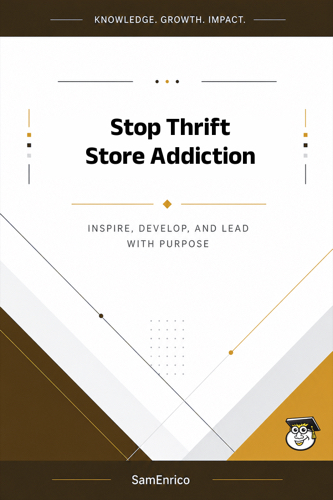
Stop Thrift Store Addiction
Break the cycle of bargain hunting when even cheap
Break the cycle of bargain hunting when even cheap purchases are compulsive.
Formats
About this book
Free sample
Chapter 1: The Dopamine Hook--It is a Saturday morning, and you have just walked into a thrift store. The air smells like fabric softener, old wood, and the faint ghost of someone else’s laundry. Rows of mismatched clothing stretch before you. A shelf of dusty glassware catches the fluorescent light. Somewhere in the back, a customer laughs at a ridiculous find.
Your eyes begin to scan. Not looking for anything specific. Just looking. Then you see it. Tucked between a broken lamp and a stained sweater, there is a jacket.
It is made of wool. The label is from a brand you recognize—one that sells for $200 new. The price tag says $7.50. Your heart rate increases. Your palms might even feel a little warm.
You pick it up. It fits. You do not need another jacket. You already have four at home. But this one is different.
This one is a score. You buy it. You drive home feeling victorious. You hang it in your closet. Six months later, you have never worn it.
You cannot remember why you needed it. But you remember the feeling of finding it.That feeling has a name. It has a chemical signature. It has a evolutionary purpose that has been hijacked by the modern thrift store. And until you understand how it works, you will never break the cycle of compulsive bargain hunting.The Anatomy of the Thrill Every time you find something unexpectedly valuable at a low price, your brain releases a neurotransmitter called dopamine.
Dopamine is often called the "feel-good" chemical, but that is not quite accurate. It is actually the anticipation chemical. It is released not when you receive a reward, but when you predict that a reward might be coming. This is a critical distinction.In the 1950s, two neuroscientists named James Olds and Peter Milner discovered what they called the brain's "reward center." They implanted electrodes in the brains of rats and allowed the rats to press a lever that stimulated a specific region called the nucleus accumbens. The rats pressed that lever compulsively—thousands of times per hour, ignoring…
This is the end of the free sample. Get the eBook to keep going. Buy now
Contents
- Chapter 1
- Chapter 2
- Chapter 3
- Chapter 4
- Chapter 5
- Chapter 6
- Chapter 7
- Chapter 8
- Chapter 9
- Chapter 10
- Chapter 11
- Chapter 12
Details
- Author
- Galvez Jerrie
- Publisher
- SamEnrico
- Language
- English
- Genre
- Non-Fiction, Self-Help, Bargain
- Released
- 2026-06-06
- Pages (approx.)
- 113
- Available as
- eBook, Audiobook

Read better in the ZLOADR app
Your eBooks on your phone or tablet. Sign in with your SamEnrico account and start reading.
More by Galvez Jerrie
 Self Esteem For Support RolesGalvez Jerrie$11.99
 Relapse Prevention StimulantsGalvez Jerrie$11.99
 Competitive Sibling HealingGalvez Jerrie$11.99
 Name Recall Sleep EffectGalvez Jerrie$11.99
 Divorce Conversations GuideGalvez Jerrie$11.99
 The Retirement Location Decision BriefGalvez Jerrie$11.99
 SMART Goals for Sleep ImprovementGalvez Jerrie$11.99
 The Bronze Alchemists: Nok’s Lost Sculptors of the SavannahGalvez Jerrie$11.99
 The Architects of the Nile: Designing the Eternal City of MeroëGalvez Jerrie$11.99
 Service Providers Guide to Car RentalsGalvez Jerrie$11.99
 How to Produce KeyboardsGalvez Jerrie$11.99
 How to Produce USB Flash DrivesGalvez Jerrie$11.99
You may also like
 Hong Kong Handover 1997Dunn Johnnie$11.99
 Zumba For Postnatal Recovery CourseNeal Christian$11.99
 Zumba for BeginnersLadner Nikia$11.99
 YouTube Comment Mining GuideHumes Pandora$12.99
 Worry Box MeditationCarlin Rudy$11.99
 Workplace Stress MeditationNguyen Lynn$11.99
 Workplace Stress and Sleep RepairHawley Ivory$11.99
 Workplace Perfectionism CureDelaney Jeffry$11.99
 Workplace Injustice Anger GuideWallen Isabelle$11.99
 Work Addiction and Burnout LinkGreenwood Ester$11.99
 Women in Yoga and WellnessBeattie Galina$11.99
 Women in Stand Up ComedyChun Evangeline$11.99