
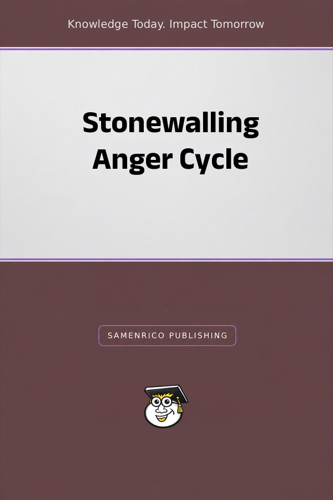
Non-FictionSelf-Help / Stonewalling
Stonewalling Anger Cycle eBook
Breaks the silent treatment pattern and re-engages
by Riley Krista
Breaks the silent treatment pattern and re-engages communication.
Formats
Free sample
Chapter 1: The Spectrum of Silence--–- The fight ended forty-seven minutes ago, but the silence in the room has taken on a life of its own. It sits between you like a third person—cold, heavy, and completely uninvited. You have replayed the argument in your head at least a dozen times: what you said, what they said, where the conversation veered off the rails and crashed into that familiar, awful wall of nothing. Your partner sits across the room, eyes fixed on a phone screen that hasn’t changed in ten minutes, jaw set, shoulders turned away. You feel the anger rising again, hot in your chest, because the silence feels like a verdict.
It feels like punishment. And somewhere underneath that anger, there is something far more vulnerable: a quiet, desperate question. Do you still care?If you are reading this book, you have likely lived this moment more times than you can count. You know the Stonewalling Anger Cycle by its symptoms even if you have never called it by name. One of you escalates—voice rising, criticism sharpening, demands increasing.
The other shuts down—eyes glazing over, body going still, words evaporating. The pursuer chases for a reaction, any reaction, because silence feels like abandonment. The withdrawer retreats further because the noise and the criticism feel like an attack. The cycle spins. Trust erodes.
And by the time the dust settles, neither of you can remember what the argument was originally about. You only remember the silence and the explosion that followed.This book exists because that cycle can be broken. But before you can break it, you have to understand what it actually is. And that begins with a truth that runs counter to almost everything our culture tells us about silence in relationships.Silence is not a single thing. It is a spectrum.The Dangerous Oversimplification Most relationship advice treats silence as a monolith.
If your partner goes quiet during a conflict, the common wisdom says they are either “giving you the silent treatment” (toxic, manipulative, a sign of emotional immaturity) or they are “keeping their cool” (mature, controlled, better than yelling). Both of these interpretations miss the point entirely. They are oversimplifications that actually make the Stonewalling Anger Cycle worse.Why? Because if you believe all silence is manipulation, you will attack every moment of quiet as if it were a weapon—which guarantees that your partner will withdraw even further. And if you believe all silence is healthy self-control, you will never recognize when your own withdrawal is causing real harm to your partner.
The truth is more nuanced. And that nuance is the key to unlocking the entire cycle.Let us be precise. In the context of romantic relationships, silence during conflict falls into one of three categories. These are not opinions. They are distinct behavioral patterns with different physiological mechanisms, different psychological drivers, and—most importantly—different solutions.
I call this the Spectrum of Silence.Category One: The Regulated Time-Out The first category is the only truly healthy form of conflict silence. A Regulated Time-Out is a deliberate, communicated, time-limited pause in a conversation that has become too heated to continue productively. It looks like this: one partner says, “I am feeling flooded right now. I cannot hear you clearly. I need twenty minutes to calm down, and then I will come back to finish this conversation.
I love you. I am not leaving.” Then they leave—not storming out, not slamming doors, but walking away with a clear return time.Notice what is present in this scenario. There is a stated reason for the pause. There is a specific time limit. There is a reassurance of connection (“I love you”).
And there is a commitment to return. The silence that follows is not rejection. It is regulation. It is the equivalent of a boxer stepping back to the corner to have a cut treated before the next round. The fight is not over.
The relationship is not in question. The silence is a tool, not a weapon.How do you know if you are in a Regulated Time-Out? Ask yourself three questions. First, was the pause announced clearly before the silence began? Second, is there a specific time (not “later” or “when I am ready”) attached to the return?
Third, does the silent partner genuinely intend to resume the conversation at the agreed time? If the answer to all three is yes, you are looking at healthy regulation. If any answer is no, you are looking at one of the other two categories.Category Two: The Flooded Shutdown The second category is the most common and the most misunderstood. A Flooded Shutdown is an involuntary physiological response to overwhelming emotional stress. It is not chosen.
It is not strategic. It is the nervous system slamming the emergency brake because it perceives threat.Here is what happens inside the body during a Flooded Shutdown. Your sympathetic nervous system—the “fight or flight” branch—activates. Your heart rate spikes above one hundred beats per minute. Your adrenal glands pump cortisol and adrenaline into your bloodstream.
Your prefrontal cortex, the part of your brain responsible for rational thought, empathy, and complex communication, literally begins to go offline. Blood flow redirects away from your higher brain centers and toward your large muscle groups, preparing you to fight or flee. Your field of vision narrows. Your hearing becomes less sensitive. You may feel a sense of tunnel vision or emotional numbness.In this state, you cannot process complex language.
You cannot empathize with your partner’s perspective. You cannot problem-solve. You cannot even remember, in the moment, that you love the person standing in front of you. All you know is that you need to escape the threat. And because most of us have learned that physically running away from a partner is socially unacceptable, the escape takes the form of psychological withdrawal.
You go silent not because you want to punish, but because your brain has literally stopped producing coherent responses.Here is the crucial point. A Flooded Shutdown feels very different from the inside than it looks from the outside. From the outside, it looks like stonewalling: the partner goes quiet, turns away, stops responding. From the inside, it feels like a white wall of static. The person who is flooded is not thinking, “Good, now I have the upper hand.” They are thinking, “I cannot do this.
I need to get out. Everything is too loud.” They are often as distressed by their own silence as their partner is.The tragedy of the Flooded Shutdown is that it is almost always interpreted as intentional rejection. The pursuer sees the silence and feels abandoned. The withdrawer feels attacked and shuts down further. The cycle accelerates.
And neither person realizes that the problem is not malice. The problem is physiology.Category Three: The Weaponized Silent Treatment The third category is the one most people think of when they hear “silent treatment.” A Weaponized Silent Treatment is a deliberate, strategic withdrawal of communication used to punish, control, or manipulate a partner. Unlike the Regulated Time-Out, it has no stated return time—or the return time keeps…
This is the end of the free sample. Get the eBook to keep going. Buy now
About this book
Details
- Author
- Riley Krista
- Publisher
- SamEnrico
- Language
- English
- Genre
- Non-Fiction, Self-Help / Stonewalling
- Released
- 2026-06-08
- Pages (approx.)
- 145
- Available as
- eBook, Audiobook

Read better in the ZLOADR app
Your eBooks on your phone or tablet. Sign in with your SamEnrico account and start reading.
More by Riley Krista
 Reba McEntire Fancy LifeRiley Krista$11.99
 Name Memory for JournalistsRiley Krista$11.99
 Nutrition During DetoxRiley Krista$11.99
 Breathe Before You BattleRiley Krista$11.99
 Napping For Memory EnhancementRiley Krista$11.99
 F1 Halo Protection GuideRiley Krista$11.99
 Child Therapy In Low Resource SettingsRiley Krista$11.99
 The Last Ronin's Oath: A Samurai's Vow to a Phantom QueenRiley Krista$11.99
 The Lost Gold of Nippur: The Jewelry Heist That Saved a DynastyRiley Krista$11.99
 Ultimate Handbook Guide to Fuyang : (China) Travel GuideRiley Krista$11.99
 Stock Footage Channel End Screens StrategyRiley Krista$12.99
 Small Business Grant EligibilityRiley Krista$12.99
You may also like
 Hong Kong Handover 1997Dunn Johnnie$11.99
 Zumba For Postnatal Recovery CourseNeal Christian$11.99
 Zumba for BeginnersLadner Nikia$11.99
 YouTube Comment Mining GuideHumes Pandora$12.99
 Worry Box MeditationCarlin Rudy$11.99
 Workplace Stress MeditationNguyen Lynn$11.99
 Workplace Stress and Sleep RepairHawley Ivory$11.99
 Workplace Perfectionism CureDelaney Jeffry$11.99
 Workplace Injustice Anger GuideWallen Isabelle$11.99
 Work Addiction and Burnout LinkGreenwood Ester$11.99
 Women in Yoga and WellnessBeattie Galina$11.99
 Women in Stand Up ComedyChun Evangeline$11.99