
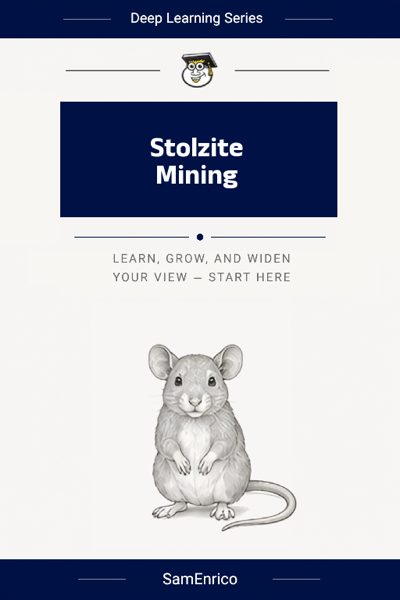
Non-FictionInformativeEducational
Stolzite Mining eBook
A Coursebook on Stolzite Mining
by Adams Traci
A Coursebook on Stolzite Mining
Formats
Free sample
Chapter 1: The Yellow Killer...-- The first thing you notice about Stolzite is the color. A buttery yellow, sometimes deepening into amber or blood-orange, it catches the light like a tiny sun trapped in stone. Prospectors who have pulled it from ancient rock describe an almost animal reaction—a racing heart, dry mouth, the sudden conviction that they have found something extraordinary. And they have. But what they rarely understand, in that first electric moment of discovery, is that this beautiful crystal has a dark history written in the lungs of dead miners, the bankruptcies of foolish investors, and the classified files of wartime intelligence agencies.This book is not a dry mineralogical catalog.
It is a treasure map and a warning, a technical manual and a detective story. It is for the weekend prospector panning a forgotten creek in Arizona, the junior geologist staring at a promising soil anomaly in Namibia, the investor wondering whether to back a tungsten exploration play, and the collector who has fallen under the spell of one of Earth's rarest and most beautiful creations. Whether you want to find it, mine it, process it, or simply understand why a yellow crystal no bigger than your thumbnail can be worth more than a car, this book will show you the way.Let us begin where all great treasure hunts begin: with the question of value.The Metal That Wins Wars Before you can understand Stolzite, you must understand tungsten. And to understand tungsten, you need only know one number: 3,422. That is the melting point of tungsten in degrees Celsius—the highest of any metal on Earth.
It is denser than steel, harder than titanium, and conducts electricity almost as well as copper. When the engineers of the early twentieth century needed a filament that would not melt inside a light bulb, they turned to tungsten. When the armorers of World War II needed a projectile that could punch through enemy tank armor, they turned to tungsten carbide. When the aerospace industry needed a counterweight that would not deform under extreme heat, they turned to tungsten alloys.Tungsten is not glamorous. It does not glitter like gold or catch the eye like silver.
But it is the skeleton of modern industry, the hidden backbone that makes high-speed cutting tools, jet engine turbines, and military ordnance possible. Without tungsten, the green revolution would stall—wind turbines need tungsten-carbide bearings, and electric vehicles need tungsten-heavy battery contacts. Without tungsten, the microchip industry would collapse—the fine wires that connect silicon to the outside world are tungsten. Without tungsten, the lights would go out—literally, because the filaments that still illuminate millions of homes are tungsten.The world consumes approximately 100,000 tonnes of tungsten annually. China produces more than eighty percent of it.
The European Union classifies tungsten as a "critical raw material"—a polite way of saying that if supply were cut off, entire industrial sectors would grind to a halt within weeks. The United States Geological Survey keeps tungsten on its list of "critical minerals," alongside rare earth elements and lithium. In other words, the yellow crystal you are about to learn about sits at the intersection of geology, economics, and national security.But the tungsten that powers the world comes almost exclusively from two primary ores: scheelite (calcium tungstate, Ca WO₄) and wolframite (iron-manganese tungstate, (Fe,Mn)WO₄). These are the workhorses of the tungsten industry, the minerals that fill the cargo ships leaving Chinese ports and the hoppers of Russian concentrators. They are abundant, predictable, and—crucially—easy to process with conventional gravity and flotation circuits.Stolzite is none of these things.The Riddle of the Secondary Ore Stolzite (lead tungstate, Pb WO₄) is what geologists call a secondary mineral.
It does not crystallize directly from the molten magma that rises from the Earth's mantle. It does not form in the deep, hot veins where primary tungsten ores are born. Instead, Stolzite is a ghost of a mineral—the product of long, slow chemical alchemy that takes place in the oxidation zone, the weathered upper layer of a tungsten deposit where rainwater, oxygen, and time conspire to transform one substance into another.Imagine a primary tungsten vein deep underground. It contains scheelite or wolframite, perhaps mixed with galena (lead sulfide) or chalcopyrite (copper iron sulfide). For millions of years, this vein sits undisturbed.
Then the landscape changes. Erosion strips away the overlying rock. Rainwater begins to percolate downward, carrying dissolved oxygen. The sulfides oxidize, turning into sulfates. The tungstates weather, releasing tungsten ions into the groundwater.
And somewhere in this chemical soup—usually in the vadose zone, just above the water table, where evaporation concentrates the ions—lead and tungsten find each other.They precipitate as Stozlite: Pb WO₄.The crystal that forms is soft enough to scratch with a good fingernail. It cleaves perfectly along two planes, meaning it splits into thin, flat flakes rather than random fragments. It has an adamantine luster—the same diamond-like sparkle that makes faceted gemstones so appealing. And it ranges in color from pale honey to deep cinnabar red, depending on the trace elements trapped in its lattice.This is the mineral that has driven prospectors mad for nearly two centuries.Because here is the cruel irony of Stolzite: it is beautiful, valuable, and almost impossible to mine profitably by conventional methods. The same oxidation process that creates the crystals also makes them scarce.
They occur in "pockets"—small, irregular cavities in the weathered rock, often no larger than a bread box. A single pocket might yield a few kilograms of high-grade Stolzite, surrounded by hundreds of tonnes of barren gossan. The crystals are fragile; they shatter under the hammer of a mechanical excavator or the roar of a blast. And because they are soft, they grind themselves into worthless fines during conventional crushing and milling.Yet the value is real. A single sharp Stolzite crystal from Tsumeb, Namibia—the world's most famous locality—has sold for more than ten thousand dollars.
A flawless, gemmy crystal the size of a thumbnail can command prices that rival fine sapphires. And the tungsten locked inside even low-grade Stolzite ore is worth extracting, provided you know the right metallurgical tricks.The trick, as you will learn in this book, is to stop thinking like a bulk miner and start thinking like a treasure hunter.A Brief and Bloody History The story of Stolzite begins in 1845, in the Erzgebirge mountains that straddle the border between Germany and the Czech Republic. This ancient range, whose name means "ore mountains," has been mined for silver, tin, and uranium for more than eight centuries. The town of Zinnwald—now Cínovec in the Czech Republic—was a center of tin mining long before anyone gave a name to the yellow crystals that occasionally turned up in the dumps.Wilhelm Karl von Haidinger, an Austrian mineralogist, received a shipment of these unusual crystals and recognized them as a new species. He named them after his colleague, Joseph Alexis Stolz, a Prague-based mineralogist who had made significant contributions to the study of ore deposits.
The type specimen—the reference standard against which all future finds would be compared—came from Zinnwald, where it occurred in quartz…
This is the end of the free sample. Get the eBook to keep going. Buy now
About this book
Details
- Author
- Adams Traci
- Publisher
- SamEnrico
- Language
- English
- Genre
- Non-Fiction, Informative, Educational
- Released
- 2026-05-11
- Pages (approx.)
- 144
- Available as
- eBook, Audiobook

Read better in the ZLOADR app
Your eBooks on your phone or tablet. Sign in with your SamEnrico account and start reading.
More by Adams Traci
 Alcohol Recovery Gratitude PracticeAdams Traci$11.99
 The Inner Child Guided JournalAdams Traci$11.99
 SEAL Sniper TrainingAdams Traci$11.99
 Phenibut Withdrawal GuideAdams Traci$11.99
 The Grand Jeté: Pioneers of Black Ballet and Choreographic BrillianceAdams Traci$11.99
 How to Produce Cleaner and DegreaserAdams Traci$11.99
 Managing Asynchronous Teams GuideAdams Traci$12.99
 Ultimate Handbook Guide to Zhanjiang : (China) Travel GuideAdams Traci$11.99
You may also like
 Hong Kong Handover 1997Dunn Johnnie$11.99
 Zumba For Postnatal Recovery CourseNeal Christian$11.99
 Zumba for BeginnersLadner Nikia$11.99
 YouTube Comment Mining GuideHumes Pandora$12.99
 Worry Box MeditationCarlin Rudy$11.99
 Workplace Stress MeditationNguyen Lynn$11.99
 Workplace Stress and Sleep RepairHawley Ivory$11.99
 Workplace Perfectionism CureDelaney Jeffry$11.99
 Workplace Injustice Anger GuideWallen Isabelle$11.99
 Work Addiction and Burnout LinkGreenwood Ester$11.99
 Women in Yoga and WellnessBeattie Galina$11.99
 Women in Stand Up ComedyChun Evangeline$11.99