
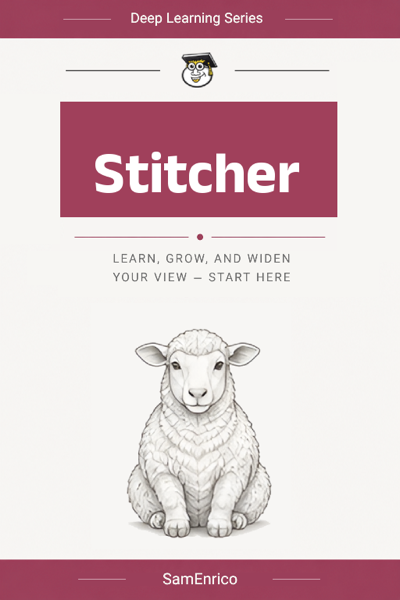
Non-FictionInformativeEducational
Stitcher eBook
A Coursebook on Stitcher
by Duke Britt
A Coursebook on Stitcher
Formats
Free sample
Chapter 1: The Stitcher’s First Thread...--Every mastery begins with a single, imperfect act. The first stitch you take will not be straight. The thread will knot when you least expect it. Your finger will find the point of the needle before the fabric does. This is not failure.
This is the stitcher’s first truth: proficiency is not born from talent but from the quiet accumulation of small corrections.You have picked up this book because something in you wants to make. Perhaps you remember the embroidery hoop your grandmother kept by her armchair, its fabric permanently stretched around a half-finished rose. Perhaps you have scrolled through images of thread-painted botanicals on social media, wondering if such beauty is achievable by ordinary hands. Perhaps you simply need to slow down in a world that has forgotten how. Whatever brought you here, know this: the skills you are about to learn have been passed from hand to hand for thousands of years, across every continent and culture.
You are joining a lineage that includes medieval nuns, Japanese workwear makers, Indian court artisans, and contemporary artists whose work hangs in museums.But before you can create beauty, you must understand your tools. The single biggest mistake new stitchers make is not a misplaced stitch or uneven tension—it is buying the wrong materials. Walking into a craft store without preparation is like entering a kitchen without knowing the difference between a chef’s knife and a paring knife. You will leave with a jumble of supplies that fight against you rather than serve you. This chapter exists to prevent that.
By the time you finish these pages, you will know exactly which needle to reach for, which thread behaves predictably under your fingers, and which fabric will hold your stitches without puckering or tearing.More importantly, you will assemble the one tool that no store sells: your personal sampler portfolio. This will become the backbone of your entire stitching education. Each subsequent chapter in this book will instruct you to stitch on a specific numbered swatch from this portfolio. By the final chapter, you will hold in your hands a complete record of every technique in this book—a tangible map of your transformation from novice to stitcher.Let us begin.The Philosophy of Tools: Why Your Materials Matter Before we examine individual tools, a word about the relationship between stitcher and material. Embroidery is not like painting.
A painter can scrape away a mistake or paint directly over it. A stitcher cannot. Every hole your needle makes in the fabric is permanent. Every thread you pull leaves a record of its passage. This is why choosing the right tool for each task is not pedantry—it is the difference between a project that flows joyfully from your hands and one that fights you at every turn.The best stitchers develop an almost intuitive sense of material behavior.
They know that silk thread slips through fabric like water, while wool grips and fills. They know that a dull needle does not cut cleanly through linen but instead pushes the weave aside, creating a distorted hole that never quite recovers. These are not arcane secrets. They are observations you can learn in an afternoon, provided someone shows you what to look for.This chapter honors two traditions simultaneously. Some of the finest embroidery in history used the most precious materials available—silks from China, gold threads from Italy, linens from Flanders.
Other traditions, equally rich, emerged from thrift and necessity: Sashiko stitchers reinforcing worn indigo with scavenged cotton, Kantha makers layering discarded saris into new textiles with nothing but running stitch. Neither approach is superior. Each serves a different purpose. In the first half of this book, you will work with new, predictable materials that teach you control. In the second half, you will explore sustainable stitching using upcycled and found objects.
The stitcher who knows both traditions is the stitcher who can make anything from anything.Needle Anatomy: The Most Overlooked Tool The needle is the simplest of all stitcher’s tools—a slender shaft of steel with a point at one end and an eye at the other—yet no tool is more frequently misunderstood. Most beginners buy a multi-pack of “assorted needles” and then wonder why their stitches look uneven or why the fabric puckers. The truth is that needles are specialized instruments, and using the wrong one is like using a screwdriver to hammer a nail: it will work poorly, and something will eventually break.The Five Needle Families You Will Use Sharps needles are the most common sewing needles, medium-length with a round eye and a very sharp point. They are designed to pierce woven fabrics cleanly, slipping between fibers rather than tearing them. Use sharps for general embroidery on linen, cotton, and silk when you are not counting threads.
They are the default needle for Chapters 2 through 4 and Chapters 6 through 12 unless otherwise specified.Crewel needles look nearly identical to sharps but have a longer eye. This seemingly minor difference is crucial: the longer eye accommodates thicker threads like wool and multiple strands of floss without fraying. The name comes from crewel embroidery, which uses wool thread exclusively. Use crewel needles whenever you stitch with two or more strands of cotton floss, any wool thread, or ribbon. You will need them for Chapter 9’s crewel project.Tapestry needles are the exception to the sharp-point rule.
They have a blunt, rounded tip and a large, elongated eye. The blunt tip pushes between the threads of evenweave fabric rather than piercing them. This makes tapestry needles essential for counted thread work on Aida cloth or linen evenweave, where you need to slide the needle into pre-existing holes without damaging the fabric grid. Use tapestry needles for Chapter 5’s blackwork and Chapter 10’s Sashiko. Never use a sharp needle on counted fabric—it will split threads and destroy your pattern.Milliners needles are the longest and thinnest of all embroidery needles, with a small eye and a perfectly uniform shaft from point to eye.
They are designed for French knots and bullion stitches because the consistent thickness allows wrapped thread to slide off the needle smoothly. Without a milliners needle, bullion knots become nearly impossible. You will need one for Chapter 7’s advanced knot work.Beading needles are extremely fine and flexible, with tiny eyes that barely admit a single strand of thread. They are designed to pass through the center hole of seed beads multiple times. They bend easily and break if forced, so handle them gently.
Beading needles are required for Chapter 4’s bead attachment and Chapter 7’s sequin work.Needle Sizes and When to Use Them Needles are numbered inversely: the larger the number, the finer (thinner and shorter) the needle. A size 10 sharps is extremely fine, suitable for high-count linen and silk. A size 3 sharps is thick and sturdy, suitable for heavy fabrics like denim or canvas.For most work in this book, a size 7 or 8 sharps or crewel needle will serve you well. For counted thread work on 14-count Aida or 28-count evenweave, use a size 24 tapestry needle. For higher-count fabrics (18-count…
This is the end of the free sample. Get the eBook to keep going. Buy now
About this book
Details
- Author
- Duke Britt
- Publisher
- SamEnrico
- Language
- English
- Genre
- Non-Fiction, Informative, Educational
- Released
- 2026-05-04
- Pages (approx.)
- 148
- Available as
- eBook, Audiobook

Read better in the ZLOADR app
Your eBooks on your phone or tablet. Sign in with your SamEnrico account and start reading.
More by Duke Britt
 Walking Meditation for VertigoDuke Britt$11.99
 Generalized Anxiety Symptom TrackerDuke Britt$11.99
 Travel Habit Formation GuideDuke Britt$11.99
 Nobel Laureates In Click ChemistryDuke Britt$11.99
 Innovation Ambition MapDuke Britt$11.99
 The Great Airline Heist: How a Single Flight Changed Aviation ForeverDuke Britt$11.99
 Galahad's Unfinished Vow: The Knight Who Chose the GrailDuke Britt$11.99
 State Annual Report Compliance GuideDuke Britt$12.99
 BPO Email Support GuideDuke Britt$12.99
 Understanding Grover's DiseaseDuke Britt$17.99
 How to Become a CleanerDuke Britt$11.99
You may also like
 Hong Kong Handover 1997Dunn Johnnie$11.99
 Zumba For Postnatal Recovery CourseNeal Christian$11.99
 Zumba for BeginnersLadner Nikia$11.99
 YouTube Comment Mining GuideHumes Pandora$12.99
 Worry Box MeditationCarlin Rudy$11.99
 Workplace Stress MeditationNguyen Lynn$11.99
 Workplace Stress and Sleep RepairHawley Ivory$11.99
 Workplace Perfectionism CureDelaney Jeffry$11.99
 Workplace Injustice Anger GuideWallen Isabelle$11.99
 Work Addiction and Burnout LinkGreenwood Ester$11.99
 Women in Yoga and WellnessBeattie Galina$11.99
 Women in Stand Up ComedyChun Evangeline$11.99