
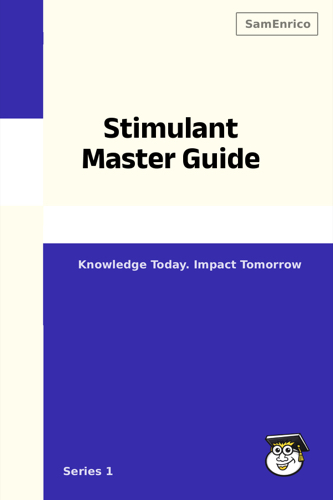
Non-FictionHealth & WellnessComplete
Stimulant Master Guide eBook
Complete reference for cocaine and meth use disord
Complete reference for cocaine and meth use disorder.
Formats
Free sample
Chapter 1: Beyond the Rush--Most people believe they understand addiction. They picture a person hunched in a dark alley, needle in arm, having lost everything years ago. They imagine a moral failure, a weakness of character, a series of bad choices finally catching up. What they do not imagine is the surgeon who maintains a perfect professional facade while secretly using methamphetamine to survive back-to-back twenty-four-hour shifts. They do not picture the suburban mother who snorts cocaine in her minivan after carpool because it is the only thing that makes her feel alive.
They do not see the college president who crushes and snorts Adderall to grade papers, write speeches, and raise millions, all while telling himself he is different from “real” addicts.I have sat across from all of these people. I have listened to their stories, read their medical charts, held their hands in emergency rooms, and buried some of them. And the single most important lesson I have learned is this: stimulant use disorder does not look the way you think it looks. It does not announce itself with obvious warning signs. It does not respect income, education, or professional success.
It does not give you time to prepare before it destroys everything. The first chapter of this book is not about treatment or recovery strategies. It is about seeing clearly—stripping away the myths, confronting the data, and understanding the true nature of the crisis that has brought you to these pages.The Hidden Epidemic In 2023, the United States recorded more than 110,000 drug overdose deaths. Of those, over 60 percent involved synthetic opioids like fentanyl. But here is what the headlines miss: stimulants—cocaine and methamphetamine—were involved in nearly 60,000 of those deaths.
That is right. Stimulants killed almost as many people as opioids, yet they receive a fraction of the public attention, research funding, and treatment resources. This is the hidden epidemic. It unfolds in emergency rooms, psychiatric wards, homeless shelters, and morgues, but it rarely makes the evening news unless a celebrity is involved or a particularly gruesome crime captures public attention.The invisibility of stimulant use disorder is both a cause and a consequence of widespread misunderstanding. Because stimulant withdrawal is not typically life-threatening in the way alcohol or benzodiazepine withdrawal can be, the medical establishment has historically treated it as less urgent.
Because there are no FDA-approved medications for stimulant use disorder comparable to methadone or buprenorphine for opioids, pharmaceutical companies have little financial incentive to invest in research or advocacy. Because the most effective psychosocial treatment—Contingency Management, which rewards abstinence with vouchers or prizes—is not widely covered by insurance, most clinicians default to approaches that were designed for other substances and work poorly for stimulants. The result is a treatment landscape that is decades behind where it should be.But the invisibility also stems from the nature of the drugs themselves. Opioids produce profound physical dependence; withdrawal involves vomiting, diarrhea, bone pain, and an overwhelming sense of doom. Stimulants produce less dramatic physical withdrawal, but the psychological withdrawal is savage.
Anhedonia—the complete inability to feel pleasure—can persist for months or years. Fatigue is crushing. Concentration evaporates. The person in stimulant withdrawal does not look sick in the way a person in opioid withdrawal looks sick. They look depressed, unmotivated, lazy.
And because our culture confuses visible suffering with legitimate illness, stimulant users are judged more harshly. They are told to “snap out of it,” to “try harder,” to “just stop.” These commands reveal a fundamental misunderstanding of the neurobiology at work, which we will explore in depth in Chapter 3. For now, understand this: the absence of visible suffering does not mean the absence of real disease.The Person Versus The Stereotype Let me introduce you to three people. Their names and identifying details have been changed, but their stories are real. I have treated them, and their experiences are more common than you might think.Marcus is a forty-seven-year-old electrician.
He started using methamphetamine ten years ago, not to get high but to work. His job requires long hours, physical stamina, and the ability to focus on complex wiring diagrams. He discovered that a small amount of meth allowed him to work sixteen-hour days for weeks at a time, taking on overtime and double shifts that boosted his income significantly. He told himself he was being responsible, providing for his family, using a tool rather than abusing a drug. By the time he sought treatment, he had lost his marriage, his job, and custody of his teenage daughter.
The meth had stopped working as a performance enhancer years ago, but he could not stop using it even though it now produced nothing but paranoia and exhaustion. Marcus is not a stereotype. He is a skilled tradesman who fell into addiction through the door of productivity.Priya is a thirty-four-year-old emergency medicine physician. She graduated near the top of her medical school class, completed a competitive residency, and was widely respected by her colleagues. She also had undiagnosed ADHD.
The long hours, high stakes, and constant interruptions of the emergency department overwhelmed her executive function. A colleague offered her Adderall during a particularly brutal shift, and for the first time in her life, her mind felt quiet and organized. She could see patients, write notes, and make decisions without the constant mental noise that had always plagued her. She began taking Adderall daily, then crushing and snorting the extended-release formulation for a faster onset. She switched to cocaine when her prescription ran out, then to methamphetamine when cocaine became too expensive.
She eventually lost her medical license, not because she made a clinical error but because she was caught diverting drugs from the hospital pharmacy. Priya is not a stereotype. She is a highly trained physician whose unrecognized ADHD led her down a path she never intended to travel.Tyrone is twenty-two years old. He grew up in a small rural town in West Virginia, the son of a coal miner disabled by black lung disease. He started using prescription opioids at sixteen, following the pattern of many of his friends and family members.
When prescription opioids became harder to obtain, he switched to heroin. When heroin became too dangerous due to fentanyl contamination, he switched to methamphetamine, which was cheap, available, and seemed less likely to kill him immediately. He never intended to use methamphetamine. He does not particularly enjoy it. But he uses it because the alternative—opioid withdrawal—is intolerable, and he cannot access buprenorphine treatment due to the nearest clinic being two hours away and his lack of health insurance.
Tyrone is not a stereotype. He is a young man caught in the collision of two epidemics, opioid and stimulant, without the resources to escape either.Marcus, Priya, and Tyrone have little in common demographically. They differ in age, race, profession, geography, and life circumstances. But they share one crucial feature: none of them fit the public image of a “drug addict.” None of them started using because they wanted to get high. None of them lost everything overnight.
None of them responded to the standard treatment approaches that work well for other substances. Their stories matter because they…
This is the end of the free sample. Get the eBook to keep going. Buy now
About this book
Details
- Author
- Higdon Sherrie
- Publisher
- SamEnrico
- Language
- English
- Genre
- Non-Fiction, Health & Wellness, Complete
- Released
- 2026-06-05
- Pages (approx.)
- 137
- Available as
- eBook, Audiobook

Read better in the ZLOADR app
Your eBooks on your phone or tablet. Sign in with your SamEnrico account and start reading.
More by Higdon Sherrie
 Shift Work Alcohol Sleep ImpactHigdon Sherrie$11.99
 Yogi Hypnosis for AsanasHigdon Sherrie$11.99
 Personalization Cognitive ShiftHigdon Sherrie$11.99
 Fear of Failure in Weight LossHigdon Sherrie$11.99
 Weight Loss Hormone BalanceHigdon Sherrie$11.99
 Vendor Negotiation ConversationsHigdon Sherrie$11.99
 The Ballad of the Piano Man: How a Forgotten Genius Changed Music ForeverHigdon Sherrie$11.99
 Anansi Weaves the Sky: The Spider’s Grand DeceptionHigdon Sherrie$11.99
 How to Start a Magnetic Recording Head Business (Beginners Guide)Higdon Sherrie$11.99
 The Essential Guide to RomanticHigdon Sherrie$11.99
 Pea, Wrinkled: Smooth Vs. Wrinkled PeaHigdon Sherrie$11.99
 Jumia Pay on Delivery vs Amazon Credit Card GuideHigdon Sherrie$12.99
You may also like
 Hong Kong Handover 1997Dunn Johnnie$11.99
 Zumba For Postnatal Recovery CourseNeal Christian$11.99
 Zumba for BeginnersLadner Nikia$11.99
 YouTube Comment Mining GuideHumes Pandora$12.99
 Worry Box MeditationCarlin Rudy$11.99
 Workplace Stress MeditationNguyen Lynn$11.99
 Workplace Stress and Sleep RepairHawley Ivory$11.99
 Workplace Perfectionism CureDelaney Jeffry$11.99
 Workplace Injustice Anger GuideWallen Isabelle$11.99
 Work Addiction and Burnout LinkGreenwood Ester$11.99
 Women in Yoga and WellnessBeattie Galina$11.99
 Women in Stand Up ComedyChun Evangeline$11.99