
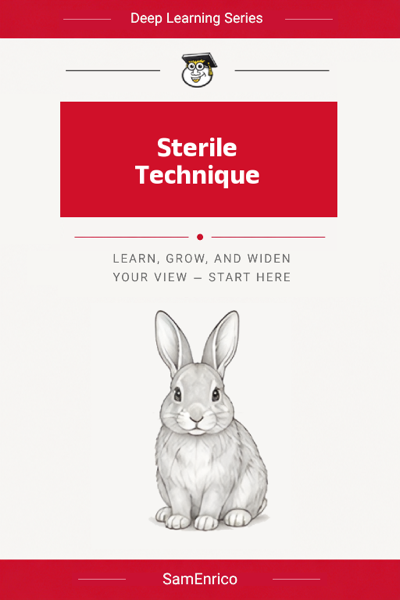
Non-FictionInformativeEducational
Sterile Technique eBook
A Coursebook on Sterile Technique
A Coursebook on Sterile Technique
Formats
Free sample
Chapter 1: The Last Clean Hands...--The last thing twenty-three-year-old Maya Rodriguez remembered was the cold weight of the IV bag being hung on her pole. She had been admitted to a prestigious university hospital for what should have been routine nutritional support—total parenteral nutrition, or TPN—after complications from Crohn's disease made it impossible for her to eat. The TPN was supposed to save her life. Instead, it became the vector for her death.Eleven days later, Maya was gone. Not from Crohn's.
Not from surgery. From Aspergillus fumigatus, a common mold found in soil, in the air, on old bread, and—as the investigation would later reveal—inside the pharmacy cleanroom where her TPN had been compounded. The mold had traveled from a damp HEPA filter housing, through the supposedly sterile air, into the open vials, and finally into Maya's bloodstream. She developed fungal sepsis. Her fever spiked to 106°F.
Her blood pressure collapsed. Antifungal drugs arrived too late.The pharmacy had passed its last inspection three weeks earlier.This is not a story about negligence in some underfunded, rural clinic. Maya's hospital was a top-tier academic medical center with a sterling reputation. This is a story about the gap between what we think we know about sterile technique and what we actually do every day. It is a story about the invisible world that surrounds us—a world teeming with life so small that a million of them could dance on the head of a pin, yet so deadly that a single one, in the wrong place, can end a life.This book is about closing that gap.
And it begins with understanding the enemy you cannot see.The Invisible Battlefield Every day, in operating rooms, pharmacies, and manufacturing facilities around the world, a war is being fought. The battlefield is every surface, every instrument, every vial, every drop of fluid that will enter a patient's body. The enemy is not a foreign army or a terrorist cell. The enemy is microscopic, ancient, and extraordinarily resilient. The enemy is the microbial world.To practice sterile technique is to wage war on a scale so small that most of us never truly grasp its dimensions.
Consider this: if you were to enlarge the average bacterium to the size of a grain of rice, a human hair would be as thick as a fire hose. A surgical glove would be the size of a circus tent. The needle on a syringe would be a pipe wide enough to drive a truck through. In this scaled-up world, the barriers we rely on—gloves, drapes, hoods, filters—suddenly look less like Fort Knox and more like a chain-link fence.Yet the microbes are not just small. They are everywhere.
On your skin right now, there are approximately one trillion bacteria. That is not a typo. One trillion. In the single square centimeter of skin on your fingertip, there are more bacteria than there are people in the United States. Most of them are harmless, even beneficial.
Some of them, given the opportunity, will kill you.The job of sterile technique is not to eliminate every microbe from the face of the earth. That would be impossible. The job is to prevent the wrong microbes from entering the wrong places in the wrong numbers. A single Staphylococcus aureus bacterium falling into an open surgical wound may be cleared by the patient's immune system without incident. A hundred thousand of them, delivered directly into the bloodstream via a contaminated IV line, can cause septic shock and death within hours.This is the mathematics of infection.
And it is unforgiving.Classifying the Enemy: The Microbial Rogues' Gallery To fight an enemy, you must know its weapons, its weaknesses, and its methods of attack. The microbial world is vast—millions of species, most of which have never been studied. But for the purposes of sterile technique, we can group the relevant pathogens into four major categories, arranged here from least to most resistant to destruction.Vegetative Bacteria: The Common Invaders Vegetative bacteria are the ones most people think of when they hear the word "germ." They are single-celled organisms that grow, divide, and metabolize in a continuous life cycle. They are vegetative—actively living and growing—as opposed to dormant. Examples include Staphylococcus aureus (the cause of most surgical site infections), Escherichia coli (a common contaminant of urinary catheters and abdominal surgeries), Pseudomonas aeruginosa (a water-loving organism that thrives in hospital plumbing and causes devastating infections in burn patients), and Streptococcus pyogenes (the "flesh-eating" bacterium).Vegetative bacteria are, relatively speaking, easy to kill.
Heat, alcohol, bleach, hydrogen peroxide, and most disinfectants will destroy them within seconds or minutes. Their Achilles' heel is their active metabolism: they need water, nutrients, and a narrow range of temperatures to survive. Denature their proteins, disrupt their cell membranes, or oxidize their DNA, and they die.But do not underestimate them. A single S. aureus bacterium, given the right conditions, can divide every twenty minutes.
Within twenty-four hours, one bacterium can become 4.7 trillion. This is not abstract mathematics. This is why a single breach of sterile technique—one touch of a non-sterile glove to a sterile catheter hub—can seed an infection that will days later fill a patient's bloodstream with billions of organisms.Bacterial Spores: The Sleeping Giants If vegetative bacteria are the enemy's infantry, spores are its special forces in deep hibernation. When certain bacteria—most notably the Bacillus and Clostridium species—face environmental stress (lack of water, extreme heat, toxic chemicals), they undergo a remarkable transformation. They form an endospore: a dormant, highly resistant structure that contains the bacterium's DNA and a small amount of cytoplasm, surrounded by a thick, multilayered coat of proteins and a unique molecule called calcium dipicolinate.The spore is not dead.
It is sleeping. And it can sleep for centuries.Spores of Bacillus anthracis (anthrax) have been recovered from burial sites of animals that died decades earlier. Spores of Clostridium tetani (tetanus) can survive in soil for forty years. Spores of Clostridium botulinum (botulism) can withstand boiling water for hours. This is not speculation.
This is the reason your autoclave must reach 121°C (250°F) under pressure—the spores of Geobacillus stearothermophilus (formerly known as Bacillus stearothermophilus), the gold standard biological indicator for sterilization, will not die at lower temperatures.Note the name change. Geobacillus stearothermophilus is the modern taxonomic classification. You may encounter the older name, Bacillus stearothermophilus, in existing literature and older protocols. The organism has not changed; our understanding of its evolutionary relationships has. Throughout this book, we will use the correct modern name, but you should recognize both.The clinical significance of spores is profound.
A surgical instrument that has been wiped with alcohol and left to air-dry may be free of vegetative bacteria. But if it was contaminated with spores—from soil, from a patient's bowel, from a previous surgery—the alcohol did nothing to them. Only heat, ethylene oxide gas, hydrogen peroxide plasma, or high-intensity radiation will kill spores reliably. This is why "sterilization" means something different from "disinfection." Disinfection kills vegetative bacteria. Sterilization kills everything, including spores.Viruses: The Molecular Parasites Viruses occupy a strange borderland between living and…
This is the end of the free sample. Get the eBook to keep going. Buy now
About this book
Details
- Author
- Pringle Angila
- Publisher
- SamEnrico
- Language
- English
- Genre
- Non-Fiction, Informative, Educational
- Released
- 2026-05-18
- Pages (approx.)
- 155
- Available as
- eBook, Audiobook

Read better in the ZLOADR app
Your eBooks on your phone or tablet. Sign in with your SamEnrico account and start reading.
More by Pringle Angila
 IBS And Celiac Disease Double Diagnosis CoursePringle Angila$11.99
 The Climate MayorPringle Angila$11.99
 LSE Online Student Mental HealthPringle Angila$11.99
 PLG Metric Mastery GuidePringle Angila$11.99
 Burke and Wills: The Ghosts of Cooper CreekPringle Angila$11.99
 Healthcare Digital Payment OutlookPringle Angila$12.99
 Fundraising Runway Trigger HandbookPringle Angila$12.99
 Understanding Hydrocephaly Low Insertion UmbilicusPringle Angila$17.99
 How to Become a Screen MakerPringle Angila$11.99
You may also like
 Hong Kong Handover 1997Dunn Johnnie$11.99
 Zumba For Postnatal Recovery CourseNeal Christian$11.99
 Zumba for BeginnersLadner Nikia$11.99
 YouTube Comment Mining GuideHumes Pandora$12.99
 Worry Box MeditationCarlin Rudy$11.99
 Workplace Stress MeditationNguyen Lynn$11.99
 Workplace Stress and Sleep RepairHawley Ivory$11.99
 Workplace Perfectionism CureDelaney Jeffry$11.99
 Workplace Injustice Anger GuideWallen Isabelle$11.99
 Work Addiction and Burnout LinkGreenwood Ester$11.99
 Women in Yoga and WellnessBeattie Galina$11.99
 Women in Stand Up ComedyChun Evangeline$11.99