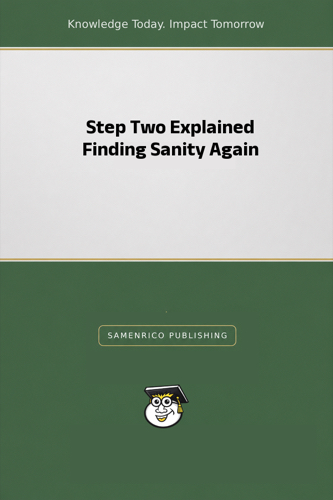
Step Two Explained Finding Sanity Again eBook
Restore hope and believe that a higher power can h
by Pence Sol
Restore hope and believe that a higher power can help restore mental balance.
Formats
Free sample
Chapter 1: The Broken Leash...--–- The dog had been barking for three hours. It was a medium-sized mutt, the kind you’d find in a shelter and feel virtuous about adopting, and it had wrapped its leash around the leg of a wrought-iron table on the back porch. The table was now tipped over. A ceramic pot had shattered. The dog could see the open gate—freedom, grass, the squirrel it had been chasing—just twelve feet away.
But every time it lunged forward, the leash pulled it back. So it barked. And lunged. And barked. And lunged.
After three hours, the dog was exhausted, hoarse, and still tied to the same table.You are that dog.Not because you’re stupid. Not because you lack willpower. Not because you’re morally defective. You are that dog because you have been trying to solve a problem with the same mind that created it, and every solution you have attempted has only tightened the leash. You have tried to drink less.
You have tried to use less. You have tried to control your anger, your spending, your eating, your gambling, your scrolling, your obsessing. You have made promises. You have broken them. You have made better promises.
You have broken those too. You have bargained: “Just on weekends.” You have rationalized: “Everyone else does it.” You have minimized: “At least I’m not as bad as so-and-so.” And through all of it, you have remained convinced that if you just tried harder, if you just found the right strategy, if you just wanted it badly enough—you could fix yourself.This is the illusion of control. And it is the single greatest obstacle between you and sanity.The Myth of the Self-Sufficient Self We live in a culture that worships autonomy. From the moment we are old enough to tie our own shoes, we are told that independence is the highest virtue. “Pull yourself up by your bootstraps.” “Take responsibility for your own life.” “No one is coming to save you.” These maxims are not entirely wrong.
Adult life requires a baseline of self-regulation, accountability, and initiative. You should pay your bills. You should show up to work. You should not expect the world to carry you. But somewhere along the way, this healthy respect for personal responsibility metastasized into something toxic: the belief that any problem can be solved by the same mind that created it.Addiction and compulsive behaviors expose this belief as a lie.Think about the last time you tried to quit something on your own.
Maybe it was alcohol. Maybe it was nicotine. Maybe it was a person you kept texting despite knowing they were bad for you. Maybe it was the phone you swore you would put down at 10 p.m., only to look up at 2 a.m., eyes burning, shame pooling in your stomach. You made a decision.
The decision lasted exactly as long as it took for the craving to arrive. And then the decision evaporated, and you were left wondering: Who made that choice? Was it me? Or was it something else?This is not a failure of character. It is a failure of scale.The mind that developed the addiction is the same mind that tries to break it.
That mind has been shaped by repetition, by neurochemical conditioning, by trauma responses, by years of reinforced neural pathways. Asking that mind to simply “decide differently” is like asking a river to stop flowing downstream because it has decided to flow upstream instead. The river doesn’t lack willpower. The river is following the path of least resistance, the same path it has carved over years and years. And so are you.Functional Control vs.
Addictive Control Let’s be precise about what we mean by control, because the word gets thrown around sloppily in recovery literature. There is a kind of control that works. Call it functional control. This is the ability to manage the ordinary tasks of daily life: showing up on time, paying rent, cooking dinner, brushing your teeth. Functional control is real, and you probably have more of it than you give yourself credit for.
You haven’t lost your job (yet). You haven’t burned down your house (yet). You can still perform the basic operations of adulthood, even if you’re white-knuckling through most of them.Then there is addictive control. This is the belief that you can use a substance or engage in a behavior without negative consequences, despite overwhelming evidence to the contrary. Addictive control says: “I can have just one drink.” Addictive control says: “I’ll only gamble with money I can afford to lose.” Addictive control says: “This time will be different.” Addictive control is not control at all.
It is a fantasy masquerading as a plan.Here is the diagnostic question that separates functional control from addictive control: If you are honest with yourself, has your behavior ever produced a consequence you swore you would avoid—and then you did it anyway?If the answer is yes, you are dealing with addictive control. And addictive control is not something you can think your way out of, because the thinking itself is the problem.The Paradox of More Effort One of the cruelest features of addictive control is that it responds to failure by demanding more effort. You relapse, so you tighten your rules. You overspend, so you download another budgeting app. You binge-eat, so you start a stricter diet.
You scroll for four hours, so you install a screen-time blocker with a password you give to a friend. And each time you apply more effort, you feel a temporary sense of righteousness. This time I’m serious. This time I’ve got the right system.Then the system fails. And the cycle repeats.This is what the Twelve Steps mean by “unmanageability.” It is not that your life has collapsed into visible chaos—though for some readers, it has.
Unmanageability is the quieter, more insidious experience of trying and failing, trying and failing, trying and failing, all while maintaining the illusion that you are still in charge. You are the dog barking at the gate, convinced that if you just bark louder, the leash will break.But leashes do not break from barking. They break when someone unties them.The Role of Willingness (Not Yet Surrender)Let me make a critical distinction before we go any further. This chapter is not asking you to surrender. Surrender—the active decision to turn your will and life over to a Higher Power—belongs to Step Three.
We are still in Step Two, which is about belief that a Higher Power can restore you to sanity. Surrender is an action. Willingness is a posture. And willingness is what we are after right now.Willingness looks like this: “I don’t know if anything outside myself can help me, but I am willing to find out.”Willingness looks like this: “My way has not worked, and I am no longer going to pretend that more effort is the answer.”Willingness looks like this: “I will read this book. I will consider the possibility that I am not the…
This is the end of the free sample. Get the eBook to keep going. Buy now
About this book
Details
- Author
- Pence Sol
- Publisher
- SamEnrico
- Language
- English
- Genre
- Non-Fiction, Self-Help, Spiritual Growth
- Released
- 2026-06-09
- Pages (approx.)
- 150
- Available as
- eBook, Audiobook

Read better in the ZLOADR app
Your eBooks on your phone or tablet. Sign in with your SamEnrico account and start reading.
More by Pence Sol
 Ketamine for AddictionPence Sol$11.99
 Equifax Settlement Payout FarcePence Sol$11.99
 Listener Responsiveness TrackingPence Sol$11.99
 Growth Hormone in Children vs AdultsPence Sol$11.99
 Retirement Goal PlanningPence Sol$11.99
 Goal Setting for SeniorsPence Sol$11.99
 Anniversary of Parent DeathPence Sol$11.99
 The Last Letter from HiroshimaPence Sol$11.99
 The Velvet Revolution: How Jazz Legends Redefined Middle Eastern Fashion (1980-2000)Pence Sol$11.99
 How to Produce Medicine BallsPence Sol$11.99
 Post Scholarship Career GuidePence Sol$12.99
 State Employment Law TrapPence Sol$12.99