
Non-FictionSelf-HelpStep Parenting
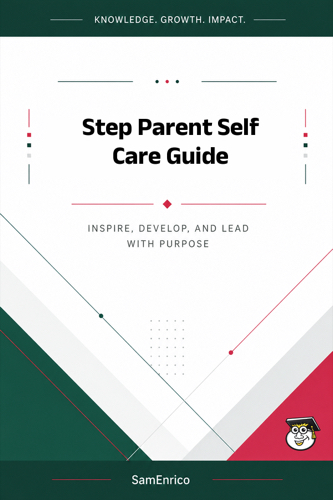
Step Parent Self Care Guide eBook
Navigate blended family stress without burning out
Navigate blended family stress without burning out.
Formats
Free sample
Chapter 1: The Panther in the Pantry--You are standing in your own kitchen at 9:17 on a Tuesday night. The dishwasher is humming. The leftover pasta has hardened on the stove. Upstairs, your partner is reading a bedtime story to their children—not your children, not really, even though you have lived here for fourteen months and you help with homework and you know which toothbrush belongs to which kid. You are crying into a box of stale crackers.
Not sobbing. Just leaking. A quiet, exhausted leak that you have become disturbingly good at hiding. You wipe your face with a paper towel, take a breath, and walk back into the living room as if nothing happened. Nobody noticed you left.
Nobody noticed you returned.This is the panther in the pantry. Not a literal animal, of course. It is the name for that private, hidden collapse that stepparents learn to perform alone, in small spaces, between the tasks of holding together a family that does not always feel like yours. The pantry is a metaphor, but the crying is real. So is the exhaustion.
So is the quiet, creeping thought that you might be failing at something you were never actually trained to do.If you are reading this book, you have probably met the panther. Maybe you cried in the car after a custody exchange. Maybe you sat in the bathroom with the shower running just to have five minutes where nobody needed anything from you. Maybe you have started to feel numb during family dinners, going through the motions while something inside you goes dark. This is not a sign that you are weak.
It is not a sign that you made a mistake by joining this family. It is a sign that you have been trying to run a marathon at a sprinter's pace, carrying a weight that was never meant to be carried alone, and your body and mind are sending you a message.This chapter is about naming that message. It is about dismantling the single most destructive myth in stepfamily life—the expectation that you should love your stepchildren as your own from day one—and replacing it with a different metric entirely. By the time you finish this chapter, you will have a new way of measuring your success as a stepparent. It will not involve how much your stepkids adore you.
It will not involve how seamlessly you have blended. It will involve something much simpler, much harder, and much more sustainable: your own internal peace.We need to start with the myth.The Fairy Tale That Kills Here is what nobody told you before you became a stepparent, or maybe they did tell you but you did not want to believe it: the expectation of instant love is a lie. It is a well-meaning lie, often repeated by people who have never been stepparents themselves, but a lie nonetheless. Society, movies, your own well-meaning mother, and even your partner may have fed you the same script: If you just try hard enough, the love will come. If you just show up, the bond will form.
Give it time, be patient, and one day you will look at these children and feel exactly what their biological parent feels.This expectation creates a toxic shame spiral. When you do not feel that immediate, overwhelming bond—when you feel more like a manager than a mother, more like a roommate than a father—you assume something is wrong with you. You assume you are cold, or broken, or incapable of love. And because you assume something is wrong with you, you try harder. You overcompensate.
You buy gifts you cannot afford. You plan elaborate outings that exhaust you. You say yes to everything. You smile through resentment. You burn yourself to ash trying to generate a feeling that cannot be forced into existence.And then, when the stepchildren still do not love you back the way you imagined, you collapse.
You cry in the pantry. You wonder if you should leave. You wonder if you are a bad person.Here is the truth: you are not a bad person. The timeline is broken.The expectation of instant love comes from nuclear family logic, where a parent holds a newborn and experiences a biochemical flood of oxytocin designed by millions of years of evolution to ensure the survival of the species. That is real.
That is powerful. And you do not have it. You entered this family after the children already had years of history, inside jokes, loyalties, and wounds. You are not a newborn to them. And they are not a newborn to you.
Expecting the same bond is like expecting a tomato plant to produce fruit in three days because a strawberry plant does. Different soil. Different season. Different rules.The Cat Theory of Bonding Let me introduce you to a concept that will save your life as a stepparent. I call it the Cat Theory.Think about dogs for a moment.
Dogs are engineered by centuries of domestication to love you immediately. A dog you meet at the park will wag its tail, lick your hand, and follow you home within ten minutes. Dogs are desperate to be loved. They wear their hearts on their furry sleeves. If you want a dog to like you, you run toward it with open arms and excited energy, and the dog will match your enthusiasm.
Dog love is fast, eager, and unconditional.Now think about cats. Cats are different. A cat you meet for the first time will not run toward you. It will sit across the room and observe. It might slowly blink at you, which is a sign of cautious curiosity.
If you walk toward a cat too quickly, the cat will run away. If you try to pick up a cat before it trusts you, you will get scratched. Cats bond on their own timeline. They need to observe you from a distance, decide that you are safe, and slowly—over weeks or months—choose to approach you. You cannot force a cat to love you.
You can only create a safe environment and wait.Stepchildren are cats. They are not dogs.When you try too hard to force love or approval from stepchildren, you trigger their defensive instincts. They have already experienced loss—divorce, separation, the departure of a parent from the home. Their nervous systems are wired for self-protection. When a new adult shows up with big smiles and forced enthusiasm and elaborate gifts, a stepchild does not think, How wonderful, a new parent!
They think, What does this person want? Why are they trying so hard? When will they leave like the last one?This is not rejection. It is survival.The radical solution that emerges from the Cat Theory is this: stop trying to love them. I do not mean be cold or cruel.
I mean stop forcing the feeling. Stop measuring yourself against the instant-love myth. Stop trying to manufacture an emotion that cannot be manufactured. Instead, aim for something smaller, more achievable, and more sustainable: respectful coexistence.Let affection develop naturally over years, not weeks. Some stepparents never…
This is the end of the free sample. Get the eBook to keep going. Buy now
About this book
Details
- Author
- Dunaway Lillia
- Publisher
- SamEnrico
- Language
- English
- Genre
- Non-Fiction, Self-Help, Step Parenting
- Released
- 2026-06-09
- Pages (approx.)
- 143
- Available as
- eBook, Audiobook

Read better in the ZLOADR app
Your eBooks on your phone or tablet. Sign in with your SamEnrico account and start reading.
More by Dunaway Lillia
 Men Means Restriction SafetyDunaway Lillia$11.99
 Self Hypnosis For IBS ReliefDunaway Lillia$11.99
 Fear Of Darkness Treatment GuideDunaway Lillia$11.99
 Maca Root GuideDunaway Lillia$11.99
 Pet Loss Bargaining GuideDunaway Lillia$11.99
 REIT Liquidity TrapDunaway Lillia$11.99
 Postpartum Mood SuggestionDunaway Lillia$11.99
 Voltaire’s War: The Pen That Defied Kings and TyrantsDunaway Lillia$11.99
 The Fur Trade Kings: Canada's Arctic PioneersDunaway Lillia$11.99
 International Trade & Finance Law: Tariffs, WTO & Export ControlsDunaway Lillia$11.99
 How to Become a Battery-wrecker OperatorDunaway Lillia$11.99
 A Collector's Handbook to the Alvis SaDunaway Lillia$11.99
You may also like
 Hong Kong Handover 1997Dunn Johnnie$11.99
 Zumba For Postnatal Recovery CourseNeal Christian$11.99
 Zumba for BeginnersLadner Nikia$11.99
 YouTube Comment Mining GuideHumes Pandora$12.99
 Worry Box MeditationCarlin Rudy$11.99
 Workplace Stress MeditationNguyen Lynn$11.99
 Workplace Stress and Sleep RepairHawley Ivory$11.99
 Workplace Perfectionism CureDelaney Jeffry$11.99
 Workplace Injustice Anger GuideWallen Isabelle$11.99
 Work Addiction and Burnout LinkGreenwood Ester$11.99
 Women in Yoga and WellnessBeattie Galina$11.99
 Women in Stand Up ComedyChun Evangeline$11.99