
Non-FictionSelf-HelpEmotional Processing
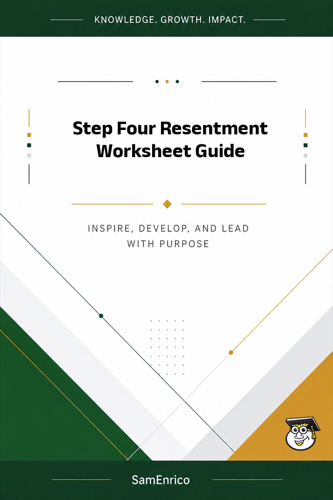
Step Four Resentment Worksheet Guide eBook
Break down resentments using columns and patterns.
by Whitlow Jay
Break down resentments using columns and patterns.
Formats
Free sample
Chapter 1: The Emotional Hangover...--–- Most people believe resentment is just anger that overstayed its welcome. They think a grudge is simply being mad at someone for a long time, and that if they could just “let it go” or “forgive and forget,” the problem would solve itself. This is wrong. And believing it keeps you sick.Resentment is not prolonged anger. Anger is a wildfire—intense, consuming, and relatively short-lived.
Resentment is the ash that smolders for years after the fire is gone. It is the compulsive, involuntary replaying of an injury long after the event has ended. It is the mental equivalent of picking a scab every single day and wondering why the wound never heals.This chapter redefines resentment from the ground up. You will learn why your brain prioritizes old hurts over new joys, why “just letting go” is neurologically impossible without a different approach, and how to detect resentment not as a thought but as a physical sensation. You will also meet the first tool of this book: The Body Scan Checklist.
By the end of this chapter, you will never look at a grudge the same way again.The Definition That Changes Everything In twelve-step recovery literature, resentment is often called “the number one offender” or “a rock that sinks sobriety.” These are useful metaphors, but they are not definitions. A definition tells you what something is, not just what it does.Here is the definition we will use throughout this book:Resentment is repeated suffering. It is the act of mentally rehearsing an injury so often that your brain treats the memory as a current threat, triggering the same stress response as the original event.Let me break that down. When something hurtful happens—someone lies to you, ignores you, betrays you—your brain encodes that event as a memory. That is normal.
What is not normal is when your brain flags that memory as still dangerous, months or years later, and replays it on a loop. Every time you replay the memory, your body releases cortisol and adrenaline. Every time, your jaw tightens, your stomach knots, and your heart rate spikes. You are not remembering pain. You are re-living it.This is why resentment is so exhausting.
You are not carrying one injury. You are carrying the same injury thousands of times.The Emotional Hangover Alcohol causes a physical hangover: dehydration, inflammation, disrupted sleep, and the dull throb of regret. Resentment causes an emotional hangover: the lingering exhaustion, irritability, hypervigilance, and low-grade depression that follows a resentment spiral.Here is how an emotional hangover feels:Waking up already tired because your brain spent the night replaying an argument from three years ago Feeling irritable with innocent people because you are still carrying the weight of an old wound Scanning every interaction for signs of the same betrayal, treating new people as guilty until proven innocent A sense of vague, nameless dread that never fully lifts Most people experiencing an emotional hangover do not connect it to resentment. They think they are just “in a bad mood” or “stressed out.” But the source is specific: a memory you have not stopped replaying.I once worked with a client we will call Maria. She had been resentful at her ex-husband for seven years.
The divorce was final. The children were grown. She had moved to a new city. And yet, every morning, she spent fifteen minutes mentally rehearsing the affair he had. “I can’t help it,” she said.
“It just plays in my head.” Maria was not suffering from the affair. The affair lasted six months. She was suffering from the replay, which had lasted seven years. Her emotional hangover was not from the original event—it was from the thousands of times she had re-injured herself by replaying it.The good news is that once you recognize the emotional hangover for what it is, you can do something about it. But first, you have to name it.The Replay Loop: Why Your Brain Hates Moving On Your brain has a negativity bias.
This is not a character flaw—it is a survival mechanism. Your ancient ancestors who paid more attention to threats (a rustle in the grass that might be a predator) were more likely to survive than those who paid more attention to pleasures (a beautiful sunset). As a result, the human brain is wired to prioritize negative information over positive information.Here is what that means for resentment: your brain treats a single betrayal as more important than a hundred acts of kindness. One lie from your partner outweighs ten honest conversations. One insult from your boss lingers longer than a month of praise.
This is not unfair. It is biology.The Replay Loop works like this:Something hurtful happens.Your brain encodes it as a threat memory.Your brain periodically “checks” whether the threat is still present.Because the memory is stored as a threat, your brain activates the stress response as if the event were happening now.The stress response strengthens the memory’s emotional charge, making it more likely to be replayed again.Repeat steps 3-5 indefinitely.This is a closed loop. The more you replay, the stronger the memory becomes. The stronger the memory becomes, the more you replay. Resentment is not a storage problem—you are not just remembering something.
Resentment is a rehearsal problem. You are practicing the injury every single time you replay it. And practice makes permanent.Consider this analogy. Imagine you have a song stuck in your head. The more you hum it, the more stuck it becomes.
The only way to get the song out of your head is to stop humming it. But you cannot force yourself to stop humming by sheer willpower—you have to replace it with another song, or distract yourself, or wait it out. The Replay Loop works the same way. You cannot think your way out of a resentment spiral. The part of your brain that replays the injury is not the same part that does logical reasoning.
You have to interrupt the loop physically and emotionally before you can change it mentally.Resentment Is Not Anger This distinction is so important that it deserves its own section. Anger and resentment are often confused, but they operate on completely different timelines and serve different functions.Anger is a single-event emotion. Someone cuts you off in traffic. You feel a flash of anger. Thirty seconds later, it fades.
Your boss criticizes your work unfairly. You feel angry for an hour. Then you move on. Anger has a beginning, a middle, and an end. It is designed to signal that a boundary has been crossed and to motivate you to address it.
Healthy anger lasts minutes to hours.Resentment is a relationship with a memory. It is not an emotion—it is a structure of repeated emotions. Resentment keeps you connected to an event long after the event is over. It is the unwillingness to let the past be the past. Resentment can last years, decades, or a lifetime.Here is a simple test to tell the difference: If you can describe the event without your body tightening…
This is the end of the free sample. Get the eBook to keep going. Buy now
About this book
Details
- Author
- Whitlow Jay
- Publisher
- SamEnrico
- Language
- English
- Genre
- Non-Fiction, Self-Help, Emotional Processing
- Released
- 2026-06-09
- Pages (approx.)
- 134
- Available as
- eBook, Audiobook

Read better in the ZLOADR app
Your eBooks on your phone or tablet. Sign in with your SamEnrico account and start reading.
More by Whitlow Jay
 HGH and Gut HealthWhitlow Jay$11.99
 Union Salary NegotiationWhitlow Jay$11.99
 Internal Audit Schedule CreationWhitlow Jay$11.99
 Recording Hypnosis for SleepWhitlow Jay$11.99
 Goal Setting for SalesWhitlow Jay$11.99
 Voltaire EnlightenmentWhitlow Jay$11.99
 Grief and Parenting After Parent LossWhitlow Jay$11.99
 The Silk Road Gambit: Han China's March to the West (138-126 BC)Whitlow Jay$11.99
 Whispers of the Forbidden Garden: The Enchantress of BabylonWhitlow Jay$11.99
 A Collector's Handbook to the Packard Standard 8 (1930-31)Whitlow Jay$11.99
 How to Produce Wooden and Pegged PuzzlesWhitlow Jay$11.99
 Growing AllosyncarpiaWhitlow Jay$11.99
You may also like
 Hong Kong Handover 1997Dunn Johnnie$11.99
 Zumba For Postnatal Recovery CourseNeal Christian$11.99
 Zumba for BeginnersLadner Nikia$11.99
 YouTube Comment Mining GuideHumes Pandora$12.99
 Worry Box MeditationCarlin Rudy$11.99
 Workplace Stress MeditationNguyen Lynn$11.99
 Workplace Stress and Sleep RepairHawley Ivory$11.99
 Workplace Perfectionism CureDelaney Jeffry$11.99
 Workplace Injustice Anger GuideWallen Isabelle$11.99
 Work Addiction and Burnout LinkGreenwood Ester$11.99
 Women in Yoga and WellnessBeattie Galina$11.99
 Women in Stand Up ComedyChun Evangeline$11.99