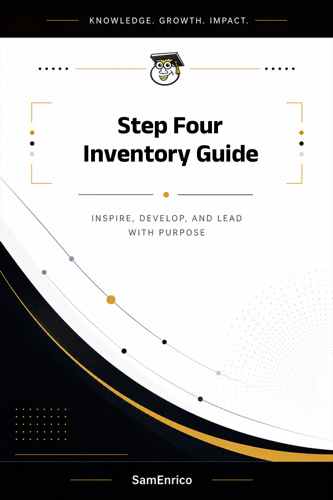
Step Four Inventory Guide eBook
Take a searching moral inventory of resentments, f
Take a searching moral inventory of resentments, fears, and harms without shame.
Formats
Free sample
Chapter 1: The Mirror's Invitation...--–- You are about to do something that most people will spend their entire lives avoiding. You are going to look at yourself. Not the curated version you post on social media. Not the brave face you wear at family dinners. Not the competent professional you pretend to be when your insides are crumbling.
You are going to look at the actual, unvarnished, sometimes embarrassing, often confusing, and entirely human collection of thoughts, feelings, resentments, fears, and behaviors that make up your interior life. And here is the radical promise of this book: that act of looking will not destroy you. It will set you free.If you are holding this book, you have likely already taken the first three steps of a Twelve Step program. You have admitted powerlessness. You have come to believe that a Power greater than yourself could restore sanity.
You have made a decision to turn your will and your life over to the care of that Power. Those steps are essential. They clear the wreckage. But Step Four is where the actual construction begins. Step Four is where you stop running and start building.
Step Four is where you pick up the tools and learn, for perhaps the first time in your life, how to be honestly and unapologetically yourself.The official language of Step Four, drawn from the original Twelve Steps of Alcoholics Anonymous, reads: "Made a searching and fearless moral inventory of ourselves." Those words—searching, fearless, moral, inventory—have stopped more people cold than any other sentence in recovery literature. They sound like a courtroom sentencing. They sound like a punishment. They sound like something a stern father would demand while you stood in the corner wearing a dunce cap. And because of that tone, millions of people have avoided Step Four.
They have stayed in the comfortable misery of Steps One through Three, circling the airport of recovery without ever landing the plane.This book exists because that tone is wrong. Not incorrect, but wrong for the human heart. The original authors of the Big Book were well-intentioned men writing in the 1930s, using the language of their era: moralistic, religious, and binary. Good versus evil. Right versus wrong.
Selfish versus unselfish. That language worked for some people. It saved lives. But for many others, it created a wall of shame that no amount of willingness could climb. They heard "moral inventory" and translated it as "prove what a piece of garbage you are." They heard "fearless" and translated it as "terrifying." They heard "searching" and translated it as "exhausting and never-ending."The Great Misunderstanding Let me name what you might be feeling right now, even if you have not yet put words to it.
You are afraid. That is not a weakness. That is not a lack of faith. That is your nervous system doing exactly what evolution designed it to do: protect you from perceived threats. And your psyche has decided, after years of experience, that looking too closely at yourself is a threat.
Why? Because somewhere along the way, you learned that who you really are is unacceptable.Maybe you learned this from a parent who only loved you when you performed well. Maybe you learned it from a religious institution that emphasized your sinfulness more than your belovedness. Maybe you learned it from a culture that profits from your insecurity, selling you products and ideologies to fix a self that was never broken. Maybe you learned it from your own addiction or compulsion, which convinced you that you were fundamentally defective because you could not stop doing the thing you knew was hurting you and everyone you loved.Whatever the source, the message is the same: If you really knew me, you would reject me.
And Step Four, in its traditional framing, seems to confirm that fear. It asks you to write down all the evidence against yourself. It asks you to catalog your resentments, your fears, your harms. It asks you to look at your "defects of character"—a phrase that lands like a hammer on the thumb of your self-worth.But here is the truth that the traditional framing obscures: A moral inventory, properly understood, is not a list of sins. It is a map of survival strategies.Every single thing you have ever done that you regret, every resentment you have held, every fear that has paralyzed you, every harm you have caused—every single one of those was, at the moment it happened, your best attempt to protect yourself, get a need met, or avoid pain.
You were not being evil. You were being human. You were using the tools you had, in the circumstances you were in, with the nervous system and life experience you possessed. And those tools worked well enough to keep you alive. They just stopped working well enough to keep you free.The Shame Trap vs.
The Guilt Signal To do Step Four without shame—and that is the entire point of this book—you must understand a distinction that will save your recovery. The distinction is between shame and guilt.Shame says: I am bad.Guilt says: I did something that does not align with my values.Shame attaches to your identity. Guilt attaches to your behavior. Shame is global ("I am a failure"). Guilt is specific ("I failed to show up for my friend's birthday").
Shame makes you want to hide, disappear, or numb out. Guilt makes you want to repair, apologize, or change.Listen carefully to this next sentence, because it is the cornerstone of everything that follows: Shame is not a tool for change. Shame is a tool for paralysis. When you feel shame, your brain's threat response activates. Your prefrontal cortex—the part of your brain responsible for planning, insight, and self-control—literally shuts down.
You cannot learn when you are ashamed. You cannot grow when you are ashamed. You cannot see clearly when you are ashamed. All you can do is survive. All you can do is hide, lie, deflect, or numb.Guilt, on the other hand, is a signal.
It is your internal compass telling you that your actions have drifted off course. Guilt says, "Hey, this behavior does not match who you want to be." That is useful information. That is data. That is the difference between a car's "check engine" light (guilt) and the car's computer telling you that you are a terrible driver and should never get behind the wheel again (shame).The traditional approach to Step Four often confuses these two. It asks you to list your "defects" without helping you distinguish between shame and guilt.
It assumes that feeling bad about yourself is the pathway to feeling better about yourself. That is like assuming that cutting yourself open is the pathway to healing a wound. No. You need a scalpel, not a chainsaw. You need precision, not brutality.This book will teach you how to hold guilt as a signal and reject shame as a liar.
You will learn to say, "I did something selfish" instead of "I am a selfish person." You will learn to say, "I acted out…
This is the end of the free sample. Get the eBook to keep going. Buy now
About this book
Details
- Author
- Spain Aundrea
- Publisher
- SamEnrico
- Language
- English
- Genre
- Non-Fiction, Self-Help, Moral Inventory
- Released
- 2026-06-06
- Pages (approx.)
- 143
- Available as
- eBook, Audiobook

Read better in the ZLOADR app
Your eBooks on your phone or tablet. Sign in with your SamEnrico account and start reading.
More by Spain Aundrea
 The Interruption Habit LoopSpain Aundrea$11.99
 Geriatric Chiropractic CareSpain Aundrea$11.99
 Emotional Granularity TrainingSpain Aundrea$11.99
 Assertive Communication Builds ConfidenceSpain Aundrea$11.99
 Twitter Professional Networking GuideSpain Aundrea$11.99
 Creative Warm Up RoutineSpain Aundrea$11.99
 Trance For Interview SuccessSpain Aundrea$11.99
 Dolly MadisonSpain Aundrea$11.99
 The Whispering Walls of Alcatraz: A Prison of EchoesSpain Aundrea$11.99
 The Serpent’s Curse: Kali’s Forgotten NightmareSpain Aundrea$11.99
 Love Letters from the Front: The War-Time Romance of Atinuke and the Children of NigeriaSpain Aundrea$11.99
 The Mineral Guide to TungstiteSpain Aundrea$11.99