
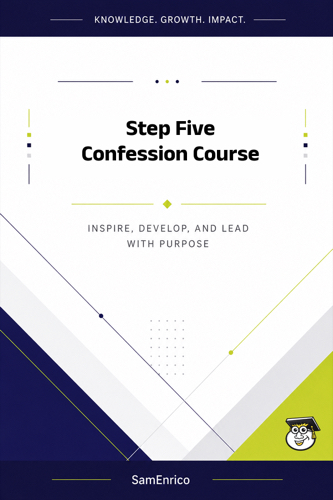
Step Five Confession Course eBook
Prepares for admitting exact nature of wrongs to a
Prepares for admitting exact nature of wrongs to another human being with safety guidelines.
Formats
Free sample
Chapter 1: The Weight We Carry--–- The first time someone told me their deepest secret, I was not a therapist, a sponsor, or a clergy member. I was twenty-two years old, sitting on a broken couch in a halfway house, and the man across from me had been sober for exactly eleven days. His hands were shaking. His eyes were fixed on a stain on the carpet. And then, without looking up, he said something he had never told another living soul.
I watched his face as the words left his mouth. For a moment, there was terror—the raw, animal fear of a person who has just jumped off a cliff and does not know if there is water below. Then something shifted. His shoulders dropped. His breathing slowed.
He looked up, confused, as if expecting lightning to strike him dead. When it didn't, he started to cry. Not the crying of grief, exactly. The crying of a person who has been holding their breath for twenty years and finally, finally exhaled.That moment changed me. Not because his confession was particularly dramatic—by the standards of recovery, it was ordinary.
He had stolen from his mother. He had lied to everyone who loved him. He had driven drunk with children in the car. Standard inventory for a standard alcoholic. What changed me was the physics of it: the way a secret, once spoken, seemed to lose its mass.
Before he spoke, that secret was a black hole inside him, collapsing everything—his self-worth, his relationships, his ability to imagine a future—into a single point of crushing density. After he spoke, it was just a story. A painful story, yes. A shameful story. But a story that could be held, examined, and eventually, set down.I have now witnessed hundreds of Step Five confessions.
I have made my own, several times, over decades of recovery work. And I have learned something that no traditional recovery text says explicitly: confession is not automatically healing. Unsafe confession is not neutral. It is actively destructive.The man on the broken couch was lucky. He chose a listener—me—who was too young and inexperienced to do much harm.
I did not interrupt him. I did not shame him. I did not use his secrets against him later. But I have also watched what happens when confession goes wrong. I have seen a woman confess childhood sexual abuse to a romantic partner who later used those details to retraumatize her during an argument.
I have seen a man admit his infidelity to a sponsor who then told the entire men's meeting "so they could pray for him correctly." I have seen a recovering addict, already fragile, confess her deepest shame to a listener who responded with a lecture about hellfire—and watched her relapse within forty-eight hours.These are not anomalies. They are predictable outcomes of a recovery culture that treats Step Five as a spiritual obligation while providing almost no practical instruction on how to do it safely. The Big Book of Alcoholics Anonymous, for all its wisdom, devotes approximately three pages to Step Five. It tells us to admit "the exact nature of our wrongs" to "another human being." It tells us this will bring "spiritual progress." But it does not tell us how to choose that human being. It does not tell us how much to say.
It does not tell us what to do if the listener betrays us. It does not tell us—and this is the most dangerous omission—that for some people, with some histories, with some listeners, a poorly executed Step Five can cause more harm than years of active addiction.This book exists to fill that gap.What This Chapter Will Teach You By the end of this chapter, you will understand: why secrecy fuels addiction at a neurobiological level; the critical difference between toxic shame and healthy guilt (and why confusing the two can destroy your recovery); the six specific ways unsafe confession causes harm; why the traditional "just do it" approach to Step Five is incomplete for trauma survivors, people with personality disorders, and anyone with a history of betrayal; and a preview of the safety framework that will guide you through the rest of this book.You will also receive the first of six Safety Guidelines that form the backbone of this course. Unlike traditional recovery literature, which treats safety as common sense, we will treat it as a skill—something you learn, practice, and apply with the same rigor you would apply to any life-saving procedure.The Neurobiology of Secrets Let us begin with the body, because the body does not lie and does not forget.When you keep a significant secret—especially a secret involving shame, guilt, or fear—your body responds as if it is under threat. The amygdala, your brain's alarm system, activates. Cortisol and adrenaline flood your system.
Your heart rate increases. Your digestion slows. Your prefrontal cortex—the part of your brain responsible for rational decision-making, impulse control, and long-term planning—actually down-regulates, because your brain believes you need to fight, flee, or freeze, not think carefully about the future.This is the secrecy-stress cycle. And it is a perfect engine for addiction.Consider: what does alcohol do? It suppresses the amygdala's alarm signals.
What do opioids do? They numb the physiological distress of shame. What do stimulants do? They artificially restore the dopamine that secrecy depletes. What do behavioral addictions—gambling, sex, shopping, eating—do?
They provide temporary relief from the unbearable tension of carrying a secret.The secrecy-stress cycle explains why active addiction and hidden shame are almost always found together. The secret comes first (or is discovered early in the addiction's progression). The secret creates chronic stress. The person uses substances or behaviors to manage the stress. The using creates more secrets.
The cycle tightens. Eventually, the person is no longer using to feel good. They are using to feel less bad—to temporarily escape the weight of what they are hiding.This is not moral weakness. This is neurobiology.And here is the good news: the same neurobiology that makes secrecy destructive also makes confession healing—when done safely. When you speak a secret aloud to a trusted, prepared listener, several things happen in your brain.
The amygdala's activity decreases. Cortisol levels drop. Oxytocin—the bonding and trust hormone—increases. Your prefrontal cortex comes back online, allowing you to think clearly about the secret rather than just react to it. Most importantly, the act of narration moves the memory from implicit (felt but not named) to explicit (articulated and structured).
This is why trauma treatment almost always involves talking about the traumatic event: not because talking erases the memory, but because talking organizes it, reducing its power to intrude unpredictably.But—and this is the most important "but" in this entire book—these neurological benefits only occur when the confession is safe. Unsafe confession triggers the opposite response. If the listener shames you, your amygdala activates more. If the listener breaks confidence, your stress hormones spike higher. If the listener responds with horror or disgust, your brain encodes the confession as a traumatic…
This is the end of the free sample. Get the eBook to keep going. Buy now
About this book
Details
- Author
- Theriault Marianela
- Publisher
- SamEnrico
- Language
- English
- Genre
- Non-Fiction, Self-Help / Confession
- Released
- 2026-06-06
- Pages (approx.)
- 150
- Available as
- eBook, Audiobook

Read better in the ZLOADR app
Your eBooks on your phone or tablet. Sign in with your SamEnrico account and start reading.
More by Theriault Marianela
 The Foster Parent Anger GuideTheriault Marianela$11.99
 Empathy For Political DifferencesTheriault Marianela$11.99
 30 Second HIIT Protocol GuideTheriault Marianela$11.99
 The Value Based Pricing GuideTheriault Marianela$11.99
 The Ballad of Beowulf: Epic Poetry and the Birth of English LiteratureTheriault Marianela$11.99
 Jet EnginesTheriault Marianela$11.99
 Seasonal Retention GuideTheriault Marianela$12.99
 Leverage Your Launch for PRTheriault Marianela$12.99
 The Breeder's Guide to Lincoln Red CattleTheriault Marianela$11.99
 How to Become a Geodetic ComputatorTheriault Marianela$11.99