
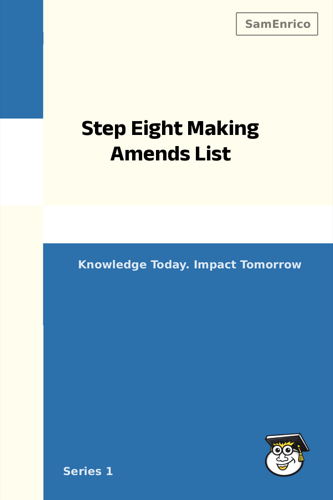
Step Eight Making Amends List eBook
Identify all people harmed by your addiction and r
by Frost Sumiko
Identify all people harmed by your addiction and rank them for amends readiness.
Formats
Free sample
Chapter 1: The Blank Page...--–- The notebook sat open on the kitchen table for seventeen days. Each morning, I would pour my coffee, sit down, pick up the pen, and stare at the white rectangle of paper that had somehow become the enemy. The assignment was simple, or so I had been told. My sponsor’s words echoed in my head: “Step Eight. Make a list of all persons you have harmed, and become willing to make amends to them all.” That was it.
A list. Just names on paper. I had filled out tax forms more complicated than this. I had written college essays, job applications, apology notes, grocery lists, love letters, and angry texts. But this list—this particular collection of names—felt like trying to swallow broken glass.I remember thinking, on day twelve, that perhaps I was the first person in the history of recovery who genuinely hadn’t harmed anyone.
Maybe my addiction was a victimless crime. Maybe all those years of drinking and using had only affected me. The thought was seductive, warm, and completely false. But my mind wrapped around it like a life raft. No list meant no amends.
No amends meant no vulnerability. No vulnerability meant no pain. And no pain meant I could keep pretending that the wreckage I had left behind me was just a series of unfortunate events rather than a trail of my own choices.This chapter is for everyone who has ever stared at a blank page and felt their throat close up. It is for the person who has avoided their sponsor’s phone calls because they haven’t started the list yet. It is for the recovering addict who has completed Step Four, Step Five, Step Six, and Step Seven with seeming ease, only to grind to a complete halt at Step Eight.
You are not lazy. You are not spiritually deficient. You are not the only one. You are afraid. And fear, when it is not understood, always disguises itself as logic, as delay, as forgetfulness, as busyness, or as the comforting lie that you haven’t really hurt anyone at all.The Anatomy of Eighth Step Paralysis Let us name the beast before we attempt to slay it.
The Eighth Step stall is not a single problem but a cluster of four distinct fears, each dressed in different clothing. Understanding these fears is the first act of courage, because you cannot dismantle what you refuse to see.The first fear is shame. This is the terror that writing down a name will somehow confirm what your addiction has whispered to you for years: that you are a monster, irredeemable, beyond repair. Shame says, “If I write my mother’s name on this list, I am admitting that I am a bad son, not just that I did a bad thing.” Shame collapses behavior into identity. It turns “I stole money” into “I am a thief.” It turns “I lied” into “I am a liar.” And because shame is so painful, the mind protects itself by avoiding the act that triggers the shame.
If writing the list makes you a monster, then not writing the list makes you safe. The logic is flawed but emotionally powerful.The second fear is pride. This is the ego’s refusal to admit that you were wrong to specific people. Pride is selective. It has no problem admitting you were wrong to someone you dislike or someone who has already hurt you.
But pride rages against admitting you were wrong to someone you have always blamed, someone you have constructed a whole story around, someone whose role in your life narrative is “villain.” For example, a man I worked with in recovery could not bring himself to write his older brother’s name on his list. He had spent twenty years telling himself that his brother was controlling, judgmental, and emotionally abusive. And much of that was true. But when we dug deeper, he admitted that he had also stolen money from that brother, lied to him repeatedly, and missed his wedding because he was drunk. Pride said, “He deserves it.
He hurt me first. I am not putting his name on any list.” Pride will keep you sick longer than almost any other defect.The third fear is rational fear: fear of legal or professional consequences. This fear is not irrational. It is, in fact, entirely reasonable. If you write down that you embezzled money, that you assaulted someone, that you drove under the influence with a child in the car—these are real actions with real potential consequences.
The fear is that the list, if discovered, could be used against you in a court of law, in a custody battle, in a professional licensing board hearing. This fear has stopped more recovering people than any other, and it deserves respectful attention rather than dismissive platitudes.The fourth fear is resentment. This is the refusal to include someone because “they hurt me worse.” Resentment is a strange beast because it feels like justice. When you resent someone, you are not just angry—you believe you have a right to be angry. And you do.
But the problem is not whether your anger is justified. The problem is that leaving someone off your list because you resent them hands them power over your recovery. Every name you omit because “they don’t deserve my amends” becomes a chain that ties you to your past. You are not forgiving them by including them. You are freeing yourself.The Myth of the Victimless Addiction Let me be direct: there is no such thing as a victimless addiction.
This is not a moral judgment; it is a factual observation. Addiction is a disease of relationships. It damages the addict’s relationship with themselves, with their body, with their mind, with their spirit, with their family, with their friends, with their employers, with their creditors, with their community, and often with complete strangers who happened to be in the wrong place at the wrong time.Consider the physical harm. Addiction may have led you to drive while impaired, risking the lives of everyone on the road. It may have led you to neglect your health to the point of requiring emergency medical care, costing the healthcare system and your family time and money.
It may have led you to shake a baby, punch a wall next to a child’s head, shove a partner who was trying to stop you from leaving the house drunk. Physical harm does not require leaving a bruise. It includes the terror of wondering whether you will come home safely. It includes the exhaustion of a spouse who stayed awake all night listening for your car.Consider the mental and emotional harm. Addiction makes you unreliable.
You break promises. You lie about where you have been and what you have done. You gaslight the people who love you by telling them they are overreacting, that they are crazy, that it is not as bad as they think. You manipulate. You withdraw.
You threaten to leave, to hurt yourself, to hurt others. You create an environment of constant walking on eggshells. Children…
This is the end of the free sample. Get the eBook to keep going. Buy now
About this book
Details
- Author
- Frost Sumiko
- Publisher
- SamEnrico
- Language
- English
- Genre
- Non-Fiction, Self-Help
- Released
- 2026-06-09
- Pages (approx.)
- 139
- Available as
- eBook, Audiobook

Read better in the ZLOADR app
Your eBooks on your phone or tablet. Sign in with your SamEnrico account and start reading.
More by Frost Sumiko
 Stress and Infertility JourneyFrost Sumiko$11.99
 The Remote Celebration GuideFrost Sumiko$11.99
 Hair Loss Podcasts GuideFrost Sumiko$11.99
 The Last Ride of the Wild West: Canada's Forgotten Cartel WarFrost Sumiko$11.99
 How to Produce Antibacterial Body SOAPFrost Sumiko$11.99
 Canoe BuilderFrost Sumiko$11.99
 Complex PDF TranslationFrost Sumiko$12.99
 How to Become a Core-oven TenderFrost Sumiko$11.99
You may also like
 Hong Kong Handover 1997Dunn Johnnie$11.99
 Zumba For Postnatal Recovery CourseNeal Christian$11.99
 Zumba for BeginnersLadner Nikia$11.99
 YouTube Comment Mining GuideHumes Pandora$12.99
 Worry Box MeditationCarlin Rudy$11.99
 Workplace Stress MeditationNguyen Lynn$11.99
 Workplace Stress and Sleep RepairHawley Ivory$11.99
 Workplace Perfectionism CureDelaney Jeffry$11.99
 Workplace Injustice Anger GuideWallen Isabelle$11.99
 Work Addiction and Burnout LinkGreenwood Ester$11.99
 Women in Yoga and WellnessBeattie Galina$11.99
 Women in Stand Up ComedyChun Evangeline$11.99