
Non-FictionStudent's ShortcutSTEM Admissions
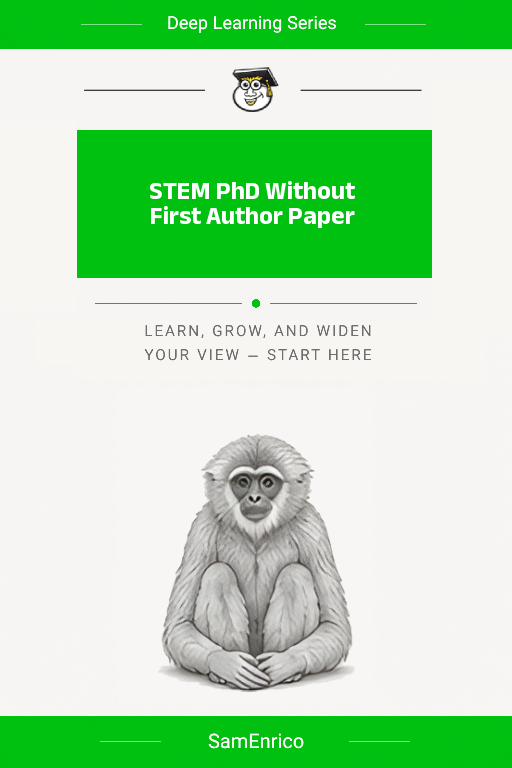
STEM PhD Without First Author Paper eBook
Apply to science and engineering programs using co
Apply to science and engineering programs using conference posters, technical reports, and co-author acknowledgments effectively.
Formats
Free sample
Chapter 1: The Hidden Curriculum–- You have just finished a twelve-hour day in the lab. The experiment failed again, but you think you know why. Between troubleshooting, you drafted two paragraphs of your dissertation introduction, responded to four emails from your advisor, and helped a first-year student learn the protocol for protein purification. On your desk, buried under printouts of papers you will never have time to read, sits a conference poster from six months ago. It was well received.
People stopped to talk. A professor from another university asked thoughtful questions. Your name was listed first on that poster. But when you look at your publication record — at the blank space where a first-author journal paper should be — you feel a familiar tightening in your chest. Everyone keeps asking: “Where is your paper?”This book is written for that exact moment.
It is written for the Ph D student who is doing real, valuable, rigorous scientific work but cannot point to a first-author journal article as proof. You are not alone. You are not failing. And the blank space on your CV does not mean what you think it means.Let us begin with a radical proposition: The first-author journal paper is not the only legitimate output of a STEM Ph D. It is not even the most common output in many fields.
Yet it has become the single most overvalued metric in academic evaluation — a metric so pervasive that it has hidden the actual work of science from view.The Myth You Have Been Taught Every STEM Ph D student has absorbed some version of the following belief: To be a real scientist, you must publish first-author papers. To graduate, you must publish first-author papers. To get a postdoc, you must publish first-author papers. To get a faculty job, you must publish many first-author papers in high-impact journals. This belief is so deeply embedded in academic culture that it feels like a law of nature.
It is not. It is a historical accident that has become a dogma.The first-author paper as the primary unit of scientific credit emerged from a specific time and place: mid-twentieth-century laboratory science, where a single principal investigator ran a small team of two to five researchers. In that setting, the first author was clearly the person who did most of the hands-on work. The corresponding author was clearly the person who secured funding and provided intellectual direction. The system made sense because the scale matched the metric.But science has changed.
Many fields now operate at scales that make the first-author paper meaningless. A high-energy physics paper with three thousand authors cannot be read as a story of individual contribution. A civil engineering technical report reviewed by a state transportation agency undergoes more rigorous scrutiny than many journal papers, yet it is classified as “grey literature” and treated as lesser. A computational methods paper where the Ph D student wrote the entire software package but the advisor is listed as first author because “that’s how our lab does it” leaves the student with nothing to show for years of work.The mismatch between the metric and the reality is not your fault. It is a structural problem.
But you are the one who pays the price for it.Who This Book Is For This book is written for three specific types of STEM Ph D students. If you recognize yourself in any of these descriptions, keep reading.The Big Science Student. You work in a collaboration with dozens, hundreds, or thousands of co-authors. Your name appears on papers — but as one name among many. You have contributed substantially, perhaps designing a critical subsystem or running a key analysis.
But there is no such thing as a “first author” in your field. The expectation that you produce a first-author paper is not just difficult; it is definitionally impossible.The Applied Engineering Student. Your research is funded by an industry partner or government agency. Your primary deliverable is a technical report, a patent, a prototype, or a dataset. You could publish a journal paper, but it would require stripping away the proprietary details that make your work valuable.
Your advisor tells you that patents and reports “count” — but then your committee asks why you have no publications.The Slow Science Student. Your research takes time. You study ecological succession, which requires multiple growing seasons. You develop clinical interventions, which require patient recruitment over years. You run climate models, which take months to complete on supercomputers.
You have results — preliminary results, partial results, negative results — but not the tidy, positive, complete story that journals want. Your third-year review asks for publications. You have none. The implication is clear: you are behind. But you are not behind.
You are working on nature’s timeline, not the university’s.If you are a first-year Ph D student who has not yet started research, this book will help you plan. If you are a fifth-year student with no first-author paper and a committee that is losing patience, this book will give you tools to salvage your degree. If you are somewhere in between, you will find specific strategies for your situation.This book is not written for students who have produced no research outputs of any kind. If you have never presented a poster, written a report, or co-authored anything, stop reading and go do research. This book assumes you have done the work.
The problem is that the work has not been recognized in the traditional currency of academic publishing.The Cost of the Myth Before we discuss solutions, we must understand the damage. The belief that every Ph D student must have a first-author paper causes real harm.First, it drives students out of science. Every year, talented researchers leave Ph D programs because they have internalized the message that their lack of a first-author paper means they are not good enough. They are not leaving because they cannot do science. They are leaving because they have been taught that the only legitimate proof of doing science is a document that their research environment makes impossible to produce.Second, it distorts research priorities.
Students choose projects based on publishability rather than importance. They avoid high-risk, high-reward questions because negative results do not publish. They avoid long-term studies because the timeline does not fit the degree. They avoid collaborations because sharing credit dilutes their individual record. The system incentivizes safe, small, fast science at the expense of the ambitious, collaborative, slow science that actually solves hard problems.Third, it creates a hidden curriculum.
The rules of success are not taught. They are inferred. Students from families with academic backgrounds learn earlier that first-author papers matter and how to strategize around them. First-generation students often learn only when it is too late, after years of working on projects that cannot produce the expected output. The first-author paper requirement is not a meritocracy.
It is a barrier that favors those who already know the game.What Counts as Research Output? A Broader View Let us expand your understanding of what constitutes legitimate research output. Each of the following has been accepted as evidence of doctoral-level work by some university…
This is the end of the free sample. Get the eBook to keep going. Buy now
About this book
Details
- Author
- Sanborn Kenna
- Publisher
- SamEnrico
- Language
- English
- Genre
- Non-Fiction, Student's Shortcut, STEM Admissions
- Released
- 2026-05-30
- Pages (approx.)
- 134
- Available as
- eBook, Audiobook

Read better in the ZLOADR app
Your eBooks on your phone or tablet. Sign in with your SamEnrico account and start reading.
More by Sanborn Kenna
 OCD And Hoarding DisorderSanborn Kenna$11.99
 The Discord Gaming Server EscapeSanborn Kenna$11.99
 Parenting with Depression GuideSanborn Kenna$11.99
 Body Language For Customer Service GuideSanborn Kenna$11.99
 Survey Data Enrichment with AISanborn Kenna$11.99
 The Ghost of Flight 447: Voices from the Black BoxSanborn Kenna$11.99
 Soft Landing After PR ApprovalSanborn Kenna$12.99
 Understanding CalculiSanborn Kenna$17.99
 York Gum HarvestingSanborn Kenna$11.99
 How to Become a Car-cleaning SupervisorSanborn Kenna$11.99
You may also like
 Hong Kong Handover 1997Dunn Johnnie$11.99
 Zumba For Postnatal Recovery CourseNeal Christian$11.99
 Zumba for BeginnersLadner Nikia$11.99
 YouTube Comment Mining GuideHumes Pandora$12.99
 Worry Box MeditationCarlin Rudy$11.99
 Workplace Stress MeditationNguyen Lynn$11.99
 Workplace Stress and Sleep RepairHawley Ivory$11.99
 Workplace Perfectionism CureDelaney Jeffry$11.99
 Workplace Injustice Anger GuideWallen Isabelle$11.99
 Work Addiction and Burnout LinkGreenwood Ester$11.99
 Women in Yoga and WellnessBeattie Galina$11.99
 Women in Stand Up ComedyChun Evangeline$11.99