
Non-FictionStudent's ShortcutSTEM
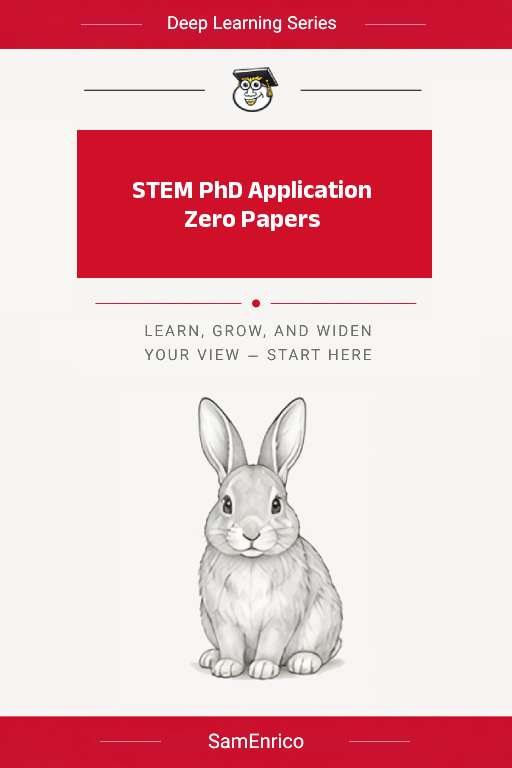
STEM PhD Application Zero Papers eBook
Apply to science and engineering PhDs using lab ro
by Horner Ahmad
Apply to science and engineering PhDs using lab rotations and technical skills instead of first-author pubs.
Formats
Free sample
Chapter 1: The Paper Mirage--–- Every autumn, a quiet tragedy unfolds across university campuses. A talented undergraduate researcher—let us call her Maya—has spent two years in a molecular biology lab. She has cloned eighteen constructs. She has optimized a protein purification protocol that reduced aggregation by forty percent. She has trained two new students.
She has presented a poster at a regional conference. She does not have a first-author paper. Her project, a high-risk attempt to characterize a novel regulatory pathway, yielded interesting but inconclusive results. Her PI said the work was “promising but not yet publishable.”Maya opens the application portal for her dream Ph D program. She scrolls through the required materials.
She looks back at her CV. She sees the blank space where “publications” would go. She closes the browser. She does not apply. She spends another year as a technician, hoping for a paper that never comes.
Meanwhile, a student from a different lab—one who happened to join a project that worked on the first try—submits a third-author paper and secures a funded offer at the same program.This is the paper mirage: the illusion that first-author publications are the universal currency of Ph D admissions, that without them you are invisible, that committees have a stack of CVs and simply sort by publication count. The mirage is sustained by anxious graduate forums, by well-meaning but out-of-touch professors who published early in their own careers, and by a small number of hyper-competitive programs that broadcast their admissions statistics without context. The reality, hidden beneath the surface, is radically different.Most admitted Ph D students do not have first-author papers. What they have instead is something that Maya possesses in abundance: sustained research experience, demonstrated technical competence, and evidence of resilience. The mirage costs science thousands of qualified applicants every year.
This chapter is the first step toward dismantling it—not to minimize the value of publications, but to show you exactly what admissions committees actually need, and how you can provide it without a single first-author paper.The Data That Admissions Committees Do Not Broadcast Let us begin with numbers, because numbers are the antidote to anxiety. If you believe that everyone admitted to competitive STEM Ph D programs has a first-author paper, you have been misled by a selection bias. You see the successful applicants who post on Reddit’s r/gradadmissions or on Twitter/X, celebrating their acceptances. You do not see the silent majority—the admitted students who do not post because they assume their profile is unremarkable.Here is what the data actually shows, aggregated from multiple sources: internal admissions reports from public universities, surveys conducted by the Council of Graduate Schools, and data released through FOIA requests.In the biological sciences—molecular biology, biochemistry, cell biology, neuroscience—only 20 to 30 percent of admitted students at mid-tier and upper-mid-tier R1 universities have a first-author paper at the time of application. At top-tier programs like Harvard BBS or Stanford Biosciences, the number rises to approximately 40 to 50 percent.
That is still a minority. Most admitted students at even the most competitive programs do not have first-author papers.In chemistry, the numbers are similar: approximately 25 percent of admitted students have a first-author paper. In physics, the figure hovers around 20 percent, with experimental physics slightly higher than theoretical. In engineering disciplines—mechanical, civil, chemical, electrical, biomedical—the numbers drop significantly, to approximately 10 to 15 percent. Engineering programs value industry experience, patents, and design projects as much or more than publications.In computer science, the picture is complicated by the conference publication culture.
Many CS applicants list conference proceedings as publications. Even accounting for this, the majority of admitted Ph D students in CS do not have a first-author paper at a top conference. They have research experience, strong letters, and technical portfolios on Git Hub.What do the other 70 to 85 percent of admitted students have? They have one to three years of sustained research experience. They have worked in a lab—sometimes multiple labs.
They have learned techniques. They have attended lab meetings and journal clubs. They have made mistakes and fixed them. They have contributed to projects that did not work out, or worked out too slowly, or were scooped by another lab. In other words, they have done the work of science without producing the final artifact of a published paper.These statistics are not secrets.
They are published in sources like Nature’s career columns, the Chronicle of Higher Education, and internal reports from university graduate divisions. Yet they remain invisible to most applicants because admissions committees have no incentive to broadcast them. Committees are happy to accept papers when they come; they do not want to signal that publications are optional. But they do not require them, and the data proves it.Consider an internal study conducted by a large public R1 university in the Midwest, which tracked admitted Ph D students in biological sciences over a five-year period. The study found no statistically significant difference in completion rates or time-to-degree between students who entered with a first-author paper and those who entered without one.
Zero difference. What did predict success? The number of semesters of undergraduate research experience. Students with four or more semesters—regardless of publication output—completed their Ph Ds at the same rate as students with papers. Students with two or fewer semesters struggled, with or without publications.The implication is clear and important: committees value time in the lab more than papers from the lab.
A paper can be a fluke. A paper can result from a project that worked on the first try, a generous mentor who included a student on a large collaboration, or a lab that prioritizes quick-and-dirty experiments over rigorous but slow work. Sustained research experience cannot be faked. It requires showing up, week after week, through failed PCRs and contaminated cell cultures and equipment failures and disappointing data. That is the signal committees actually want.The Difference Between Desirable and Necessary A common mistake that zero-paper applicants make is confusing what is desirable with what is necessary.
A first-author paper is desirable. It helps. It gives a committee member a quick, easy justification to say yes. It signals that you have completed a project from start to finish and that someone—at least two peer reviewers and an editor—deemed the work publishable. These are real benefits.
But a first-author paper is not necessary. You can be admitted without one.To understand why, you must understand how admissions committees actually operate. A typical committee consists of five to ten faculty members who have volunteered—or been conscripted—to read between fifty and five hundred applications. Each application receives between five and fifteen minutes of total attention. Faculty read during evenings and weekends, often while traveling or between other obligations.
They are not looking for reasons to reject you. They are looking for reasons to admit you, because their program needs to fill seats with funded students.In that five to fifteen minutes, a professor will scan your CV, read your statement of purpose, glance at your letters, and check your transcript. They are asking a single overarching question: will this student…
This is the end of the free sample. Get the eBook to keep going. Buy now
About this book
Details
- Author
- Horner Ahmad
- Publisher
- SamEnrico
- Language
- English
- Genre
- Non-Fiction, Student's Shortcut, STEM
- Released
- 2026-06-01
- Pages (approx.)
- 146
- Available as
- eBook, Audiobook

Read better in the ZLOADR app
Your eBooks on your phone or tablet. Sign in with your SamEnrico account and start reading.
More by Horner Ahmad
 Loving Kindness JournalHorner Ahmad$11.99
 Drug Dependency Sleep Recovery PlanHorner Ahmad$11.99
 The Watson Crick BreakthroughHorner Ahmad$11.99
 Money Dream SymbolismHorner Ahmad$11.99
 The Disaster Finance SurvivalHorner Ahmad$11.99
 Anapanasati for FlyingHorner Ahmad$11.99
 Tinnitus Anxiety MeditationHorner Ahmad$11.99
 Parent Driving CessationHorner Ahmad$11.99
 Mindfulness Of Thoughts PracticeHorner Ahmad$11.99
 The Twitter Files: Unraveling the Secrets of Social Media’s Shadow WarHorner Ahmad$11.99
 The Sleeping Serpent: Hypnotic Rituals of the Silk RoadHorner Ahmad$11.99
 Silk and Rebellion: The Rise of Japanese Avant-Garde Fashion (1960s-1970s)Horner Ahmad$11.99
You may also like
 Hong Kong Handover 1997Dunn Johnnie$11.99
 Zumba For Postnatal Recovery CourseNeal Christian$11.99
 Zumba for BeginnersLadner Nikia$11.99
 YouTube Comment Mining GuideHumes Pandora$12.99
 Worry Box MeditationCarlin Rudy$11.99
 Workplace Stress MeditationNguyen Lynn$11.99
 Workplace Stress and Sleep RepairHawley Ivory$11.99
 Workplace Perfectionism CureDelaney Jeffry$11.99
 Workplace Injustice Anger GuideWallen Isabelle$11.99
 Work Addiction and Burnout LinkGreenwood Ester$11.99
 Women in Yoga and WellnessBeattie Galina$11.99
 Women in Stand Up ComedyChun Evangeline$11.99