
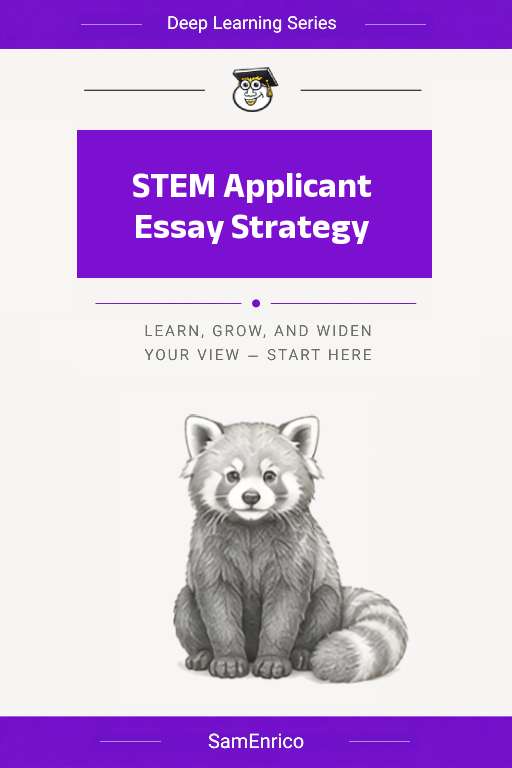
STEM Applicant Essay Strategy eBook
Humanize research experiences by explaining why yo
Humanize research experiences by explaining why your science curiosity began and what questions remain.
Formats
Free sample
Chapter 1: The Resume Trap--–- You have run forty PCR reactions this semester. Thirty-eight of them failed. One gel looked like a Jackson Pollock painting. And the single success came from a sample you are still not sure you labeled correctly.You are now sitting down to write your STEM admissions essay. Every instinct tells you to hide those thirty-eight failures.
You want to list the techniques you mastered, the hours you logged, the awards you almost won. You want to prove you belong.That instinct will ruin your application.This chapter dismantles the most dangerous myth in STEM admissions: the belief that a laundry list of research projects, high test scores, and numerous awards automatically creates a compelling applicant. It does not. In fact, for thousands of students every year, that approach backfires spectacularly. Admissions officers read hundreds of applications that look identical on paper—same AP courses, same lab techniques, same vague declarations of passion for science.
What separates the memorable from the forgettable is not what you did. It is why you cared, what confused you, and what you still do not understand.Welcome to the first chapter of STEM Applicant Essay Strategy. This book will teach you to humanize your research by replacing performative expertise with authentic intellectual curiosity. But before we get to the how, we must burn down the what. You cannot write a great essay while believing that your resume is your ticket in.
It is not. Your resume is proof of attendance. Your essay is proof of a mind at work.The Data That Will Upset You Let us start with what admissions officers actually say when they are not being polite.Over the past decade, multiple universities have released internal studies on what predicts strong STEM applications. The results are surprisingly consistent. According to a 2022 survey of admissions officers at fifty top-tier research universities, seventy-eight percent reported that they could identify a "performative excellence" application within the first two paragraphs.
When asked to define that term, the same officers used phrases like "checklist mentality," "absence of voice," and "I have no idea who this person is."One officer from a competitive engineering program put it bluntly in an anonymous interview: "I read thirty applications yesterday that all said some version of 'I have always loved science because it explains the world around us.' Thirty. That sentence means nothing. It tells me you read a sample essay online and copied the template."Another officer, this one from a top medical school pipeline program, noted: "The students who write about their failures are the ones I remember. Not because I enjoy failure, but because they sound like real scientists. Real science is ninety percent confusion and ten percent 'oh, that's interesting.' The students who only write about success sound like they have never actually done research."The data backs this up.
A study of holistic admissions review at a large public university found that applicants who mentioned a specific intellectual struggle or unresolved question in their personal statement were twenty-three percent more likely to receive a second read than applicants who only listed accomplishments. Twenty-three percent. That is the difference between the maybe pile and the yes pile.Here is what no one tells you: admissions officers are bored. Not of students—of sameness. They read the same five essays on repeat.
The future doctor who shadowed a surgeon and felt a calling. The engineer who took apart a computer at age seven and never looked back. The researcher who quantified something impressive using a technique that sounds important. These essays are not wrong. They are just forgettable.Your job is not to be correct.
Your job is to be remembered.The Brag Sheet Versus the Personal Essay Most STEM applicants walk into the essay-writing process with a fundamental category error. They confuse the brag sheet with the personal essay.A brag sheet is a list. It answers the question: what did you do? It includes courses, grades, test scores, research hours, publications, presentations, awards, and leadership positions. The brag sheet is useful.
Admissions offices need it. That is why your transcript and activities list exist. They are designed to collect brag sheet data efficiently.The personal essay answers a completely different question: who are you when you stop performing? What do you think about when no one is grading you? What confuses you?
What would you work on if prestige and parental approval disappeared overnight?Here is the mistake. Students take their brag sheet and translate it into paragraph form. They write things like:*"I conducted independent research on gene expression patterns in Drosophila melanogaster under varying thermal stress conditions. Using q PCR, I quantified m RNA levels of heat shock protein 70 and observed a statistically significant increase at thirty-seven degrees Celsius."*That is a brag sheet wearing a costume. It has no narrator.
It has no curiosity. It has no human being.Now compare that to this, written by a real applicant who was admitted to a competitive neuroscience program:"I pipetted the same sample seven times and got seven different numbers. My first instinct was to ignore the ones that did not fit. My second instinct was to blame the machine. My third instinct—the one I am proudest of—was to ask: what if the variability is the data?
What if reproducibility is not a statistical problem but a human one?"That essay begins with failure, confusion, and a question. It does not hide the mess. It walks directly into it. And that is exactly why an admissions officer remembered it.The difference between these two approaches is the difference between proving you can follow a protocol and demonstrating that you can think. Anyone can follow a protocol with enough training.
Not everyone can look at a confusing result and ask a smarter question.Why Your Accomplishments Are Not Enough This section will make some readers uncomfortable. That is intentional.Your accomplishments are real. You worked for them. You stayed late in the lab, studied for exams, competed against hundreds of other students, and produced work that impressed your mentors. None of that is meaningless.
But here is the hard truth: in the context of elite STEM admissions, your accomplishments are table stakes. They are the price of entry, not the winning hand.Think about it this way. If you are applying to a competitive engineering program, every single applicant in the pool has high grades in math and science. Every single applicant has research experience or impressive projects. Every single applicant has letters of recommendation saying they are wonderful.
When everyone has the same accomplishments, no one stands out for having them.Admissions officers have a term for this: "the hollow resume." It refers to an application that looks perfect on paper but reveals nothing about the person underneath. The hollow resume is dangerous because it does not give the officer a reason to advocate for you in committee meetings. When the officer says, "I think we should admit this student," someone else will ask, "Why? What is memorable about them?" If the only answer is "good grades and research," you will lose to the student who…
This is the end of the free sample. Get the eBook to keep going. Buy now
About this book
Details
- Author
- Brennan Shondra
- Publisher
- SamEnrico
- Language
- English
- Genre
- essays, Student's Shortcut
- Released
- 2026-05-30
- Pages (approx.)
- 151
- Available as
- eBook, Audiobook

Read better in the ZLOADR app
Your eBooks on your phone or tablet. Sign in with your SamEnrico account and start reading.
More by Brennan Shondra
 Mental Toughness Hypnosis HandbookBrennan Shondra$11.99
 Eye Pain Meditation GuideBrennan Shondra$11.99
 Compulsive Online Shopping FixBrennan Shondra$11.99
 Press Release For FundraisingBrennan Shondra$11.99
 Circadian Rhythm Self Help PlanBrennan Shondra$11.99
 Building Trust With ColleaguesBrennan Shondra$11.99
 Spontaneity in RelationshipsBrennan Shondra$11.99
 Body Scan Anxiety ReleaseBrennan Shondra$11.99
 Irish Mother Emigration TaleBrennan Shondra$11.99
 The Laundromat: How the Pandora Papers Exposed the World’s Dirty MoneyBrennan Shondra$11.99
 The Ballad of the Black Cowboy: Nat Love and the Untamed FrontierBrennan Shondra$11.99
 Quetzalcoatl's Celestial Serpent SongBrennan Shondra$11.99
You may also like
 YouTube Video Essay DepthLeon Lala$11.99
 TOEFL Independent Essay GuideMintz Alex$11.99
 Music Theory Essay GuideWilkinson Maisha$11.99
 Expository Essay AI PromptsApplegate Dalia$11.99
 Exam Essay MemorizationMcgovern Johna$11.99
 Compare Contrast Essay PromptsOntiveros Marx$11.99
 College Application Essay GuideSisson Aimee$11.99College Application Essay GuideSisson Aimee$11.99
 The 100 Word Essay ChallengeAli Luciana$11.99
 Journalism Essay PromptsThatcher Williemae$11.99
 Finance Essay PromptsShrader Lamont$11.99
 Cause Effect Essay GPT GuideBland Jacelyn$11.99