
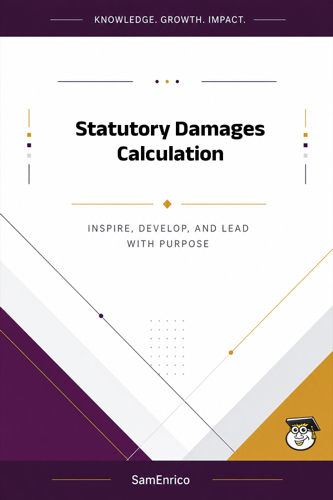
Non-FictionCompliance & Risk ArchiveStatutory Damages
Statutory Damages Calculation eBook
Calculate 100 to 750 per consumer per incident sta
by Crisp Kori
Calculate 100 to 750 per consumer per incident statutory damages under CCPA.
Formats
Free sample
Chapter 1: The Liability Trap...--–- On a Tuesday morning in March 2025, the general counsel of a mid-sized e-commerce company received an email that would redefine her understanding of liability. A plaintiff’s law firm had filed a class action complaint alleging that her company’s website—which used three standard marketing pixels—had violated the California Consumer Privacy Act. The demand? Statutory damages of $799 per consumer per incident. With 1.2 million unique California visitors over the preceding twelve months, the potential exposure exceeded $958 million.
The company’s annual revenue was $47 million. Within hours, the board was on an emergency call. The CEO asked a single question that no one could answer: “What does ‘per incident’ even mean, and how do we calculate what we actually owe?”That question sits at the heart of modern privacy litigation. The California Consumer Privacy Act, as amended by the California Privacy Rights Act, created a private right of action that has fundamentally altered the risk calculus for any business that collects personal information from California residents. Unlike traditional data breach litigation, where plaintiffs must prove actual harm—identity theft, financial loss, or emotional distress—the CCPA offers a shortcut.
A consumer can recover statutory damages between $100 and $750 per consumer per incident without demonstrating any concrete injury whatsoever. The only requirements are that the business violated its duty to maintain reasonable security and that unauthorized access, exfiltration, or disclosure occurred.This chapter establishes the statutory baseline for every calculation that follows. It provides the foundational numbers, the legal text, the legislative intent, and—most critically—the framework for understanding how a range as wide as $107 to $799 per incident narrows into a specific number in real-world litigation. By the end of this chapter, a practitioner should be able to answer the CEO’s question: not with certainty, but with a defensible methodology.The Statutory Text: What the Law Actually Says The private right of action for statutory damages appears in California Civil Code Section 1798.150(a)(1). The full text reads:“Any consumer whose nonencrypted or nonredacted personal information is subject to an unauthorized access and exfiltration, theft, or disclosure as a result of the business’s violation of the duty to implement and maintain reasonable security procedures and practices appropriate to the nature of the information to protect the personal information may institute a civil action for any of the following: (A) A penalty in an amount not exceeding seven hundred fifty dollars ($750) per consumer per incident or actual damages, whichever is greater.”Several elements of this text deserve close attention.
First, the statute uses the word “may,” not “shall.” The private right of action is permissive, not mandatory. Consumers can choose to sue, but they are not required to do so. This seemingly minor word has enormous practical implications because it creates a settlement dynamic where plaintiffs hold a bargaining chip—the threat of litigation—but defendants can argue that the absence of actual harm militates toward the lower end of the range.Second, the statute explicitly ties statutory damages to a violation of the “duty to implement and maintain reasonable security procedures and practices.” This is not merely a data breach statute; it is a negligence statute dressed in privacy clothing. A business that experiences a breach but had reasonable security in place at the time owes no statutory damages. Conversely, a business with terrible security that somehow avoids any breach still owes nothing because the trigger event—unauthorized access, exfiltration, or disclosure—never occurred.
Both elements must coexist: a breach and a violation of the duty of care.Third, the statute caps the penalty at $750 “per consumer per incident.” That is an upper bound, not a floor. The lower bound—$100—appears in the same subsection as part of the original statutory language before the CPRA amendments. As discussed below, both numbers adjust annually for inflation. But the critical point is that the range exists to give courts and litigants flexibility. The statute anticipates that not all violations are equal, and the damages should reflect that reality.Fourth, the statute allows plaintiffs to elect either statutory damages or actual damages, “whichever is greater.” This provision prevents the absurd outcome where a consumer who suffered $50,000 in actual identity theft losses would be limited to $750 in statutory damages.
In practice, most CCPA class actions plead both actual and statutory damages in the alternative, then drop the actual damages claim at certification if proving individual harm would defeat predominance.The 2025 Inflation Adjustment: From $100–$750 to $107–$799When the CCPA originally took effect on January 1, 2020, the statutory damages range was $100 to $750. The CPRA amendments, which became fully operative on January 1, 2023, included a provision requiring the California Attorney General to adjust these amounts annually for inflation based on the Consumer Price Index for All Urban Consumers (CPI-U). The first adjustment took effect on January 1, 2024, increasing the range to $101–$757. The second adjustment, effective January 1, 2025, increased the range to $107–$799.This adjustment mechanism has profound implications for case valuation. A complaint filed in December 2024 would cite the $101–$757 range.
The same complaint filed in January 2025 would cite $107–$799. For a class of 100,000 consumers, the difference between the old floor and the new floor is $600,000. The difference between the old ceiling and the new ceiling is $4.2 million. These are not trivial amounts. Practitioners must verify the effective date of any alleged violation and apply the range in effect at the time of the incident, not the time of filing.
If a breach occurred in November 2024 but the complaint filed in February 2025, the applicable range is $101–$757, not $107–$799. The adjustment is not retroactive.The table below shows the annual adjustments from 2020 through 2025:Effective Date Lower Bound Upper Bound CPI-U Adjustment Factor Jan 1, 2020$100$7501.000 (baseline)Jan 1, 2021$100$750None (CPRA not yet operative)Jan 1, 2022$100$750None (CPRA not yet operative)Jan 1, 2023$100$750None (CPRA operative but no adjustment until 2024)Jan 1, 2024$101$7571.01x Jan 1, 2025$107$7991.07x (cumulative)For 2026 and beyond, practitioners should monitor the California Department of Justice website for annual adjustments, typically announced in October of the preceding year. The adjustment mechanism is automatic; no legislative action is required.Actual Damages vs. Statutory Damages: The Election Problem One of the most misunderstood aspects of CCPA statutory damages is the relationship between the statutory penalty and actual damages. The statute permits recovery of “a penalty in an amount not exceeding seven hundred fifty dollars ($750) per consumer per incident or actual damages, whichever is greater.” The phrasing creates an election: the plaintiff takes the larger of the two amounts, but cannot take both for the same harm.Consider three scenarios.
First, a consumer suffers no actual damages—no identity theft, no out-of-pocket losses, no emotional distress that rises to the level of compensable harm. In that case, the statutory damages range of $107 to $799 is the only available recovery. Second, a consumer suffers $50 in actual damages—perhaps a small fraudulent charge that was reversed by the bank. The statutory damages floor is $107, which exceeds $50, so the consumer would elect statutory damages. Third, a consumer suffers $5,000 in actual damages—significant identity theft, credit repair costs, and lost wages.
The consumer would elect actual damages because $5,000 exceeds the $799 statutory ceiling.In class action practice, this election creates strategic complexity. Plaintiffs’ counsel typically prefer statutory damages because they are uniform across the class…
This is the end of the free sample. Get the eBook to keep going. Buy now
About this book
Details
- Author
- Crisp Kori
- Publisher
- SamEnrico
- Language
- English
- Genre
- Non-Fiction, Compliance & Risk Archive, Statutory Damages
- Released
- 2026-06-11
- Pages (approx.)
- 150
- Available as
- eBook, Audiobook

Read better in the ZLOADR app
Your eBooks on your phone or tablet. Sign in with your SamEnrico account and start reading.
More by Crisp Kori
 Motivated Seller Lead Generation GuideCrisp Kori$11.99
 Mentorship for Real Estate InvestorsCrisp Kori$11.99
 Immigrant Pest Control To FranchisorCrisp Kori$11.99
 Active Listening For Hearing ImpairedCrisp Kori$11.99
 Snowboarding Wrist PreventionCrisp Kori$11.99
 Concentrating the Mind with BreathCrisp Kori$11.99
 High Intensity Spin DrillsCrisp Kori$11.99
 Assertiveness For MeetingsCrisp Kori$11.99
 Operation Fast and Furious: The Untold Story of the DEA's Secret Gunrunning ScandalCrisp Kori$11.99
 The Chessboard Coup: How a Single Move Redrew the Global Power MapCrisp Kori$11.99
 The Maestro of the Medici: Palestrina and the Divine Harmony of RomeCrisp Kori$11.99
 How to Start a Artillery Ammunition Business (Beginners Guide)Crisp Kori$11.99
You may also like
 Hong Kong Handover 1997Dunn Johnnie$11.99
 Zumba For Postnatal Recovery CourseNeal Christian$11.99
 Zumba for BeginnersLadner Nikia$11.99
 YouTube Comment Mining GuideHumes Pandora$12.99
 Worry Box MeditationCarlin Rudy$11.99
 Workplace Stress MeditationNguyen Lynn$11.99
 Workplace Stress and Sleep RepairHawley Ivory$11.99
 Workplace Perfectionism CureDelaney Jeffry$11.99
 Workplace Injustice Anger GuideWallen Isabelle$11.99
 Work Addiction and Burnout LinkGreenwood Ester$11.99
 Women in Yoga and WellnessBeattie Galina$11.99
 Women in Stand Up ComedyChun Evangeline$11.99