
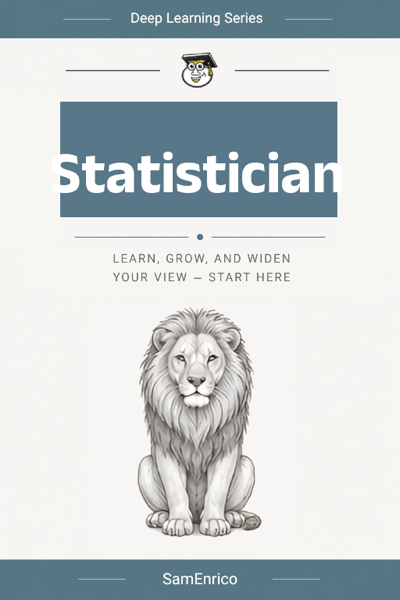
Non-FictionInformativeEducational
Statistician eBook
A Coursebook on Statistician
A Coursebook on Statistician
Formats
Free sample
Chapter 1: The Uncertainty Mandate--–- The call came in at 11:47 PM on a Tuesday. A hospital’s predictive model had flagged a 94% probability of sepsis for a post-operative patient. The attending physician, exhausted after a fourteen-hour shift, ordered a full antibiotic protocol immediately. The patient suffered a severe allergic reaction and spent three days in intensive care. The sepsis test came back negative.
The model was wrong.The statistician who built that model was not in the room when the decision was made. But she was the one who had to explain, three weeks later, why ninety-four percent did not mean what everyone thought it meant. She had to sit across a table from the hospital’s chief medical officer, two lawyers, and the patient’s family, and answer one question: If your number was wrong, why should we trust any number you give us?That question is the starting point of this book. Not a formula. Not a dataset.
Not a software tutorial. A question about trust, uncertainty, and the difference between being mathematically correct and being usefully right.The Great Misconception Most people believe that statistics is a branch of mathematics. They imagine a statistician as someone who is exceptionally good at arithmetic, who can calculate means and standard deviations in their head, who never makes a calculation error. This is approximately as accurate as saying that a chef is someone who is exceptionally good at using a knife. The knife is a tool.
The cooking is the art.Mathematics is about certainty, proof, and necessary truths. When a mathematician proves that the square root of two is irrational, that proof holds for all eternity in all possible universes. It does not depend on data, or sample size, or measurement error. It is true because logic says it is true.Statistics is about uncertainty, evidence, and probabilistic conclusions. When a statistician estimates that a new drug reduces blood pressure by an average of five millimeters of mercury, with a margin of error of plus or minus two millimeters, and acknowledges that there is a five percent chance this conclusion is a false positive, that estimate depends entirely on the data collected, the way it was collected, and the assumptions made during analysis.
Change the data, and the conclusion changes. Change the assumptions, and the conclusion changes. Nothing is certain. Everything is conditional.This distinction is not a minor philosophical quibble. It is the foundation upon which everything else in this book rests.
A mathematician who makes a mistake has made an error in logic. A statistician who makes a mistake has usually made an error in judgment about what the data mean, how they were generated, or what conclusions they support.The ancient Greek philosopher Aristotle distinguished between episteme, which is scientific knowledge that is certain and demonstrable, and doxa, which is common belief or probable opinion. For two thousand years, Western intellectual tradition privileged episteme. It sought certainty. It wanted proofs.
It believed that true knowledge was knowledge that could not be wrong.Statistics, which emerged only in the seventeenth century from the analysis of mortality data and gambling problems, is the first systematic discipline built on doxa. It says: We cannot know for certain, but we can be systematically uncertain. We can measure our uncertainty. We can communicate it clearly. And we can help decision-makers act wisely in its presence.That is the statistician’s mandate.
Not to eliminate uncertainty—that is impossible outside of closed mathematical systems—but to discipline it. To measure it. To communicate it honestly. And to never, ever pretend that a probabilistic statement is a guarantee.The Calculator Versus The Statistician Imagine two people. The first has memorized every formula in a thousand-page textbook.
She can compute a maximum likelihood estimator in her sleep. She knows the difference between a probit and a logit model. She can recite the central limit theorem from memory. But when you give her a messy, real-world dataset, she runs a t-test without checking the assumptions, reports a p-value of 0.048 as statistically significant, and declares the analysis complete.The second person knows far fewer formulas. He struggles to remember the exact degrees of freedom for a two-sample t-test with unequal variances.
He has to look up the formula for a confidence interval for a proportion. But when you give him the same dataset, he asks: Where did these numbers come from? How were they measured? Are there missing values, and if so, why are they missing? Is the sample representative of the population I care about?
Are there confounders I have not considered? What assumptions am I making, and how would the conclusion change if those assumptions were violated?Then he runs a t-test. He checks the normality and variance assumptions. He notes the limitations in his report. He presents the results with appropriate caveats.
And he tells you, explicitly, what he does not know.The first person is a calculator. The second is a statistician.This distinction is the single most important idea in this entire book. Statistical technique is relatively easy to learn. There are software packages that will run any test you can name with a few clicks. You can teach a motivated student to run a regression in an afternoon.
Statistical thinking is hard. It requires humility, skepticism, curiosity about data provenance, and the intellectual discipline to say I do not know when the evidence is ambiguous.I have taught statistics to hundreds of students over the years, from first-year undergraduates to seasoned researchers with decades of experience. The ones who struggle are rarely the ones who have difficulty with the math. The ones who struggle are the ones who cannot let go of the need for certainty. They want a definitive answer.
They want to reject the null hypothesis or fail to reject it. They want to say the drug works or the drug does not work. They find it deeply uncomfortable to say: The drug appears to work in this sample, but there is a non-trivial probability that this is a false positive, and even if it is a real effect, its practical significance depends on costs, benefits, and patient preferences that are not statistical questions.The statistician’s job is to provide that discomfort. To insist that uncertainty is acknowledged. To refuse false certainty even when clients, bosses, or the public demand it.The Four Pillars of Statistical Thinking Statistical thinking rests on four core principles that will recur throughout this book.
Master these principles, and you will be able to approach any statistical problem with the right mindset. Neglect them, and you will be a calculator no matter how many formulas you memorize.Pillar One: Acknowledge Variation Everywhere Unlike the deterministic world of classical physics, where the same initial conditions produce the same outcome every time, the world of statistics is populated by events that vary. Measure the same person’s blood pressure five times in a row, and you will get five different numbers. Run the same marketing campaign in two identical cities, and you will get different conversion rates. Administer the same test to two students with identical preparation, and they will get different scores.This variation is not…
This is the end of the free sample. Get the eBook to keep going. Buy now
About this book
Details
- Author
- Borden Suzann
- Publisher
- SamEnrico
- Language
- English
- Genre
- Non-Fiction, Informative, Educational
- Released
- 2026-06-03
- Pages (approx.)
- 146
- Available as
- eBook, Audiobook

Read better in the ZLOADR app
Your eBooks on your phone or tablet. Sign in with your SamEnrico account and start reading.
More by Borden Suzann
 Parenting Partner Self EsteemBorden Suzann$11.99
 Neural Frames Animation GuideBorden Suzann$11.99
 Facebook Dating ComparisonBorden Suzann$11.99
 OKRs for Parenthood TransitionBorden Suzann$11.99
 Women Alcohol and the Pressure to DrinkBorden Suzann$11.99
 The Frozen Frontier: Nansen’s Arctic OdysseyBorden Suzann$11.99
 How to Start a Briquette Solid Fuel Production Business (Beginners Guide)Borden Suzann$11.99
 Indoor Air Quality Standard PrimerBorden Suzann$12.99
 Digital Twin Fields GuideBorden Suzann$12.99
 Understanding Ilyina–amoashy–grygory SyndromeBorden Suzann$17.99
You may also like
 Hong Kong Handover 1997Dunn Johnnie$11.99
 Zumba For Postnatal Recovery CourseNeal Christian$11.99
 Zumba for BeginnersLadner Nikia$11.99
 YouTube Comment Mining GuideHumes Pandora$12.99
 Worry Box MeditationCarlin Rudy$11.99
 Workplace Stress MeditationNguyen Lynn$11.99
 Workplace Stress and Sleep RepairHawley Ivory$11.99
 Workplace Perfectionism CureDelaney Jeffry$11.99
 Workplace Injustice Anger GuideWallen Isabelle$11.99
 Work Addiction and Burnout LinkGreenwood Ester$11.99
 Women in Yoga and WellnessBeattie Galina$11.99
 Women in Stand Up ComedyChun Evangeline$11.99