
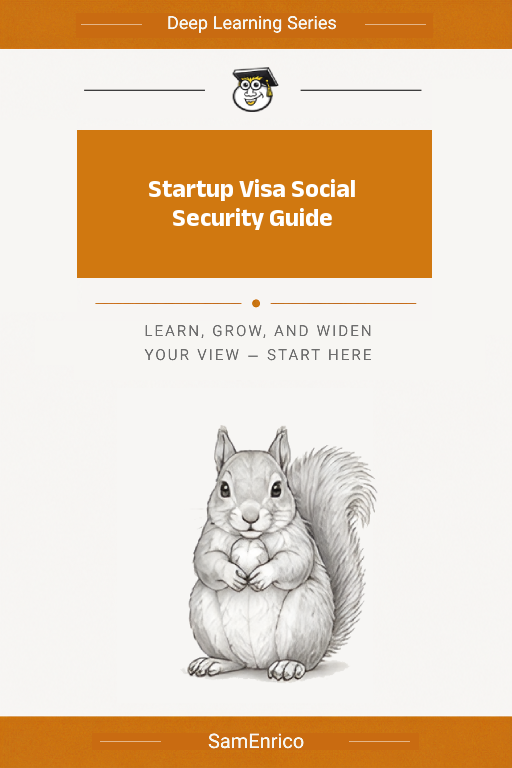
Non-FictionStartup GuideFounder Immigration
Startup Visa Social Security Guide eBook
Register for social security after startup visa. B
Register for social security after startup visa. Benefits and contributions explained.
Formats
Free sample
Chapter 1: The €47,000 Mistake--–- Marina had done everything right. She had a degree from a top European university, seven years of product management experience, and a startup that had just been accepted into one of Lisbon’s most respected accelerators. Her startup visa was approved in record time. She rented an apartment in Príncipe Real, opened a Portuguese bank account, and even learned enough Portuguese to order coffee without embarrassing herself. She was, by any reasonable measure, a model immigrant entrepreneur.–- What Marina did not do was register for social security.
Not because she was lazy or rebellious. Because no one told her she had to. Her immigration lawyer focused on the visa application itself. Her accountant set up her corporate tax ID but never mentioned Segurança Social. Her accelerator mentor talked about product-market fit, fundraising, and growth metrics.
Social security, in their world, was something for employees at traditional companies. Marina was a founder. She was building something. She would take care of herself.–- Eighteen months later, Marina felt a lump in her breast. She ignored it for three weeks because she was in the middle of a funding round.
When she finally saw a doctor, the diagnosis was aggressive. The treatment plan included surgery, chemotherapy, and radiation. The estimated cost for a private patient in Portugal was €47,000.–- Marina had private insurance. She had paid €89 per month for an international plan recommended by her home country’s expat forum. When she filed her claim, the insurance company denied it.
The reason? A clause buried on page 47 of her policy document stated that any condition requiring treatment within the first 24 months of coverage would be considered “pre-existing” unless proven otherwise. Marina could not prove otherwise. She had no Portuguese medical history. The insurance company offered to cancel her policy and refund her premiums.
That was all.–- Marina’s founder friend, Tiago, had also moved to Portugal on a startup visa around the same time. Tiago had registered for social security on his second day in the country. Not because he was smarter than Marina. Because his previous startup had failed in Canada, and he had learned the hard way that social security was not optional. Tiago walked Marina to the nearest Centro de Saúde, presented his social security registration and residence permit, and obtained a Número de Utente — a public health card — in forty minutes.
Marina, who had never registered, could not get the card.–- Tiago’s treatment was covered. Marina’s was not.–- Marina survived. Her startup did not. She drained her company’s bank account, then her personal savings, then borrowed from family. When she applied to renew her startup visa, immigration authorities requested her social security contribution history.
She had none. They denied her renewal on the grounds that she had failed to maintain the minimum requirements of her visa category. Marina was given thirty days to leave Portugal.–- She now runs her startup remotely from her parents’ apartment in a city she left fifteen years ago. Tiago received Portuguese citizenship last year. The difference between their outcomes was not skill, luck, or hard work.
It was a single administrative action that took forty minutes and cost €47 per month.–- This book exists because Marina’s story is not rare. It is the rule.The Invisible Risk That Founders Ignore–- Startup founders on visas share a peculiar blind spot. They obsess over runway, product-market fit, investor updates, and hiring timelines. They build financial models that project cash flow eighteen months into the future. They calculate customer acquisition costs to three decimal places.
They treat every expense as a line item to be optimized, negotiated, or eliminated.–- And they treat social security as a bureaucratic nuisance. A tax. A deduction from their already-stretched salary. Something to minimize, avoid, or deal with “later.”–- This chapter exists to reframe that assumption entirely. Social security is not a tax.
It is not a nuisance. It is the single most important financial asset you will acquire in your host country — and the one most founders discover only after they need it.The Three Pillars of Founder Risk–- Every human being faces risks: illness, accident, disability, unemployment, old age. Most people have safety nets: family support, home country health insurance, savings, credit history, friends who can lend money. Startup founders on visas have none of these. They are, by definition, living in a country where they have no family, no local credit history, no network of friends who have known them for decades, and often no savings beyond what is required for the visa itself.–- This creates a unique vulnerability that can be broken into three distinct pillars of risk.–- Pillar One: Healthcare Shock.
In your home country, you know how the system works. You know which hospitals are good, how to see a specialist, what your insurance covers. In a new country, you are a child again. You do not know the phone number for an ambulance. You do not know whether the emergency room requires payment upfront.
You do not know what happens if you cannot pay. A healthcare shock — a car accident, a sudden illness, a cancer diagnosis — is not just a medical event. It is a financial and legal event that can trigger visa revocation if you become a “public charge.” Every developed country has the legal authority to deport visa holders who rely on state-funded healthcare without having paid into the system. Marina learned this the hard way.–- Pillar Two: Disability. You are young.
You are healthy. You exercise. You eat well. Disability happens to other people. This is what every founder believes until it happens to them.
Disability does not mean paralysis or blindness. It means a herniated disk that prevents you from sitting at a computer for six weeks. It means long COVID that reduces your energy to two productive hours per day. It means depression that makes it impossible to pitch investors. In your home country, disability benefits might exist.
In your host country, they exist only if you have contributed to the social security system before becoming disabled. If you wait until you are disabled to register, you are too late.–- Pillar Three: Total Loss of Income. Startups fail. This is not pessimism. It is statistics.
More than ninety percent of startups fail within three years. Most founders have a Plan B: go back to consulting, take a job at a larger company, move to a lower-cost city. But if you are on a startup visa, your Plan B is constrained by immigration rules. You cannot simply “take a job” without work authorization. You cannot move to a lower-cost city if that city is in a different country.
If your startup fails and you have no social security contributions, you have no unemployment benefits, no healthcare, and no path to residency renewal. You have a plane ticket home.Why Private Insurance Is Not the Answer–- Every founder reading this chapter is thinking the same thing: “I have private insurance. I’m fine.”–- You are not fine. Private insurance is designed to protect the insurance company, not you.…
This is the end of the free sample. Get the eBook to keep going. Buy now
About this book
Details
- Author
- Bernard Genevive
- Publisher
- SamEnrico
- Language
- English
- Genre
- Non-Fiction, Startup Guide, Founder Immigration
- Released
- 2026-05-30
- Pages (approx.)
- 159
- Available as
- eBook, Audiobook

Read better in the ZLOADR app
Your eBooks on your phone or tablet. Sign in with your SamEnrico account and start reading.
More by Bernard Genevive
 Twenty Minutes Twice Daily GuideBernard Genevive$11.99
 The Sibling's PerspectiveBernard Genevive$11.99
 Retirement Community Entrance Fee AnalysisBernard Genevive$11.99
 The Google Keep Reminder GuideBernard Genevive$11.99
 Parenting Stress Relationship RescueBernard Genevive$11.99
 Love, Lies, and War: The Cold War's Deadliest Romance ScamBernard Genevive$11.99
 Understanding VulvodyniaBernard Genevive$17.99
 How to Start a Basins Made of Metal Business (Beginners Guide)Bernard Genevive$11.99
 Beta Test Terms GuideBernard Genevive$12.99
 Quartz Crystal Microbalance TechnicianBernard Genevive$11.99
You may also like
 Hong Kong Handover 1997Dunn Johnnie$11.99
 Zumba For Postnatal Recovery CourseNeal Christian$11.99
 Zumba for BeginnersLadner Nikia$11.99
 YouTube Comment Mining GuideHumes Pandora$12.99
 Worry Box MeditationCarlin Rudy$11.99
 Workplace Stress MeditationNguyen Lynn$11.99
 Workplace Stress and Sleep RepairHawley Ivory$11.99
 Workplace Perfectionism CureDelaney Jeffry$11.99
 Workplace Injustice Anger GuideWallen Isabelle$11.99
 Work Addiction and Burnout LinkGreenwood Ester$11.99
 Women in Yoga and WellnessBeattie Galina$11.99
 Women in Stand Up ComedyChun Evangeline$11.99