

Non-FictionMental WealthLeadership Mental HealthExit Guide
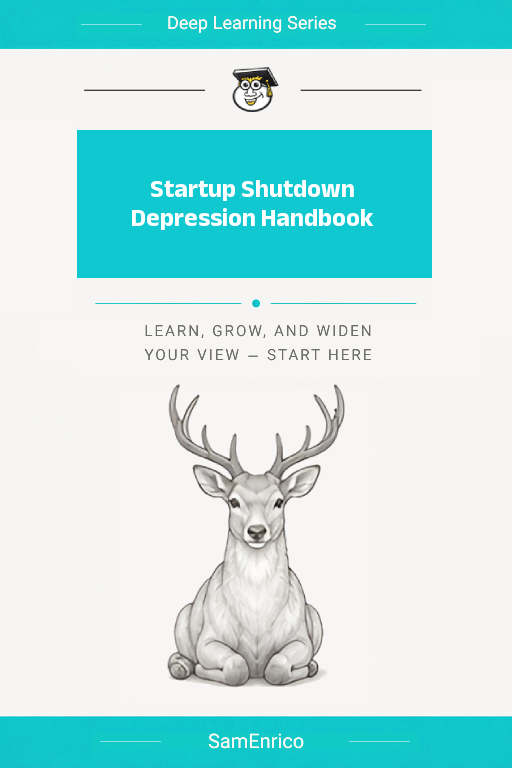
Startup Shutdown Depression Handbook eBook
Navigate startup failure or acquisition while alre
by Fite Tamekia
Navigate startup failure or acquisition while already depressed without spiraling deeper. Covers post-exit identity loss, liquidation logistics without burnout, and recovery planning.
Formats
Free sample
Chapter 1: The Dual Crisis--–- The Slack notification pinged at 11:47 PM. "Hey, any update on the Series A?" I stared at the message for a full minute, my thumbs hovering over the keyboard, knowing that the honest answer was "We're out of money and I've been lying to everyone for three months." Instead, I typed: "Working on it. Great convos this week." Then I closed my laptop, walked to the bathroom, and sat on the floor with my back against the tub, trying to remember the last time I had gone a full day without wanting to disappear.This is not a book about failure. This is a book about surviving failure when you were already drowning before the ship went down.If you are reading this, chances are you know exactly what I mean. You built a company because building something felt better than sitting alone with your thoughts.
You raised money because the adrenaline of a pitch meeting drowned out the voice that said you weren't good enough. You worked eighteen-hour days because exhaustion was the only reliable way to fall asleep without replaying every mistake you've ever made. The startup wasn't just your job. It was your antidepressant. Your therapy.
Your reason to get out of bed when getting out of bed felt like climbing a mountain with no summit.And now it's ending.The chapters that follow will give you a step-by-step framework for navigating shutdown while protecting what remains of your mental health. But before we get to the tactics, we need to name what's actually happening to you. Because if you don't understand the nature of this crisis, no amount of liquidation checklists or meditation apps will save you.The Scaffolding That Was Never Meant to Hold You Here is something no one tells you when you start a company: Entrepreneurs with pre-existing depression don't build startups the way other people do. Other people build startups to solve problems, get rich, or change the world. You built a startup to hold yourself together.Think of it this way.
A neurotypical founder has a solid internal foundation. They have a sense of self that exists independently of their work. They have coping mechanisms that don't depend on quarterly revenue targets. When their startup fails, they lose a project. It hurts.
It stings. But the foundation remains.You, on the other hand, built your startup as scaffolding. The scaffolding was never meant to be permanent, but it was the only thing keeping the structure of your life upright. Every morning you woke up and strapped yourself into the CEO role because that role gave you a script. You knew what to say, what to do, who to be.
The startup provided external structure for an internal chaos that you had never learned to manage on your own.Now the scaffolding is coming down.This is what I call the Double Grief Problem. First, you grieve the company. The mission. The team. The future you imagined.
That grief is real, and it hurts. But there is a second grief underneath it, deeper and more dangerous. You grieve the person you got to be when you had a company. The competent person. The visionary.
The one with answers. Without the startup, you're not sure who you are, and what you're finding in that empty space is the depression you've been outrunning for years.Most books about startup failure address the first grief. They tell you how to process the loss, learn from your mistakes, and bounce back. They assume you have a self to bounce back to.This book assumes you don't. Or at least, that you're not sure you do.
And that's why the standard advice—"just get back out there," "failure is a badge of honor," "your next venture will be your best"—can be not just useless but actively destructive for someone in your position.Why Hustle Culture Will Kill You Let me say something that might get me thrown out of every accelerator program in the country: Hustle culture is a death sentence for depressed founders.I don't mean that metaphorically. I mean that when you are clinically depressed, the physiological effects of chronic overwork—elevated cortisol, disrupted sleep, impaired executive function—compound the physiological effects of the depression itself. You are not just tired. You are not just burned out. You are experiencing a neurochemical cascade that makes it nearly impossible to think clearly, regulate your emotions, or make sound decisions.Here's what the research shows, stripped of academic language.
When a healthy person experiences stress, their cortisol levels spike and then return to baseline within a few hours. When a depressed person experiences stress, their cortisol levels spike and stay elevated, sometimes for days. This is not a character flaw. This is biology. Your HPA axis—the system that regulates your stress response—is literally wired differently.Now add startup shutdown to this picture.
You are not facing a normal stressor. You are facing the loss of your primary coping mechanism, your social identity, your daily structure, and your source of meaning, all at the same time. Your cortisol is not just elevated. It's flooding your brain. And every time you tell yourself to "hustle harder," "push through," or "just get it done," you are adding more fuel to a fire that is already burning out of control.This is what I call the Burn Rate Paradox.
The same hustle mentality that helped you build the company becomes lethally toxic when you try to shut it down. Because shutting down doesn't require speed. It requires discernment. It requires pacing. It requires the ability to say "not today" to non-urgent tasks and "this can wait" to everything except your own survival.But hustle culture has trained you to believe that slowing down is failure.
So you keep sprinting. You keep answering emails at 2 AM. You keep taking meetings you don't need to take. You keep telling yourself that if you can just close down fast enough, clean enough, professionally enough, you'll somehow redeem yourself.You won't. You'll just crash harder.The Munchery Mistake: When Hope Becomes a Weapon In 2016, the food delivery startup Munchery was valued at $300 million.
By 2019, it was out of money. But instead of shutting down immediately, the founder kept the company alive for another six months. He told investors he was exploring strategic alternatives. He told employees a buyer was imminent. He told himself that if he could just hold on a little longer, something would turn around.Nothing turned around.
The company died anyway, but only after bleeding out six more months of everyone's time, energy, and hope. And when the final shutdown came, it was worse than if he had pulled the plug earlier, because the six months of false hope had given everyone time to imagine a rescue that was never coming.I call this Zombie Mode: running a dead company to avoid facing a dead self.Zombie Mode is seductive for depressed founders because it feels like hope. Every morning you wake up and tell yourself that maybe today will bring a miracle. Maybe the investor will call back. Maybe the deal will close.
Maybe you don't have to face the reality that your company—the thing that has been holding you together—is over.But here…
This is the end of the free sample. Get the eBook to keep going. Buy now
About this book
Details
- Author
- Fite Tamekia
- Publisher
- SamEnrico
- Language
- English
- Genre
- Non-Fiction, Mental Wealth, Leadership Mental Health, Exit Guide
- Released
- 2026-05-30
- Pages (approx.)
- 117
- Available as
- eBook, Audiobook

Read better in the ZLOADR app
Your eBooks on your phone or tablet. Sign in with your SamEnrico account and start reading.
More by Fite Tamekia
 Blockchain for Supply Chain FinanceFite Tamekia$12.99
 Self Talk for Depression RecoveryFite Tamekia$11.99
 Childrens Influencer DisclosureFite Tamekia$11.99
 Beneficiary Designation Coordination CourseFite Tamekia$11.99
 Governor's Rural ChallengeFite Tamekia$11.99
 The Senior Move Manager Selection GuideFite Tamekia$11.99
 Silk and Shadows: The Spies of ConstantinopleFite Tamekia$11.99Blockchain for Supply Chain FinanceFite Tamekia$12.99
 Graphic DesignerFite Tamekia$11.99
 Understanding Isthmian CoarctationFite Tamekia$17.99
 How to Become a Nuclear Medicine TechnologistFite Tamekia$11.99
You may also like
 Hong Kong Handover 1997Dunn Johnnie$11.99
 Zumba For Postnatal Recovery CourseNeal Christian$11.99
 Zumba for BeginnersLadner Nikia$11.99
 YouTube Comment Mining GuideHumes Pandora$12.99
 Worry Box MeditationCarlin Rudy$11.99
 Workplace Stress MeditationNguyen Lynn$11.99
 Workplace Stress and Sleep RepairHawley Ivory$11.99
 Workplace Perfectionism CureDelaney Jeffry$11.99
 Workplace Injustice Anger GuideWallen Isabelle$11.99
 Work Addiction and Burnout LinkGreenwood Ester$11.99
 Women in Yoga and WellnessBeattie Galina$11.99
 Women in Stand Up ComedyChun Evangeline$11.99