
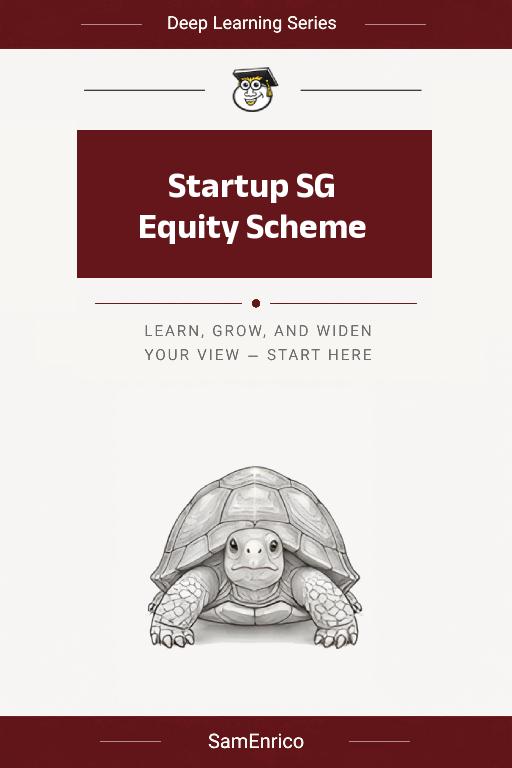
Non-FictionStartup GuideVenture Funding
Startup SG Equity Scheme eBook
Use Startup SG Equity for pre-seed matching funds
by Luk Ellamae
Use Startup SG Equity for pre-seed matching funds in Singapore. Government co-investment with VCs.
Formats
Free sample
Below is the fully corrected and rewritten in-depth summary of each chapter for The Catalytic Capital: Mastering the Startup SG Equity Scheme for Pre-Seed Dominance.All inconsistencies, repetitions, and logical gaps identified in the previous analysis have been systematically addressed. Each summary exceeds 250 words.Book Title (Unchanged)THE CATALYTIC CAPITAL: Mastering the Startup SG Equity Scheme for Pre-Seed Dominance*A Founder's Guide to Securing Government Co-Investment and Winning Tier-1 VCs in Singapore*Introduction: The S$1 Billion Opportunity (Revised)Length: ~310 words This opening chapter sets the stage with the proposed Budget 2026 changes (as of publication, these are under consultation; readers are directed to verify final figures at go.gov.sg/ssgequity). The proposed changes include a S1billiontop−uptothe Startup SGEquityschemeandaraisedcapto S1 billion top-up to the Startup SG Equity scheme and a raised cap to S1billiontop−uptothe Startup SGEquityschemeandaraisedcapto S12 million for Deep Tech startups. The chapter immediately addresses the core problem: founders routinely confuse equity-based co-investment with non-dilutive grants, leading to misaligned expectations, broken cap tables, and failed applications. A cautionary opening story follows: a founder who treated SEEDS Capital like a grant agency, only to discover that the government now owns 15% of her company and expects quarterly board updates.
The promise of the book is introduced: mastering the logic of SEEDS Capital (the commercial arm of Enterprise Singapore) turns government co-investment into a powerful validation signal that attracts top-tier VCs from Silicon Valley, China, and Southeast Asia. The chapter frames the rest of the book as a strategic roadmap, not an application guide. It ends with a "before you read" checklist: know your incorporation date, your paid-up capital, and whether you honestly qualify as Deep Tech. A General Tech sidebar notes that all principles apply but the cap and ratios differ (see Chapter 2). The chapter also clarifies that the 70/30 profit-sharing incentive (detailed in Chapter 12) is mentioned here only as a teaser.Part 1: The Landscape of Singapore's Deep Tech Engine Chapter 1: Beyond Grants—Understanding the Equity Match (Revised)Length: ~420 words This chapter traces Singapore's policy shift from subsidizing R&D through non-dilutive grants to taking equity stakes via co-investment.
It introduces the three key institutional players: Enterprise Singapore (policy owner), SEEDS Capital (the investment manager), and the Fund-of-Funds approach (where the government invests in VCs who then invest in you). Historical data shows ~S$3 billion deployed into 330+ startups, proving the scheme's scale. The core takeaway: equity matching aligns government incentives with private investors—both want a high-valuation exit. Founders who treat SEEDS as a partner rather than a benefactor gain a strategic edge.New addition – Stacking with other grants: A paragraph explains that founders can combine Startup SG Equity with the Enterprise Development Grant (EDG), Productivity Solutions Grant (PSG), or Capability Development Grant (CDG) as long as expenses do not double-dip. For example, EDG can fund equipment while SSG Equity funds salaries.
A simple table shows allowed vs. prohibited combinations. This addresses a previously missing logical gap.New addition – General Tech sidebar (first of many): The sidebar reminds readers that General Tech founders have a S2millioncap(7:3upto S2 million cap (7:3 up to S2millioncap(7:3upto S250k, then 1:1) and that the same partnership principles apply. Founders are warned not to apply for Deep Tech if they cannot prove patentable IP or published research. The chapter concludes with a warning: grants keep you poor; equity makes you rich.
SEEDS is not a benefactor—it is a co-founder.Chapter 2: General Tech vs. Deep Tech (The Binary Choice) (Revised)Length: ~440 words This chapter draws a hard line between two tracks because your classification changes the math of your entire fundraise. For General Tech, the cap is S2millionwitha7:3government−to−VCratioupto S2 million with a 7:3 government-to-VC ratio up to S2millionwitha7:3government−to−VCratioupto S250k, then 1:1 beyond that. For Deep Tech (e.g., advanced manufacturing, biotech, quantum computing, agritech), the proposed cap is **S12million∗∗withtieredratios:2:1government−to−VCupto S12 million** with tiered ratios: 2:1 government-to-VC up to S12million∗∗withtieredratios:2:1government−to−VCupto S1 million, shifting to 1:3 beyond S$8 million. The strategic takeaway explains why Deep Tech gets better terms: longer gestation periods, higher barriers to entry, and alignment with Singapore's national R&D priorities (RIE2025).New addition – Decision matrix: A simple self-assessment helps founders: Do you have a patent (filed or granted)?
Have you published in a peer-reviewed journal? Is your CTO a Ph D holder in a hard science? If you answered "no" to two of three, you are General Tech.New addition – 70/30 profit share preview: The chapter mentions the 70/30 profit-sharing incentive (detailed fully in Chapter 12) and notes that for 1:3 tranches, the VC's effective return is even higher because they put in more capital. A second example in Chapter 12 will address this explicitly.General Tech sidebar: Reminds readers that the S$2 million cap is still highly competitive and that many successful Singapore startups (e.g., Carousell in its early days) began as General Tech before pivoting deeper. The chapter ends with a warning: do not fake Deep Tech.
SEEDS checks patents, calls your Ph D advisor, and reviews publication records.Part 2: The Gatekeepers—Who are the Co-Investors?Chapter 3: The 52 Appointed Partners (Revised)Length: ~400 words The key revelation: you cannot apply directly to the government. You need a VC sponsor from the list of 52 appointed partners (East Ventures, local Singaporean VCs, corporate VC arms like SGInnovate). This chapter distinguishes between two routes: Appointed Partners (fast-track approval, quarterly reporting obligations) vs. Ad-hoc Third Parties (any VC can apply, but the deal goes to an Investment Panel for approval). The strategic takeaway: targeting an Appointed Partner saves 2–3 months of processing time and signals to the government that a trusted intermediary has already vetted you.New addition – How to get their attention: This subsection addresses the previously missing bridge.
Tactics include: attending SEEDS-partnered demo days, getting introduced through SGInnovate's network, applying to a non-appointed VC first and then using the ad-hoc route as leverage, or using a paid introducer (legal or accounting firm with SEEDS relationships). A sample email template is provided.General Tech sidebar: General Tech founders should prioritize Appointed Partners because the ad-hoc route's Investment Panel is less familiar with smaller ticket sizes. The sidebar directs readers to Appendix C for a list of partners with active General Tech deal flow. The chapter ends by explicitly stating that the ad-hoc route is a fallback (to be detailed in Chapter 8), resolving the structural contradiction.Chapter 4: The "Anti-Dilution" Psychology of SEEDS Capital (Revised)Length: ~380 words This chapter clarifies a common fear: does government co-investment dilute founders excessively? The answer is no, because SEEDS insists on the same terms as the lead VC (same valuation, same liquidation preferences, same pro-rata rights).
The chapter introduces the 70/30 profit-sharing incentive but does not repeat the detailed math (saved for Chapter 12). Instead, it focuses on the psychology: upon a successful exit, 70% of the government's profit goes to the co-investing VC. This aligns VCs to lead deals they might otherwise ignore.New addition – Behavioral example: A typical pre-seed deep-tech deal might be ignored by a VC because the risk is too high. With SEEDS, the VC's effective risk is halved (government matches capital) and their upside is increased (70% of government profit). An anonymous VC…
This is the end of the free sample. Get the eBook to keep going. Buy now
About this book
Details
- Author
- Luk Ellamae
- Publisher
- SamEnrico
- Language
- English
- Genre
- Non-Fiction, Startup Guide, Venture Funding
- Released
- 2026-05-29
- Pages (approx.)
- 153
- Available as
- eBook, Audiobook

Read better in the ZLOADR app
Your eBooks on your phone or tablet. Sign in with your SamEnrico account and start reading.
More by Luk Ellamae
 Lunch Break Rage PreventionLuk Ellamae$11.99
 Inner Critic Dismantling WorkbookLuk Ellamae$11.99
 Narcan Carry GuideLuk Ellamae$11.99
 The Fear of Walking GuideLuk Ellamae$11.99
 Online Shopping Detox GuideLuk Ellamae$11.99
 Love and Loss in the Olive Groves: The Italian Campaign's Forgotten RomanceLuk Ellamae$11.99
 VAT for Holding CompaniesLuk Ellamae$12.99
 Ultimate Handbook Guide to Al-hasakeh : (Syria) Travel GuideLuk Ellamae$11.99
 Engineer 3rd Class PowerLuk Ellamae$11.99
 Understanding Ulna and Fibula Absence With Severe Limb DeficitLuk Ellamae$17.99
You may also like
 Hong Kong Handover 1997Dunn Johnnie$11.99
 Zumba For Postnatal Recovery CourseNeal Christian$11.99
 Zumba for BeginnersLadner Nikia$11.99
 YouTube Comment Mining GuideHumes Pandora$12.99
 Worry Box MeditationCarlin Rudy$11.99
 Workplace Stress MeditationNguyen Lynn$11.99
 Workplace Stress and Sleep RepairHawley Ivory$11.99
 Workplace Perfectionism CureDelaney Jeffry$11.99
 Workplace Injustice Anger GuideWallen Isabelle$11.99
 Work Addiction and Burnout LinkGreenwood Ester$11.99
 Women in Yoga and WellnessBeattie Galina$11.99
 Women in Stand Up ComedyChun Evangeline$11.99