
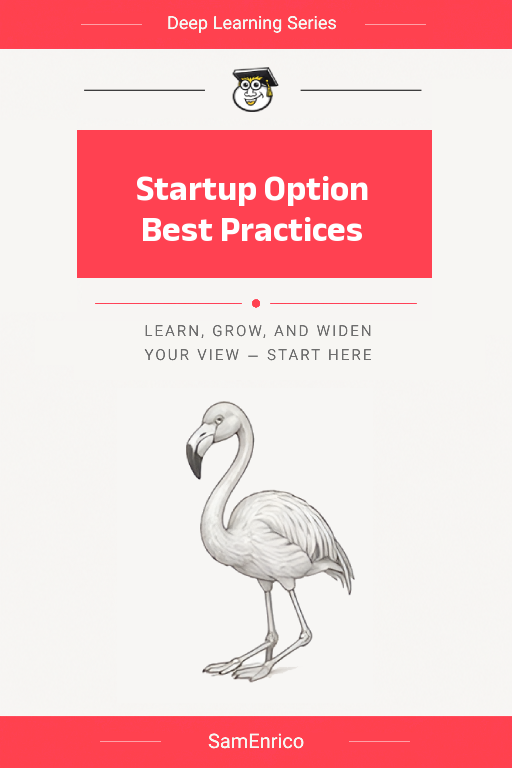
Startup Option Best Practices eBook
Design globally compliant option plans for early-s
Design globally compliant option plans for early-stage companies.
Formats
Free sample
Chapter 1: The Hundred-Thousand-Dollar Error--–- In 2018, a promising artificial intelligence startup called Neural Wave raised a 15million Series A.Thecompanyhadfiftyemployees,aworkingprototype,andcontractswiththree Fortune500customers.Thefounderswerecelebratedintechmediaasthenextbigthing.Eighteenmonthslater,Neural Wavewasacquiredfor15 million Series A. The company had fifty employees, a working prototype, and contracts with three Fortune 500 customers. The founders were celebrated in tech media as the next big thing. Eighteen months later, Neural Wave was acquired for 15million Series A.Thecompanyhadfiftyemployees,aworkingprototype,andcontractswiththree Fortune500customers.Thefounderswerecelebratedintechmediaasthenextbigthing.Eighteenmonthslater,Neural Wavewasacquiredfor200 million. It should have been a life-changing event for every employee.
Instead, it became a cautionary tale.The company had granted stock options to all fifty employees. The options were documented in a hastily assembled employee stock option plan that the founders had downloaded from an online template service. The plan had never been reviewed by a lawyer who understood global equity compensation. When the acquisition closed, the company discovered that the option agreements for seventeen employees—more than a third of the workforce—were missing critical signatures, contained incorrect vesting start dates, and in two cases, had never been properly issued at all. The acquirer's legal team refused to recognize those options.
The seventeen employees received nothing.One of them was Maria, a senior software engineer who had joined Neural Wave as the fifth employee. She had turned down a 250,000offerfrom Googletoworkat Neural Wavefora250,000 offer from Google to work at Neural Wave for a 250,000offerfrom Googletoworkat Neural Wavefora120,000 salary and a 1.5 percent option grant. She had worked nights, weekends, and through the birth of her first child. When the acquisition was announced, she calculated her share at roughly 3millionbeforetaxes.Thatmoneywasgoingtopayoffherstudentloans,buyahouse,andfundherdaughter′scollegeeducation.Afterthelegalreview,hersharewaszero.Thepaperworkerror—amissingsignatureonasinglepage—costher3 million before taxes. That money was going to pay off her student loans, buy a house, and fund her daughter's college education.
After the legal review, her share was zero. The paperwork error—a missing signature on a single page—cost her 3millionbeforetaxes.Thatmoneywasgoingtopayoffherstudentloans,buyahouse,andfundherdaughter′scollegeeducation.Afterthelegalreview,hersharewaszero.Thepaperworkerror—amissingsignatureonasinglepage—costher3 million.Maria sued. She lost. The courts upheld the acquirer's position: no validly executed option agreement, no options. The founder who had signed the defective agreements wept during his deposition.
He had known the documents were rushed. He had known they needed review. He had told himself he would fix it later. Later never came.This is not an isolated story. Every year, thousands of startups make mistakes with their equity that cost employees millions of dollars in lost wealth.
A 409A violation triggers surprise tax bills and IRS penalties. An improperly structured option pool dilutes employees into insignificance. A missing signature on an option agreement wipes out years of hard work. These mistakes are not inevitable. They are preventable.
But they require founders to treat equity with the seriousness it deserves.This chapter explains why stock options are the secret weapon of successful startups, what the research reveals about effective equity distribution, and how to develop an equity philosophy that will guide every decision in this book. You will learn the four stages of an option's life, the global equity gap that puts non-US employees at a disadvantage, and the critical warning that every founder must heed: create your ESOP before you make your first option grant.Why Stock Options Matter Stock options give employees the right to purchase shares of your company at a predetermined price, known as the strike price or exercise price. If the company's value increases, employees can buy shares at the old, lower price and capture the difference. This simple mechanism solves two problems that every early-stage startup faces.First, options allow you to compete for talent when cash is tight. You cannot pay Google or Meta salaries, but you can offer something those companies cannot: meaningful ownership in a company with massive upside potential.
As one founder put it, "Options are your secret weapon. They shift your compensation strategy from a mere cost center into a powerful magnet for top performers."Second, options align incentives. When employees own a piece of the company, they think like owners. They care about the long-term success of the business, not just their quarterly bonus. They recruit their friends.
They stay through difficult periods. They celebrate when the company wins because they win too. This alignment is not theoretical. Studies of startup outcomes consistently show that companies with broad-based equity ownership have lower turnover, higher employee engagement, and better long-term performance.The data backs this up. Index Ventures, one of Europe's leading venture capital firms, conducted a comprehensive study of startup equity across 73 European startups, analyzing over 4,000 individual option grants and surveying 53 startups covering approximately 11,000 employees.
Their conclusion: "If you are building a startup in Europe, sharing equity is not just fair, it is strategic. It attracts great people, locks in loyalty, and helps your company scale toward greatness."Yet despite this evidence, most startups get equity wrong. They treat it as an afterthought, a necessary evil, a box to check before getting back to building product. This attitude is the single biggest predictor of future equity disasters.The Four Stages of an Option's Life Before we go further, you need to understand the basic mechanics. Every stock option moves through four stages.
Each stage creates different legal, tax, and operational considerations. Most employees understand none of them.Stage One: Grant. The company gives the employee a contractual right to buy a specific number of shares at a fixed strike price. This is a promise, not ownership. No money changes hands at grant.
The grant is documented in an option agreement, which must be properly executed by both parties. A missing signature—as Maria discovered—can invalidate the entire grant.Stage Two: Vesting. The employee earns the right to exercise their options over time. The standard schedule is four years with a one-year cliff: nothing vests in the first year, then 25 percent vests at the one-year anniversary, and the remaining 75 percent vests monthly over the next 36 months. Vesting schedules are designed to encourage retention.
If an employee leaves before their options vest, they forfeit the unvested portion.Stage Three: Exercise. The employee pays the strike price to purchase actual shares. This is when ownership transfers. For incentive stock options (ISOs), exercise can have complex tax implications, including potential alternative minimum tax (AMT) liability. Many employees do not understand that exercising options can trigger a tax bill even if they have not sold any shares.Stage Four: Sale.
The employee converts their shares to cash at a liquidity event such as an acquisition or IPO. This is when they finally capture the value of their options. But even here, taxes apply. The difference between the sale price and the strike price is taxable as either ordinary income or capital gains, depending on how long the employee held the shares.Understanding these stages is essential because each one creates opportunities for mistakes. A poorly drafted grant agreement.
An incorrectly calculated vesting start date. An exercise that triggers unexpected AMT. A sale that could have been structured more tax-efficiently. Each mistake erodes employee wealth. Each mistake is preventable.The Global Equity Gap The Index Ventures study revealed significant differences between how US and European startups approach equity.
These differences matter because they show what is possible—and what is at stake.In the United States, a culture of employee…
This is the end of the free sample. Get the eBook to keep going. Buy now
About this book
Details
- Author
- England Michaela
- Publisher
- SamEnrico
- Language
- English
- Genre
- Non-Fiction, Business Brief
- Released
- 2026-05-30
- Pages (approx.)
- 131
- Available as
- eBook, Audiobook

Read better in the ZLOADR app
Your eBooks on your phone or tablet. Sign in with your SamEnrico account and start reading.
More by England Michaela
 Sam Sheppard Legal LegacyEngland Michaela$11.99
 Probiotics For IBS GuideEngland Michaela$11.99
 Witness Trauma Survivor GuideEngland Michaela$11.99
 Space Economy InvestmentEngland Michaela$11.99
 Compound Lifts MasteryEngland Michaela$11.99
 Postpartum Formula Feeding GuideEngland Michaela$11.99
 System Usability ScaleEngland Michaela$11.99
 Alcohol Recovery and EmploymentEngland Michaela$11.99
 Dreaming for Addiction RecoveryEngland Michaela$11.99
 The Last Theorem: Archimedes' Hidden CodeEngland Michaela$11.99
 The Silk and Steel of Charlemagne: Fashioning a RenaissanceEngland Michaela$11.99
 Gold, Glory, and the Ghost of MunichEngland Michaela$11.99
You may also like
 Hong Kong Handover 1997Dunn Johnnie$11.99
 Zumba For Postnatal Recovery CourseNeal Christian$11.99
 Zumba for BeginnersLadner Nikia$11.99
 YouTube Comment Mining GuideHumes Pandora$12.99
 Worry Box MeditationCarlin Rudy$11.99
 Workplace Stress MeditationNguyen Lynn$11.99
 Workplace Stress and Sleep RepairHawley Ivory$11.99
 Workplace Perfectionism CureDelaney Jeffry$11.99
 Workplace Injustice Anger GuideWallen Isabelle$11.99
 Work Addiction and Burnout LinkGreenwood Ester$11.99
 Women in Yoga and WellnessBeattie Galina$11.99
 Women in Stand Up ComedyChun Evangeline$11.99