

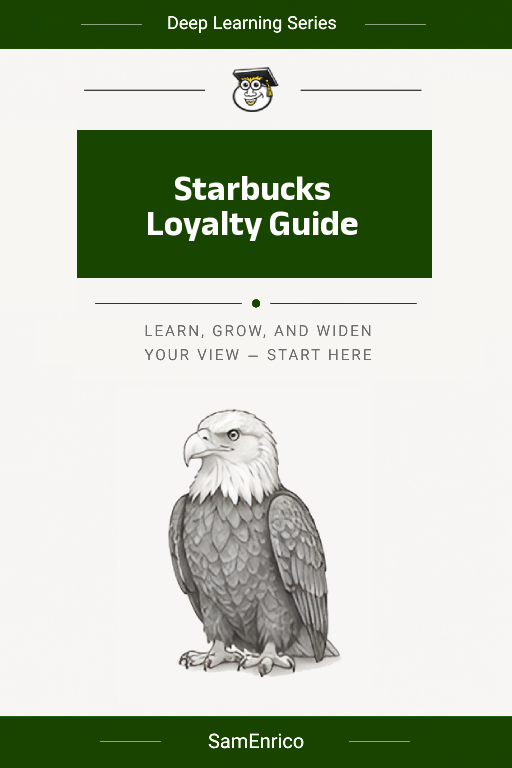
Non-FictionStrategic AtlasRetention Strategy
Starbucks Loyalty Guide eBook
Decode stars program, mobile order ahead, and pers
by Scully Suzi
Decode stars program, mobile order ahead, and personalized offers that increase frequency and spend.
Formats
Free sample
Chapter 1: The Ownership Trap--–- Every morning, 94 million people wake up and do the same thing. They stumble to their kitchen, or they pull into a drive-thru lane, or they tap a phone against a gray plastic reader. They exchange currency for caffeine. And then they walk away, having completed a transaction that is, by any rational measure, perfectly ordinary.But for 31 million of those people—the ones who have downloaded the Starbucks app, created an account, and started watching a little green circle fill up—something else is happening beneath the surface. They are not just buying coffee.
They are playing a game they did not know they had joined, and the rules are changing while they sleep.This chapter is about the moment loyalty programs stopped being about discounts and started being about identity. It is about the day Starbucks killed the punch card and replaced it with something far more dangerous: a psychological contract that makes you feel like you own a status you have only rented.Before we talk about stars, or tiers, or mobile hacks, we have to understand the trap you are already standing in. Because if you do not see the cage, you cannot build the key.The Punch Card Funeral Let us go back to 2008. Starbucks was bleeding customers. The Great Recession had turned the $4 latte into a symbol of financial irresponsibility.
People were brewing at home, and Howard Schultz—the man who built the empire—had just returned as CEO to find a company that had forgotten why it mattered.At the time, loyalty meant a paper punch card. Buy ten coffees, get the eleventh free. Simple. Transparent. Boring.
The average customer used 1.2 punch cards per year, and the redemption rate was steady but uninspiring. Starbucks knew it needed something different, but what?The answer came from an unexpected place: casinos. For decades, casinos had understood something that coffee companies had not. The human brain does not value a free drink the same way it values a gold card. Status is stickier than savings.
A player who feels like a "high roller" will spend seven times more than a player who just wants a free buffet. The reward is not the thing you get. The reward is the feeling of being the kind of person who gets the thing.In 2008, Starbucks launched its first digital loyalty program. It was clunky, web-based, and required customers to register physical gift cards online. But it planted a seed.
By 2016, the modern Starbucks Rewards program was born, and the punch card died a quiet death. Nobody mourned it.Why? Because the punch card treated all customers equally. And equality, it turns out, is terrible for business.The Mathematics of Emotional Progression To understand why tiers work, you have to understand a concept called the Endowment Effect. It sounds academic, but it is actually quite simple.
Psychologists Daniel Kahneman and Jack Knetsch demonstrated in a famous 1990 experiment that people value something they already own significantly more than something they do not own—even when the objective value is identical.In the experiment, one group of participants was given a coffee mug. Another group was not. The first group was asked how much money they would accept to sell the mug. The second group was asked how much they would pay to buy the mug. The mug was the same.
The market was the same. But the owners demanded roughly twice as much as the buyers were willing to pay.You are the owner of your Starbucks status. Not legally, of course. But psychologically, once you have achieved Gold status, that status feels like yours. You earned it.
You watched the progress bar fill. You told yourself you would just get to 500 Stars and then slow down.But here is the trap: losing something you own feels twice as painful as gaining something you never had. This is called loss aversion. And Starbucks has built an entire loyalty architecture around exploiting it.When you are a Green member (0 to 499 Stars in a calendar year), you are playing a gain game. Every star you earn brings you closer to a reward you do not yet have.
The motivation is positive. But once you cross the threshold into Gold, the psychology flips. Now you are playing a loss game. Every dollar you do not spend brings you closer to losing the status you already own. The motivation becomes fear.And fear, as any marketer will tell you, is a far more reliable engine than hope.The Three Tiers of Psychological Commitment Let me walk you through the architecture.
The new March 2026 program has three tiers. Each one is designed to capture a different level of behavioral commitment.Green Tier (0–499 Stars per calendar year)This is the courtship phase. Starbucks does not need you to be loyal yet. It just needs you to be curious. The benefits at this level are deliberately modest: free refills on brewed coffee (in-store only), birthday reward (one day only), and the ability to earn Stars.
The progress bar is your guide. It fills slowly at first, then accelerates as you approach 500 Stars because of a second psychological principle called the Goal Gradient Effect.The Goal Gradient Effect was first described by behaviorist Clark Hull in 1932. He noticed that rats running mazes moved faster as they got closer to the food. The same principle applies to humans. Whether you are saving for a house or finishing a project at work, you accelerate as you approach the finish line.Starbucks exploits this ruthlessly.
As you near 500 Stars, you will notice more "Double Star Days" appearing in your app. You will receive offers that expire just before your progress bar would reset. The algorithm knows exactly where you are on the journey, and it knows exactly when to apply pressure.Gold Tier (500+ Stars per calendar year)This is the commitment phase. You have crossed the threshold. You are now a Gold member, and the benefits change.
You earn 1.5 Stars per dollar instead of 1. You get a 7-day birthday window instead of 1 day. You get access to exclusive Gold-only offers.But the most important change is invisible. Once you are Gold, the progress bar shows your status expiration date. You know exactly when you will lose everything if you stop spending.
For most Gold members, that date is December 31 of the current year. If you do not earn 500 Stars in a calendar year, you drop back to Green on January 1.Let me show you the math of fear. To maintain Gold status, you need to spend 334peryearatthe Goldrate(500Stars÷1.5Starsperdollar).Thatisabout334 per year at the Gold rate (500 Stars ÷ 1.5 Stars per dollar). That is about 334peryearatthe Goldrate(500Stars÷1.5Starsperdollar).Thatisabout28 per month, or six lattes. For most Starbucks customers, that is not a stretch.
But here is what the company knows: once you are Gold, you will spend significantly more than $334.Why? Because the 334isthefloor,nottheceiling.Thefearoflosingstatusdoesnotmakeyouspendtheminimum.Itmakesyouspendanythingtoavoidtherisk.Youwillbuyamuffinyoudonotwant.Youwillreloadanextra334 is the floor, not the ceiling. The fear of losing status does not make you spend the minimum. It makes you spend anything to avoid the risk. You will buy a muffin you do not want.
You will reload an extra 334isthefloor,nottheceiling.Thefearoflosingstatusdoesnotmakeyouspendtheminimum.Itmakesyouspendanythingtoavoidtherisk.Youwillbuyamuffinyoudonotwant.Youwillreloadanextra20 you do not need. You will visit Starbucks when you pass one instead of…
This is the end of the free sample. Get the eBook to keep going. Buy now
About this book
Details
- Author
- Scully Suzi
- Publisher
- SamEnrico
- Language
- English
- Genre
- Non-Fiction, Strategic Atlas, Retention Strategy
- Released
- 2026-05-30
- Pages (approx.)
- 140
- Available as
- eBook, Audiobook

Read better in the ZLOADR app
Your eBooks on your phone or tablet. Sign in with your SamEnrico account and start reading.
More by Scully Suzi
 Nightmare Rescripting Therapy WorkbookScully Suzi$11.99
 Bipolar And Cannabis UseScully Suzi$11.99
 Smart Recovery OUD GuideScully Suzi$11.99
 Hidden Anger Triggers WorkbookScully Suzi$11.99
 The Fitness Culture Recovery GuideScully Suzi$11.99
 Stradivari’s Ghost: The Violin Maker Who Defied TimeScully Suzi$11.99
 How to Start a Tree Production BusinessScully Suzi$11.99
 Understanding Processing DisorderScully Suzi$17.99
 Executive Summary for Financial PlansScully Suzi$12.99
 Court Security OfficerScully Suzi$11.99
You may also like
 Hong Kong Handover 1997Dunn Johnnie$11.99
 Zumba For Postnatal Recovery CourseNeal Christian$11.99
 Zumba for BeginnersLadner Nikia$11.99
 YouTube Comment Mining GuideHumes Pandora$12.99
 Worry Box MeditationCarlin Rudy$11.99
 Workplace Stress MeditationNguyen Lynn$11.99
 Workplace Stress and Sleep RepairHawley Ivory$11.99
 Workplace Perfectionism CureDelaney Jeffry$11.99
 Workplace Injustice Anger GuideWallen Isabelle$11.99
 Work Addiction and Burnout LinkGreenwood Ester$11.99
 Women in Yoga and WellnessBeattie Galina$11.99
 Women in Stand Up ComedyChun Evangeline$11.99