
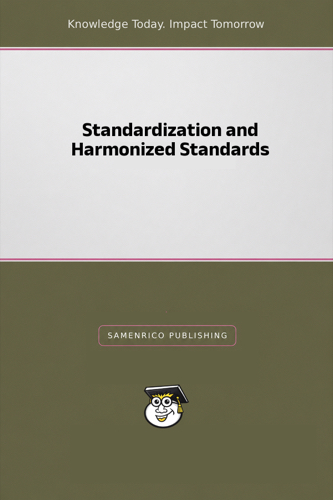
Non-FictionAnnual CheckupStandards Compliance
Standardization and Harmonized Standards eBook
Use EU harmonized standards for presumed conformit
Use EU harmonized standards for presumed conformity.
Formats
Free sample
Chapter 1: The Washing Machine War--–- In the winter of 1983, a Swedish company called Electrolux found itself in an impossible situation. It had designed a washing machine that was safe, efficient, and affordable. The machine passed every test in its home country with flying colors. But when Electrolux tried to sell the same machine in West Germany, they were told to redesign the electrical housing. When they tried France, they were told the drum dimensions violated a national standard.
When they tried Italy, they were told the water inlet valve did not meet local specifications. By 1984, Electrolux was manufacturing eleven slightly different versions of the same washing machine for eleven different European markets. The cost of managing eleven production lines, eleven sets of spare parts, and eleven technical files was eating the company alive. Electrolux was not alone. Across Europe, thousands of companies were bleeding money on what became known as "technical barriers to trade." A light bulb manufacturer in the Netherlands could not sell to Belgium without changing the base fitting.
A toymaker in Denmark could not sell to Greece without requalifying every plastic compound. A power tool company in Italy could not sell to Ireland without retesting every motor winding. The common market, which was supposed to allow goods to flow freely across borders, had become a patchwork of national fiefdoms. Each country protected its domestic industry by writing technical standards that foreign competitors could not easily meet. Some of these standards had legitimate safety purposes.
Many did not. But even the legitimate ones varied so wildly that compliance with one country told you nothing about compliance with the next. The European Commission estimated that technical barriers to trade were costing European industry more than 100 billion ECU annually—roughly 200 billion euros in today's money. More importantly, these barriers were preventing European companies from achieving the economies of scale that American and Japanese competitors enjoyed. A washing machine manufacturer in the United States designed one machine for a market of 200 million people.
A washing machine manufacturer in Europe designed eleven machines for markets that together also totaled roughly 200 million people, but with eleven times the engineering cost, eleven times the inventory cost, and eleven times the compliance cost. The European project was failing. Then, in 1985, everything changed.The Birth of an Idea The Commission's response to the washing machine war was a document called the "New Approach to Technical Harmonization and Standards," published in May 1985. The title was deliberately bureaucratic—this was, after all, a document written by civil servants—but the idea inside was revolutionary. The Commission proposed a radical reversal of how regulation worked.
Before 1985, the European Community had tried to harmonize technical rules by writing detailed, product-by-product laws. For every product category—washing machines, light bulbs, toys, power tools—the Community would produce a directive that specified exactly how the product had to be designed. Every screw, every wire, every material was defined in law. The result was directives that ran hundreds of pages, took years to negotiate, and were obsolete by the time they were published because technology had moved on. By 1985, the Community had managed to harmonize only about 200 product categories in three decades.
At that rate, it would take centuries to cover everything.The New Approach turned this model on its head. Instead of writing detailed technical specifications into law, the Commission proposed writing only high-level safety goals—called Essential Requirements—into directives. The Essential Requirements would say what a product must achieve (be safe, be healthy, be environmentally sound) but not how to achieve it. The how-to would be delegated to private technical organizations: CEN, CENELEC, and ETSI. These organizations would write voluntary standards that provided technical solutions for meeting the Essential Requirements.
A manufacturer who followed the standard would be presumed to have met the law. A manufacturer who chose not to follow the standard could still comply, but would have to prove safety through other means.The genius of this system was that it decoupled the speed of lawmaking from the speed of technology. The law—the directive with its Essential Requirements—could be stable for decades. The standards could be updated every few years as technology evolved. More importantly, the system created a powerful incentive for manufacturers to use standards.
The presumption of conformity was not just a legal nicety; it was a market access weapon. A manufacturer who used the standard could sell throughout the EU without further testing. A manufacturer who did not use the standard faced the burden of proving compliance to 27 different national authorities, each with its own interpretation of the Essential Requirements.The Legal Architecture of the New Approach To understand why Chapter 1 matters for anyone selling products in Europe today, we have to understand three legal documents that form the backbone of the system. The first is the 1985 New Approach resolution itself, which is technically not a law but a political agreement among member states. The second is Decision 768/2008/EC, known as the New Legislative Framework or NLF, which updated and codified the New Approach into binding law.
The third is Regulation (EU) 2019/1020 on market surveillance, which gave enforcement teeth to the entire system.The NLF is particularly important because it standardized the language and procedures across all product directives. Before the NLF, each directive had its own definitions of "manufacturer," "importer," "distributor," and "authorized representative." Each directive had its own rules for conformity assessment, its own format for declarations, its own requirements for technical documentation. The NLF harmonized all of this. Today, when you read the CE marking directive for machinery, medical devices, or radio equipment, you will find the same definitions, the same obligations, and the same basic structure—all derived from the NLF.The NLF also introduced the modern concept of the "economic operator." Under the NLF, a manufacturer is the person who designs or manufactures a product and places it on the market under their own name. An importer is the person who brings a product from outside the EU into the EU market.
A distributor is the person who makes a product available on the market without modifying it. And an authorized representative is a person established in the EU who acts as the manufacturer's agent for regulatory purposes. Each of these roles carries specific legal obligations. A manufacturer must design and produce the product in compliance with all applicable requirements, draw up technical documentation, issue a declaration of conformity, and affix the CE marking. An importer must verify that the manufacturer has done these things and must keep a copy of the declaration of conformity for 10 years.
A distributor must act with due care and cannot make a product available if they know or should know that it is non-compliant.The Essential Requirements: What the Law Actually Says Let us look at an actual directive to see how Essential Requirements work in practice. The Low Voltage Directive (2014/35/EU) is one of the oldest and simplest. Its Essential Requirements fill less than one page of the Official Journal. They state, in essence, that electrical equipment must be safe. Specifically, the equipment must be designed and manufactured so that it does not endanger the safety of persons, domestic animals, or…
This is the end of the free sample. Get the eBook to keep going. Buy now
About this book
Details
- Author
- Melancon Chanelle
- Publisher
- SamEnrico
- Language
- English
- Genre
- Non-Fiction, Annual Checkup, Standards Compliance
- Released
- 2026-06-06
- Pages (approx.)
- 142
- Available as
- eBook, Audiobook

Read better in the ZLOADR app
Your eBooks on your phone or tablet. Sign in with your SamEnrico account and start reading.
More by Melancon Chanelle
 Workload Renegotiation HandbookMelancon Chanelle$11.99
 Mountain Meditation GuideMelancon Chanelle$11.99
 Cousteau's Legacy FoundationMelancon Chanelle$11.99
 The RLS Leg Elevation and Positioning GuideMelancon Chanelle$11.99
 The Ghost Admiral: How Isoroku Yamamoto Outmaneuvered the PacificMelancon Chanelle$11.99
 How to Start a On-line Employment Placement Agencies Business (Beginners Guide)Melancon Chanelle$11.99
 Acceptance Criteria DefinorMelancon Chanelle$11.99
 SaaS Pricing Model EvolutionMelancon Chanelle$12.99
 Voiceover & Dubbing Automation WorkbookMelancon Chanelle$12.99
 Understanding Kjer's Optic NeuropathyMelancon Chanelle$17.99
You may also like
 Hong Kong Handover 1997Dunn Johnnie$11.99
 Zumba For Postnatal Recovery CourseNeal Christian$11.99
 Zumba for BeginnersLadner Nikia$11.99
 YouTube Comment Mining GuideHumes Pandora$12.99
 Worry Box MeditationCarlin Rudy$11.99
 Workplace Stress MeditationNguyen Lynn$11.99
 Workplace Stress and Sleep RepairHawley Ivory$11.99
 Workplace Perfectionism CureDelaney Jeffry$11.99
 Workplace Injustice Anger GuideWallen Isabelle$11.99
 Work Addiction and Burnout LinkGreenwood Ester$11.99
 Women in Yoga and WellnessBeattie Galina$11.99
 Women in Stand Up ComedyChun Evangeline$11.99