
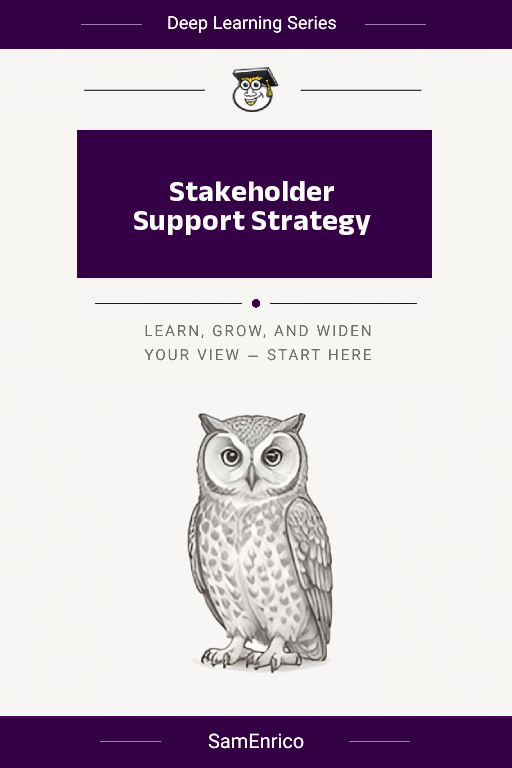
Non-FictionProfessional's Cheat SheetStakeholders
Stakeholder Support Strategy eBook
Identify and gain support from key stakeholders fo
Identify and gain support from key stakeholders for promotion business case.
Formats
Free sample
Chapter 1: The Spreadsheet Delusion--–- The rejection came on a Tuesday afternoon, but the dying started six weeks earlier.I had spent every night and weekend building what I believed was the perfect promotion business case. Forty-seven slides. Twelve financial models. Three external benchmarks. A five-year ROI projection with sensitivity analyses for bull, bear, and base cases.
I had even color-coded the appendices. My manager, Sarah, had called it “the most thorough case she’d ever seen.” My mentor had said, “They can’t say no to this.” My spouse had stopped asking when I’d come to bed.The decision meeting lasted eleven minutes.I know because I checked my watch when I entered the conference room and again when I walked out. Eleven minutes. The SVP of Operations, a man named David who had never spoken to me directly, delivered the verdict without looking up from his laptop. “We appreciate the work you’ve put into this,” he said.
“But we don’t feel the timing is right.”We don’t feel the timing is right.Not “the numbers don’t add up.” Not “we need more data.” Not “your ROI projection is flawed.” A feeling. Eleven minutes of my life, six weeks of my nights, three years of proven performance—and the decision came down to a feeling.I smiled, nodded, walked to my car, and sat in the driver’s seat for twenty minutes without starting the engine. I wasn’t angry. I was confused. How could forty-seven slides lose to a feeling?
What had I missed? And why did no one warn me that the spreadsheet was a lie?The 70% Problem That night, I started reading. Not business cases—those had failed me. I read research on decision-making, organizational politics, and stakeholder management. What I found changed everything.A metastudy of cross-functional initiatives across 220 companies found that 70 percent fail due to stakeholder friction, not flawed strategy.
Not bad ideas. Not poor execution. People. Specifically, the failure to identify, understand, and engage the human beings whose cooperation you need.Let me repeat that because it is the single most important sentence in this book: Seventy percent of initiatives fail because of stakeholder friction, not because the strategy was wrong.The researchers controlled for every variable they could think of: market conditions, resource availability, competitive pressure, even the weather. The single strongest predictor of success was not the quality of the business case.
It was the quality of the stakeholder map. The teams that won were not the teams with the best spreadsheets. They were the teams that knew who had Veto Power, who had Swing Vote influence, and who was Noise—and who acted on that knowledge before they ever opened Power Point.My forty-seven slides were beautiful. But I had never had a single conversation with David, the SVP of Operations. I had assumed that data would speak for itself.
I had assumed that logic would compel action. I had assumed that the best case would win.I was wrong about every assumption.How Decisions Actually Get Made The second thing I discovered that night came from the work of Gary Klein, a cognitive psychologist who studied how real people make real decisions under real pressure. Klein’s book Sources of Power describes something he calls “recognition-primed decision-making.” Here is what Klein found: when experts face a complex decision, they do not run a cost-benefit analysis. They do not compare options on a spreadsheet. They do not calculate expected value.Instead, they do three things.First, they size up the situation in seconds, using pattern recognition.
“This feels like the Acme disaster of 2019.” “This looks like the Johnson merger.” They are not analyzing. They are matching.Second, they run a mental simulation of the first option that comes to mind. “If I do X, what happens?” They play the movie in their head, looking for obvious failure points.Third, if the simulation doesn’t blow up, they act. If it does blow up, they move to the next option that comes to mind. They do not compare ten options.
They compare maybe two. And they never, ever build a spreadsheet.This is how your stakeholders actually decide. Not with models. With stories. Not with data.
With patterns. Not with logic. With a feeling that a particular path will work—or won’t.I had spent six weeks building a spreadsheet for brains that don’t use spreadsheets to decide. No wonder I lost to a feeling.The Pre-Mortem: Your First Strategic Tool The third discovery that night was a tool so simple I felt stupid for not inventing it myself. It comes from project management and cognitive psychology, and it is called the Pre-Mortem.Here is how a Pre-Mortem works.
Before you launch any major initiative—including, and especially, a promotion business case—you gather a small group of trusted people. You say to them: “It is six months from now. Our promotion case has failed spectacularly. The decision-makers said no. Our reputation is damaged.
The opportunity is lost. Now, work backward. Why did we fail?”Then you shut up and listen.The magic of the Pre-Mortem is that it bypasses the natural human tendency toward optimism. When you ask people, “What could go wrong?” they will give you polite, obvious answers. “Budget cuts.” “Competition.” “Weather.” When you ask, “It already failed.
Why?” they will give you specific, uncomfortable, political answers. “Because David never trusted you.” “Because the CFO owed a favor to your competitor.” “Because legal had a grudge from that thing two years ago.”I ran my first Pre-Mortem a week after the rejection. I gathered three colleagues who had known about my failed case. I said the magic words. Within ten minutes, I had a list of nine reasons I had never considered.
Reason number three: “David’s protégé was also up for a promotion, and your case would have made him look bad.” Reason number six: “The CMO thought your efficiency gains would come out of her marketing budget, but she never told you because you never asked.” Reason number eight: “Your spreadsheet was so detailed that no one wanted to admit they didn’t understand it, so they just said ‘no’ instead of looking stupid.”Every single one of those reasons was a human reason. Not a single one was about the quality of my data. My data was fine. My stakeholder map was blank.The Three Kinds of Stakeholder Failure Over the next year, as I rebuilt my approach and eventually won the promotion I had been denied, I began to notice patterns. The people who succeeded at stakeholder support—the ones who always seemed to get their initiatives approved, their promotions granted, their budgets increased—did something different.
They didn’t work harder than me. They didn’t have better data than me. They had a better map.I identified three distinct ways that stakeholder strategies fail. Every failure I have seen in the decade since fits into one of these three buckets.Failure Type One: The Invisible Stakeholder. This is what happened to me.
I didn’t know David existed as a decision-maker. I didn’t know his protégé was a competitor. I didn’t know the…
This is the end of the free sample. Get the eBook to keep going. Buy now
About this book
Details
- Author
- Cronin Nobuko
- Publisher
- SamEnrico
- Language
- English
- Genre
- Non-Fiction, Professional's Cheat Sheet, Stakeholders
- Released
- 2026-06-01
- Pages (approx.)
- 132
- Available as
- eBook, Audiobook

Read better in the ZLOADR app
Your eBooks on your phone or tablet. Sign in with your SamEnrico account and start reading.
More by Cronin Nobuko
 Sleep Meditation for ExecutivesCronin Nobuko$11.99
 Airline Pilot Fatigue ManagementCronin Nobuko$11.99
 The Overland Film MakerCronin Nobuko$11.99
 Exercise For Menopause GuideCronin Nobuko$11.99
 The Caregiver Emotional Burnout RecoveryCronin Nobuko$11.99
 The Star Chart of the Aztec Cosmos: Mapping the Heavens in Stone and BloodCronin Nobuko$11.99
 Shadows of the Forgotten War: The Unseen Battle of the ChacoCronin Nobuko$11.99
 Understanding Fifth DiseaseCronin Nobuko$17.99
 Synovial Fluid AnalysisCronin Nobuko$11.99
 Prompt Engineering for Code ReviewersCronin Nobuko$12.99
 How to Start a Printer Ink Cartridges Business (Beginners Guide)Cronin Nobuko$11.99
You may also like
 Hong Kong Handover 1997Dunn Johnnie$11.99
 Zumba For Postnatal Recovery CourseNeal Christian$11.99
 Zumba for BeginnersLadner Nikia$11.99
 YouTube Comment Mining GuideHumes Pandora$12.99
 Worry Box MeditationCarlin Rudy$11.99
 Workplace Stress MeditationNguyen Lynn$11.99
 Workplace Stress and Sleep RepairHawley Ivory$11.99
 Workplace Perfectionism CureDelaney Jeffry$11.99
 Workplace Injustice Anger GuideWallen Isabelle$11.99
 Work Addiction and Burnout LinkGreenwood Ester$11.99
 Women in Yoga and WellnessBeattie Galina$11.99
 Women in Stand Up ComedyChun Evangeline$11.99