
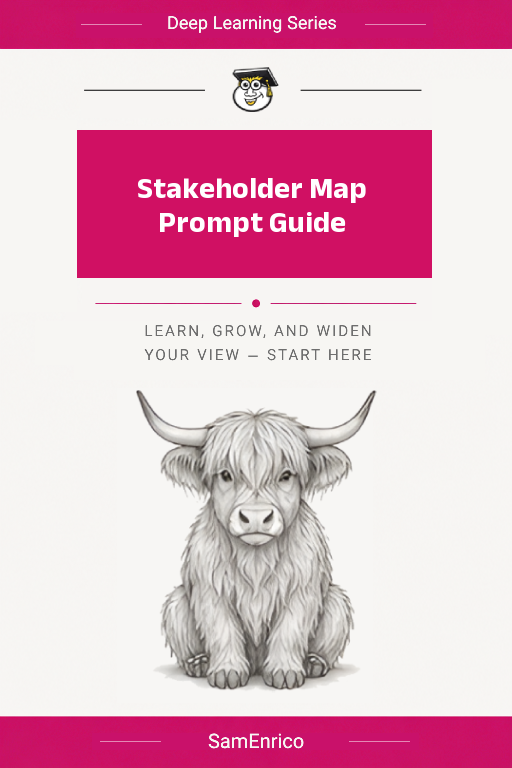
Stakeholder Map Prompt Guide eBook
Generate stakeholder matrices identifying influenc
Generate stakeholder matrices identifying influence, interest, and engagement strategies using prompts that analyze project roles and relationships.
Formats
Free sample
Chapter 1: The Whiteboard Lie--–- The meeting was going perfectly. I had my color-coded sticky notes arranged in a neat 2x2 grid on the conference room whiteboard. The project sponsor nodded approvingly. The team looked confident. We had identified eight stakeholders—the usual suspects: Sponsor, Finance, Legal, IT, Operations, Marketing, External Vendors, and Customers. I even added a ninth for good measure: "Regulatory Bodies," because it sounded thorough.Three months later, the project was dead.Not because the technology failed. Not because we ran out of budget. Because of a stakeholder who wasn't on my whiteboard. A mid-level manager in a department called "Legacy Systems Integration"—a role I didn't know existed until his veto arrived via email at 4:47 PM on a Friday. His name was Gerald. He had been copied on exactly one email six weeks earlier. He waited until the critical design review to announce, "This conflicts with a compliance remediation I'm running. You'll need to pause for six to eight months."The project didn't pause. It died. The sponsor lost confidence. The team scattered. And I learned a brutal lesson: my beautiful, color-coded stakeholder map was not just incomplete—it was dangerously, catastrophically wrong.This book exists because that meeting happened to me. And if you're reading this, it has probably happened to you, too.The Hidden Epidemic of Incomplete Maps Let me name something that most project management books dance around: stakeholder mapping is the most frequently botched exercise in all of project management, and nobody talks about it.We pretend it's simple. List everyone affected by or able to affect your project. Plot them on a grid. Talk to them. Done. But the data tells a different story. Research from the Project Management Institute consistently finds that poor stakeholder engagement is a primary contributor to project failure in nearly one-third of all projects. Not technical failure. Not budget overruns. Failure to identify, understand, and engage the right people.Why does this happen? Not because project managers are lazy or incompetent. It happens because of something I call The Whiteboard Lie—the false belief that a handful of obvious stakeholders, arranged neatly in front of you, represent the full political reality of your project.The Whiteboard Lie has three components.First, the visibility bias: we naturally remember and prioritize stakeholders with formal titles, corner offices, and loud voices. The quiet stakeholder—the compliance officer who never speaks in meetings, the subject matter expert who works remotely, the former project lead who still has informal influence—simply doesn't register.Second, the recency trap: we list stakeholders based on who we interacted with last week, not who might matter next month. If Gerald from Legacy Systems hasn't emailed anyone in 45 days, he doesn't make the list.Third, the confidence delusion: we mistake a neatly formatted grid for a complete analysis. The aesthetic pleasure of color-coded sticky notes tricks our brains into thinking the work is done. It is not. It has barely begun.I have seen this pattern repeat across tech companies, financial institutions, healthcare organizations, and government agencies. A team spends ninety minutes building a beautiful stakeholder map. They feel proud. They move to execution. And then—three weeks, three months, or three quarters later—a stakeholder they never listed emerges from the shadows and kills everything.The Whiteboard Lie is not a moral failing. It is a cognitive limitation. The human brain cannot track forty-seven relationships simultaneously. It cannot predict every handshake line between departments. It cannot hold the emotional history of a ten-year organizational feud. That is not your fault. But it is your problem.Why Your Brain Is Wired to Fail at This To understand why manual stakeholder mapping fails so consistently, we need to talk about cognitive load. Cognitive load is the total amount of mental effort being used in your working memory. And your working memory has a famously small capacity.The psychologist George Miller published a paper in 1956 called "The Magical Number Seven, Plus or Minus Two," which suggested that the number of objects an average human can hold in working memory is about seven. Seven. That's it. You can track approximately seven relationships, seven risks, seven priorities at any given moment. Everything else leaks out.Now consider the average mid-sized project. A typical enterprise software implementation, a new product launch, a reorganization—these efforts routinely involve forty to sixty identifiable stakeholders. Some projects cross one hundred. The 2023 CHAOS Report from the Standish Group found that projects with more than fifty stakeholders are three times more likely to be challenged or impaired than projects with fewer than twenty.Three times more likely. That is not a minor correlation. That is a slaughter.Here is what happens inside your brain when you try to manually map forty stakeholders. You begin with the obvious ones—the ones you talk to every day. That's maybe five people. Then you think of your boss's boss. That's six. Then Legal, because Legal is always a stakeholder. That's seven. Your working memory is now full. Everything after this requires conscious effort, external notes, and repeated prompting. And here is the cruelest part: the stakeholders who require the most mental effort to recall are often the most dangerous, because they are the least obvious.Gerald from Legacy Systems—the one who killed my project—was not in my daily meetings. He was not on the org chart I had access to. He was not mentioned in the project charter. He existed in the institutional memory of a senior developer who had been with the company for twelve years and happened to remember, "Oh, you should probably talk to Gerald. He's got some legacy thing that might touch this."The senior developer mentioned Gerald in passing, during a coffee break, after I had already finalized the stakeholder map. I did not add Gerald to the whiteboard because I was already at cognitive capacity. I had seven stakeholders. Adding an eighth felt like overcomplicating things.You see the tragedy now. The stakeholder who killed the project was excluded not because I was careless, but because my brain literally could not hold one more piece of information without dropping something else.This is not a personal failing. It is a hardware limitation. And hardware limitations require tools, not willpower.What the Top 10 Books Actually Teach (And What They Miss)Before we build the AI-powered solution, let me honor the foundational work. The top ten stakeholder management books of the past thirty years contain genuinely valuable frameworks. I have read all of them. Some twice. They are not wrong. They are incomplete in the same way that a map of a city is not wrong, but useless if you cannot find your current location.Here are the core models you will find across these books, synthesized into a single coherent landscape:Mendelow's Power/Interest Grid (from Aubrey Mendelow's 1991 research) is the workhorse. It places stakeholders on two axes: their power to affect the project and their interest in the project's outcomes. The four resulting quadrants give you clear strategies: Manage Closely (high power, high interest), Keep Satisfied (high power, low interest), Keep Informed (low power, high interest), and Monitor (low power, low interest). This grid appears in some form in nearly every stakeholder book on the shelf, and for good reason—it works. We will spend significant time on it in Chapter 4.The Salience Model (Mitchell…
This is the end of the free sample. Get the eBook to keep going. Buy now
About this book
Details
- Author
- Hardesty Alpha
- Publisher
- SamEnrico
- Language
- English
- Genre
- Non-Fiction, AI Operator
- Released
- 2026-05-29
- Pages (approx.)
- 154
- Available as
- eBook, Audiobook

Read better in the ZLOADR app
Your eBooks on your phone or tablet. Sign in with your SamEnrico account and start reading.
More by Hardesty Alpha
 Morning Mindset RitualsHardesty Alpha$11.99
 Women's Gun Violence ActivismHardesty Alpha$11.99
 Belgium Green IncentivesHardesty Alpha$11.99
 Mindfulness Techniques for Cannabis CravingsHardesty Alpha$11.99
 Psychopathy and Recidivism RatesHardesty Alpha$11.99
 Spaced Repetition for CodingHardesty Alpha$11.99
 Caregiver Self Care GuideHardesty Alpha$11.99
 Work Experience Bullet PointsHardesty Alpha$11.99
 The Vanishing Hour: How 1977’s Great Blackout Could Rewrite HistoryHardesty Alpha$11.99
 Understanding Lumbar Disc DiseaseHardesty Alpha$11.99
 A Collector's Handbook to the Chrysler (Aus) Chrysler Charger 770Hardesty Alpha$11.99
 How to Produce Slot MachinesHardesty Alpha$11.99
You may also like
 Hong Kong Handover 1997Dunn Johnnie$11.99
 Zumba For Postnatal Recovery CourseNeal Christian$11.99
 Zumba for BeginnersLadner Nikia$11.99
 YouTube Comment Mining GuideHumes Pandora$12.99
 Worry Box MeditationCarlin Rudy$11.99
 Workplace Stress MeditationNguyen Lynn$11.99
 Workplace Stress and Sleep RepairHawley Ivory$11.99
 Workplace Perfectionism CureDelaney Jeffry$11.99
 Workplace Injustice Anger GuideWallen Isabelle$11.99
 Work Addiction and Burnout LinkGreenwood Ester$11.99
 Women in Yoga and WellnessBeattie Galina$11.99
 Women in Stand Up ComedyChun Evangeline$11.99