
Non-FictionAI OperatorBusiness CommunicationInterviewing
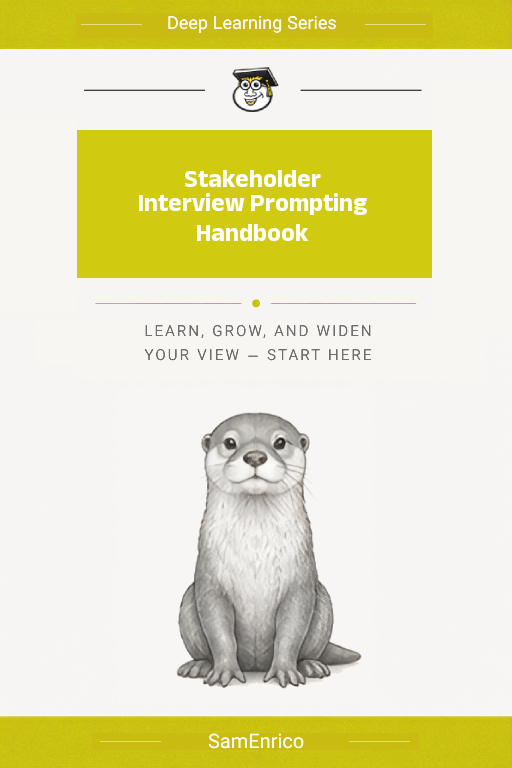
Stakeholder Interview Prompting Handbook
Design discovery prompts that uncover hidden assum
Design discovery prompts that uncover hidden assumptions and conflicting priorities. Turn interview notes into structured requirement documents instantly.
Formats
About this book
Free sample
Chapter 1: The Dashboard Lie--–- “We need a dashboard.”Four words. Spoken with confidence. Signed off with a nod. And absolutely useless.If you have ever been a product manager, business analyst, or consultant, you have heard this sentence. You have probably nodded back.
You have probably written “build dashboard” on a sticky note. You have probably spent weeks building something that nobody used, because the stakeholder who requested it meant something completely different by the word “dashboard” than the engineers assumed.This chapter is not about dashboards. It is about why direct questions like “What do you need?” are the most expensive words in discovery. It is about the structural reasons why stakeholders cannot tell you what they actually want, even when they are sincerely trying to help. And it is about the first skill you must develop before you ever open a prompt window: the ability to recognize the hidden assumptions hiding inside every seemingly simple request.By the end of this chapter, you will never hear “we need a dashboard” the same way again.The Three Lies of Direct Questions Let us start with a hard truth.
Stakeholders do not lie to you. At least, not usually. They are not malicious. They are not trying to make you fail. But they do say things that are not true, over and over, because those things feel true to them in the moment.I call these the Three Lies of Direct Questions.
They are not lies in the moral sense. They are lies in the epistemological sense – statements that sound like facts but function as smoke screens.Lie Number One: “Everything works fine.”A stakeholder says this. You are interviewing them about a process that everyone knows is broken. But they say it works fine. Why?Because “works fine” means “the disaster has been normalized.” The stakeholder has built workarounds, manual fixes, and silent approvals into their daily routine.
The process fails constantly, but they have learned to catch the failures before anyone notices. To them, that counts as “fine.” They are not lying. They are describing a reality…
This is the end of the free sample. Get the eBook to keep going. Buy now
Contents
- Chapter 1
- Chapter 2
- Chapter 3
- Chapter 4
- Chapter 5
- Chapter 6
- Chapter 7
- Chapter 8
- Chapter 9
- Chapter 10
- Chapter 11
- Chapter 12
Details
- Author
- Fahey Trinidad
- Publisher
- SamEnrico
- Language
- English
- Genre
- Non-Fiction, AI Operator, Business Communication, Interviewing
- Released
- 2026-06-01
- Pages (approx.)
- 153
- Available as
- eBook, Audiobook

Read better in the ZLOADR app
Your eBooks on your phone or tablet. Sign in with your SamEnrico account and start reading.
More by Fahey Trinidad
 Growth Hormone In MenFahey Trinidad$11.99
 Group Reframing ExerciseFahey Trinidad$11.99
 Cold Exposure HGH StimulationFahey Trinidad$11.99
 Low Income Student Stress GuideFahey Trinidad$11.99
 Dream Journaling for Shift WorkersFahey Trinidad$11.99
 Recipe Recall Peg SystemFahey Trinidad$11.99
 TM for Trauma SurgeonsFahey Trinidad$11.99
 Bipolar Postpartum Management WorkbookFahey Trinidad$11.99
 Brazilian Green Tax HandbookFahey Trinidad$11.99
 Nefertiti's Veil: The Pharaoh Who Vanished into MythFahey Trinidad$11.99
 Love in the Boardroom: The Secret Romance That Built a Tech EmpireFahey Trinidad$11.99
 The Dancer's Guide to LeventikosFahey Trinidad$11.99
You may also like
 Hong Kong Handover 1997Dunn Johnnie$11.99
 Zumba For Postnatal Recovery CourseNeal Christian$11.99
 Zumba for BeginnersLadner Nikia$11.99
 YouTube Comment Mining GuideHumes Pandora$12.99
 Worry Box MeditationCarlin Rudy$11.99
 Workplace Stress MeditationNguyen Lynn$11.99
 Workplace Stress and Sleep RepairHawley Ivory$11.99
 Workplace Perfectionism CureDelaney Jeffry$11.99
 Workplace Injustice Anger GuideWallen Isabelle$11.99
 Work Addiction and Burnout LinkGreenwood Ester$11.99
 Women in Yoga and WellnessBeattie Galina$11.99
 Women in Stand Up ComedyChun Evangeline$11.99