
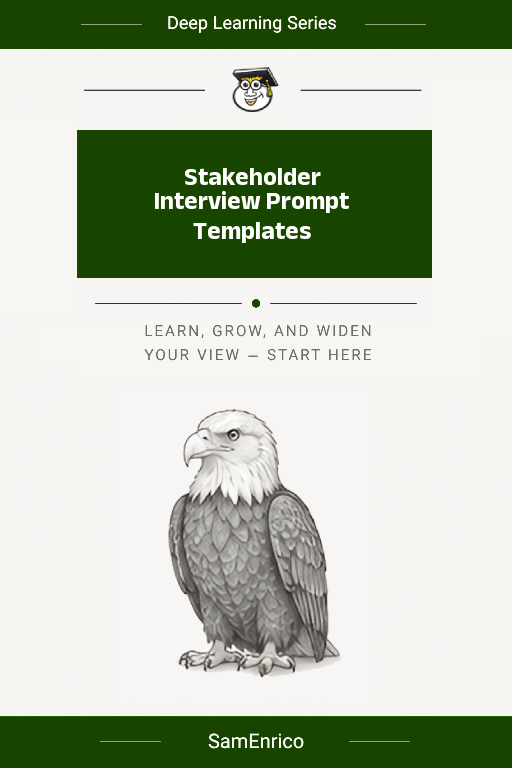
Stakeholder Interview Prompt Templates eBook
Prepare interview questions, follow-up probes, and
by Marino Angla
Prepare interview questions, follow-up probes, and synthesis frameworks using AI prompts that extract hidden requirements from stakeholder conversations.
Formats
Free sample
Chapter 1: The Four Faces--–- The meeting was supposed to be a formality. Sarah, a senior product manager at a mid-sized logistics company, had done everything right. She had a clear project charter, executive sponsorship, and a budget approved for a new customer portal. The stakeholder interview was with the VP of Operations, a man named Marcus who had been with the company for twelve years. She had prepared ten thoughtful questions.
She had a clean Notion doc ready for notes. She was confident.Marcus was polite. He agreed with every suggestion. He nodded when she described the proposed features. He said "yes" to the timeline.
He even complimented her thoroughness. The meeting ended with a handshake and a shared Google Doc summary that Marcus approved via email with a single word: "Looks good."Nine months and $2.3 million later, the project was dead.Not because the technology failed. Not because the budget ran out. Because Marcus had hidden a requirement so fundamental, so invisible, that no one thought to ask for it. And he never volunteered it.The portal required integration with a legacy warehouse management system that Marcus's team had been trying to replace for four years.
He did not mention this because admitting the system was broken would have reflected poorly on his tenure. He did not approve the integration work because doing so would have committed his team to supporting a platform he wanted to abandon. Instead, he quietly delayed, redirected resources, and nodded through every status update until the project was so far behind that the executive sponsor pulled the plug.The post-mortem revealed what the meeting notes never captured: Marcus had said "yes" out loud while thinking "no" internally. The stated requirement was a customer portal. The hidden requirement was organizational shame about a legacy system.This book exists because of Sarah.
And Marcus. And the thousands of similar conversations happening right now, in conference rooms and Zoom calls, where stakeholders say one thing and mean another—not out of malice, but out of fear, ego, assumption, or the simple human instinct to avoid uncomfortable truth.The 60-80% Problem Let me give you a number that should scare you. Across software development, product management, and organizational consulting, post-project analyses consistently show that between 60 and 80 percent of project rework traces back to requirements that were not discovered during the stakeholder interview phase. Not technical failures. Not budget overruns.
Not timeline compression. Missed requirements. The things stakeholders assumed you knew. The things they deliberately withheld. The things they did not even know they believed.This statistic comes from multiple sources: the Standish Group's Chaos Reports, the IEEE's surveys of software engineering failures, and internal data from organizations ranging from Fortune 500 companies to government agencies.
The numbers vary by industry, but the pattern is consistent. When projects fail or require massive rework, the root cause is almost never "we built what they asked for and it was wrong." It is almost always "we built what they asked for, but they didn't ask for what they actually needed."The tragedy is that these failures are not inevitable. They are not caused by bad stakeholders or incompetent interviewers. They are caused by a broken default approach to discovery—an approach that treats stakeholder interviews as information extraction rather than sense-making. Most interviewers prepare a list of questions, take notes, and produce a summary.
This is not discovery. This is transcription with extra steps.The Notion Doc Fallacy There is a specific moment in almost every failed project that, in retrospect, seems obvious. It is the moment when the stakeholder approved a document—a requirements doc, a meeting summary, a product brief—that looked clean, professional, and complete. Everyone signed off. Everyone felt good.
And everyone was wrong.I call this the Notion Doc Fallacy, named for the popular collaborative note-taking tool but applicable to any form of written alignment. The fallacy is this: the belief that a clean, consensus-driven document represents actual alignment. It does not. It represents the absence of visible disagreement. And the absence of visible disagreement is not alignment.
It is the absence of visible disagreement.Here is what actually happens when stakeholders approve a clean document. The person who disagrees but does not want to seem difficult says nothing. The person who has a hidden constraint but feels it is not their job to raise it stays quiet. The person who assumes everyone shares their unstated context signs off without realizing the gap. The person who is afraid of looking incompetent nods and hopes someone else will catch the problem later.The document itself is not the problem.
The problem is that clean documents create a psychological illusion of completeness. Once a document looks professional—once it has headings, bullet points, a table of contents—the human brain stops interrogating it for gaps. We mistake polish for substance. We mistake consensus for clarity.This book is not against documents. This book is against false confidence in incomplete documents.
And it offers a different path: using AI prompts not to produce cleaner documents, but to surface the mess that the documents are hiding.What Generative AI Actually Does (And Does Not Do)Before we go any further, we need to be brutally honest about what large language models like Chat GPT, Claude, and Gemini can and cannot do in the context of stakeholder interviews. The marketing around AI has created enormous confusion. Every day, new tools promise to "automate discovery" or "read stakeholder sentiment" or "predict requirements." Most of these promises are exaggerated. Some are outright lies.Here is what AI cannot do. AI cannot read tone.
It cannot detect sarcasm. It cannot tell the difference between a stakeholder who is genuinely excited and one who is performatively agreeable. It cannot see the micro-expression of discomfort when you ask about budget. It cannot hear the pause before an answer that signals a lie. It cannot build trust.
It cannot make a stakeholder feel safe enough to share their actual fears. AI is not a replacement for human interviewing skills. If you go into a stakeholder meeting unable to read the room, no prompt will save you.Here is what AI can do. AI is exceptionally good at pattern recognition across large volumes of text. It can scan a transcript and identify every weasel word.
It can compare what a stakeholder said at minute four to what they said at minute forty-two and flag contradictions. It can take messy, fragmented notes and organize them into structured frameworks. It can generate follow-up questions that you would not have thought of because it has been trained on millions of similar conversations. It can role-play as a skeptical CISO or a difficult compliance officer and help you pressure-test your assumptions before you ever talk to a real human.AI is not an interviewer. AI is a synthesis engine.
It is a pattern-matcher that takes human-curated input and produces structured output that accelerates your ability to find the signal in the noise. The value is not in the AI's output. The value is in the prompt discipline you bring to the process. A poorly prompted AI will hallucinate confidence, invent quotes, and…
This is the end of the free sample. Get the eBook to keep going. Buy now
About this book
Details
- Author
- Marino Angla
- Publisher
- SamEnrico
- Language
- English
- Genre
- Non-Fiction, AI Operator
- Released
- 2026-05-30
- Pages (approx.)
- 139
- Available as
- eBook, Audiobook

Read better in the ZLOADR app
Your eBooks on your phone or tablet. Sign in with your SamEnrico account and start reading.
More by Marino Angla
 Female Supreme Court JusticesMarino Angla$11.99
 Anki for College StudentsMarino Angla$11.99
 Step Ten Daily InventoryMarino Angla$11.99
 Denmark Green Tax GuideMarino Angla$11.99
 Habit for Anxiety GuideMarino Angla$11.99
 Oregon Attorney General InvestigationMarino Angla$11.99Oregon Attorney General InvestigationMarino Angla$11.99
 Distraction Proof Workspace Audit GuideMarino Angla$11.99
 Fixed Mindset Traps GuideMarino Angla$11.99
 The Silent Witness: How a Lock of Hair Solved a Victorian MurderMarino Angla$11.99
 The Obsidian Spy: A Mayan God’s GambitMarino Angla$11.99
 10 Ways to Use Rumex Scutatus (Recipe Book)Marino Angla$11.99
You may also like
 Hong Kong Handover 1997Dunn Johnnie$11.99
 Zumba For Postnatal Recovery CourseNeal Christian$11.99
 Zumba for BeginnersLadner Nikia$11.99
 YouTube Comment Mining GuideHumes Pandora$12.99
 Worry Box MeditationCarlin Rudy$11.99
 Workplace Stress MeditationNguyen Lynn$11.99
 Workplace Stress and Sleep RepairHawley Ivory$11.99
 Workplace Perfectionism CureDelaney Jeffry$11.99
 Workplace Injustice Anger GuideWallen Isabelle$11.99
 Work Addiction and Burnout LinkGreenwood Ester$11.99
 Women in Yoga and WellnessBeattie Galina$11.99
 Women in Stand Up ComedyChun Evangeline$11.99