
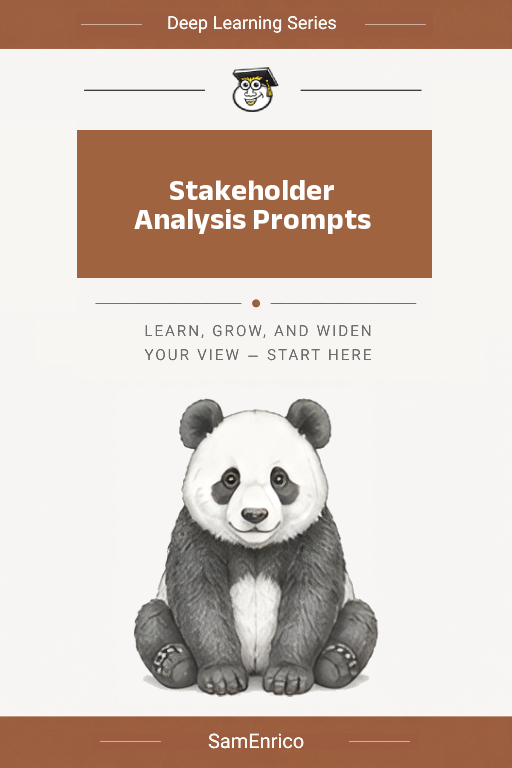
Non-FictionStudent's ShortcutStakeholder Analysis
Stakeholder Analysis Prompts eBook
Identify and analyze perspectives of different sta
by Lugo Bethel
Identify and analyze perspectives of different stakeholders using GPT prompts for multi perspective essays.
Formats
Free sample
Chapter 1: The Ghosts in the Room--–- The year is 2021. A mid-sized healthcare technology company called Med Flow Solutions has spent eighteen months and twelve million dollars developing “Care Sync,” a mobile application designed to help hospitals manage patient discharge. The app is elegant. The code is clean. The beta tests show zero bugs. The CEO presents it at the annual shareholder meeting as “the future of post-operative care.” Three months after launch, the app has a 94% satisfaction rating among hospital administrators. And yet, adoption among floor staff is below 7%. Nurses refuse to use it. Patients are confused. One hospital system abandons the program entirely after a near-miss event where a discharge instruction was delayed by forty-five minutes. Med Flow’s leadership holds a post-mortem. The engineers blame “user resistance to change.” The product manager blames “insufficient training.” The CEO blames “a few bad apples on the nursing staff.” Nobody asks the nurses. Nobody asks the patients. Six months later, Med Flow writes off the entire investment.This is not a story about bad software. This is a story about a failure far more common than technical debt or budget overruns. It is the failure of the single lens.Every project, every policy, every product, every essay, every strategic plan begins with someone seeing a problem and imagining a solution. That someone—whether a CEO, a student, a policy analyst, or an entrepreneur—inevitably sees the world from a particular vantage point. They have access to certain data. They carry certain assumptions. They answer to certain incentives. And then they make the catastrophic mistake of assuming that everyone else sees what they see, wants what they want, and fears what they fear.The Med Flow CEO saw a streamlined discharge process. The nurses saw thirty extra clicks per shift. The elderly patients saw a confusing interface with text too small to read. Three different realities, inhabiting the same hospital hallway, never once brought into the same room for a conversation. That is the problem this book exists to solve.The Invisible Architecture of Failure Let us name the enemy. Cognitive biases are not character flaws. They are not signs of laziness or stupidity. They are features of how human brains process information when faced with complexity. And they become dangerous only when we pretend they do not exist.Confirmation bias is the tendency to seek out, interpret, and remember information that confirms what we already believe. When the Med Flow CEO asked “Why isn’t the app working?” he listened to the engineers who confirmed his belief that the product was sound. He did not seek out the nurses who would have contradicted him. Confirmation bias does not make us stupid. It makes us efficient—at the cost of being wrong.Anchoring is the tendency to rely too heavily on the first piece of information we receive. In any stakeholder analysis, the first voice you hear—usually the loudest, highest-paid, or most confident—becomes the anchor. Every subsequent piece of information is judged relative to that anchor. If the CEO says “The app is great, the nurses are just lazy,” every alternative explanation now has to fight uphill against that initial framing.Availability heuristic is the tendency to overestimate the importance of information that comes easily to mind. The engineer who just fixed a critical bug will assume that all problems are technical. The marketer who just ran a successful campaign will assume that all problems are messaging problems. The stakeholder who is physically present in the room will always seem more important than the stakeholder who is absent.These biases are not errors in reasoning. They are the default settings of the human mind. And they guarantee that any analysis performed by a single person, working alone, with a single set of assumptions, will be incomplete. Not sometimes. Not accidentally. Inevitably.The Synthetic Stakeholder: A New Kind of Tool We cannot eliminate our biases by willpower alone. We cannot simply “try harder” to see other perspectives, because the very act of trying is shaped by the biases we are trying to overcome. What we need is a simulation engine—a system that can model what other rational, self-interested, emotionally complex human beings might think, feel, and do in response to our plans.Enter the Synthetic Stakeholder.Throughout this book, you will learn to use large language models (LLMs) like GPT-4, Claude, or Gemini not as oracles that know the truth, but as simulation engines that generate plausible perspectives. This distinction is absolutely critical. Let me say it again, because it is the single most important sentence in this book:The AI is not telling you what is true. It is telling you what a reasonable person in a given role might believe, given the patterns in its training data.Think of it this way. If you ask a human actor to “pretend you are a factory worker concerned about automation,” they will draw on their own experiences, their knowledge of factory workers they have known, and their understanding of human psychology. They are not reporting facts about any specific factory worker. They are simulating a plausible perspective. That is exactly what the AI does, but faster, more systematically, and with access to a vastly wider range of simulated experiences.The Synthetic Stakeholder is not a replacement for talking to real humans. It is a tool for generating hypotheses about what those real humans might say, so that you can ask better questions, design better interviews, and avoid the catastrophic blind spot of assuming you already know what everyone thinks.The Five-Step Iteration Loop Before we write our first prompt, you need to see the architecture that will organize every chapter of this book. I call it the Five-Step Iteration Loop. You will see it referenced repeatedly. By the end of the book, it should become second nature.Step 1: Define the Objective. What decision are you trying to make? What question are you trying to answer? What action will you take after the analysis is complete? Without a clear objective, stakeholder analysis becomes an academic exercise with no anchor.Step 2: Map the Stakeholders. Who has power? Who has interest? Who will be affected but has no voice? Who influences the influencers? This is where you generate the list of perspectives you need to simulate.Step 3: Separate Fact from Perspective. What is objectively true about the situation, independent of anyone’s opinion? What is the data that everyone agrees on? And what are the interpretations, values, and predictions that vary by stakeholder?Step 4: Synthesize Multiple Perspectives. Run the simulations. Generate the personas. Debate the trade-offs. Find the points of conflict and the points of alignment. This is where the AI does its heaviest work.Step 5: Reflect and Validate. Where did you inject bias? Which assumptions went unexamined? What would a skeptic say about your analysis? Then—and this is non-negotiable—go talk to real humans to check your simulated conclusions.These five steps form a loop because you will rarely complete them in a single pass. Step 5 will often send you back to Step 2 (you discover a stakeholder you missed) or Step 3 (you realize you confused a fact with an interpretation). That is not failure. That is the loop working as designed.Your First Prompt: Breaking the Anchor Let us put this framework…
This is the end of the free sample. Get the eBook to keep going. Buy now
About this book
Details
- Author
- Lugo Bethel
- Publisher
- SamEnrico
- Language
- English
- Genre
- Non-Fiction, Student's Shortcut, Stakeholder Analysis
- Released
- 2026-06-01
- Pages (approx.)
- 145
- Available as
- eBook, Audiobook

Read better in the ZLOADR app
Your eBooks on your phone or tablet. Sign in with your SamEnrico account and start reading.
More by Lugo Bethel
 Generalized Anxiety Daily PracticeLugo Bethel$11.99
 BRCA Genetic Testing GuideLugo Bethel$11.99
 Divorce After InfertilityLugo Bethel$11.99
 Commuting Without Anger GuideLugo Bethel$11.99
 Children Understanding Anticipatory GriefLugo Bethel$11.99
 Constraints for AccountantsLugo Bethel$11.99
 Boundary Setting for Truck DriversLugo Bethel$11.99
 The Last Broadcast: When the World Stopped for the 1967 Total Solar EclipseLugo Bethel$11.99
 The Sword of Hephaestus: A Blacksmith’s Oath to the GodsLugo Bethel$11.99
 How to Produce Packaging Product StockLugo Bethel$11.99
 Chimpanzees: Pan TroglodytesLugo Bethel$11.99
 How to Produce Contact CementLugo Bethel$11.99
You may also like
 Hong Kong Handover 1997Dunn Johnnie$11.99
 Zumba For Postnatal Recovery CourseNeal Christian$11.99
 Zumba for BeginnersLadner Nikia$11.99
 YouTube Comment Mining GuideHumes Pandora$12.99
 Worry Box MeditationCarlin Rudy$11.99
 Workplace Stress MeditationNguyen Lynn$11.99
 Workplace Stress and Sleep RepairHawley Ivory$11.99
 Workplace Perfectionism CureDelaney Jeffry$11.99
 Workplace Injustice Anger GuideWallen Isabelle$11.99
 Work Addiction and Burnout LinkGreenwood Ester$11.99
 Women in Yoga and WellnessBeattie Galina$11.99
 Women in Stand Up ComedyChun Evangeline$11.99