
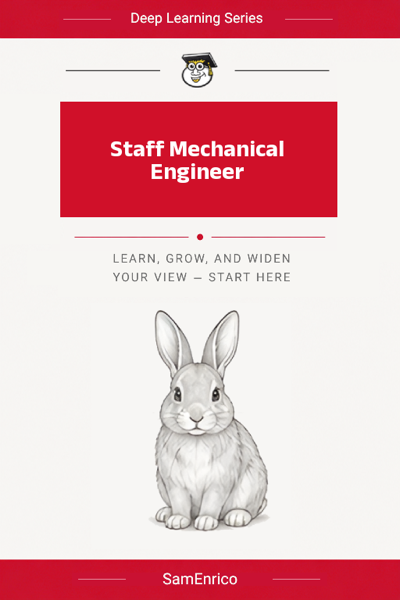
Staff Mechanical Engineer eBook
A Coursebook on Staff Mechanical Engineer
by Cyr Katy
A Coursebook on Staff Mechanical Engineer
Formats
Free sample
Chapter 1: The Bored Genius Trap...--–- The first time someone called me a “force multiplier,” I thought they were accusing me of being unable to do my own math. I was thirty-two years old, three weeks into my first Staff role, and I had just spent fourteen hours rebuilding a simulation model that a junior engineer had botched. I fixed the boundary conditions, corrected the mesh, reran the analysis, and delivered the results to the project manager by 7 AM. I felt like a hero. My manager looked at me with an expression that I misread as gratitude.
Years later, I realized it was pity.The truth is painful and simple: the skills that earned you the promotion to Staff Mechanical Engineer are the very skills that will now hold you back. Your flawless CAD work, your precise FEA analysis, your ability to debug a thermal system at 2 AM—these are no longer your primary weapons. They have become traps. And the most seductive trap of all is the one I fell into that week: the Bored Genius Trap.This chapter is about unlearning the identity of the solo hero. It is about recognizing that doing everything yourself is not a virtue at the Staff level—it is a failure of leadership.
And it introduces the single most important question you will ask for the rest of your career: “Should this problem exist at all?” before asking “How do I solve this problem well?”The Promotion That Feels Like a Demotion Let us start with a confession that most Staff Engineers are too ashamed to make aloud. The promotion to Staff feels, in the first six months, like a demotion. You were once the best engineer on your team. People came to you with the hardest problems, and you solved them with elegance and speed. You had a reputation.
You had a CAD license that was always open. You had a simulation queue that was always full. You were valuable because you produced.Then you got promoted. And suddenly, you are spending your days in meetings. You are reviewing other people’s work instead of creating your own.
You are mentoring juniors who ask questions that seem obvious. You are writing documents that no one reads. You are facilitating design reviews that used to be your stage. And in the quiet moments—late at night, when you finally open your laptop—you wonder if you have made a terrible mistake.This feeling has a name. In engineering psychology literature, it is sometimes called “role identity conflict.” But among Staff Engineers, it is known as the “Empty CAD Syndrome.” Your primary tool of production—the thing that made you an engineer—now sits unused for days at a time.
And because our professional identity is so tightly wrapped around our ability to make things, the absence of making feels like the absence of worth.Here is the reframe that will save your career: You are still making things. You are just making different things. Instead of making brackets and assemblies, you are making decisions. Instead of making drawings, you are making alignment. Instead of making simulation models, you are making the conditions under which good simulation happens reliably.
The output has changed, but the craft remains.The Bored Genius Trap is the failure to accept this reframe. It is the impulse to grab the keyboard, to fix the drawing yourself, to run the simulation yourself, because doing so feels productive and familiar. But every time you do that, you rob your team of learning, you create dependency, and you delay the day when you can work at your proper level of leverage.The Bored Genius Trap: A Detailed Autopsy Let me describe the trap in clinical terms, because if you do not learn to see it, you will fall into it every week for the rest of your Staff career.The Setup: You are in a design review. A junior engineer presents a mounting bracket for a pump. The bracket is functional but inelegant.
It uses too much material. The fastener selection is non-standard. The tolerances are unnecessarily tight. You could fix it in twenty minutes.The Temptation: You say, “I’ll just redo this quickly.” You feel a small rush of competence. The junior engineer looks relieved.
The team moves on.The Short-Term Reward: The bracket is better. The team saved time (twenty minutes versus the hour it would have taken to teach the junior how to improve it). You feel useful.The Long-Term Cost: The junior engineer learns nothing. Next time, they will bring you an even worse bracket, because they now believe that your job is to fix their work. You have created dependency.
You have also signaled that you do not trust the team to learn. And you have spent twenty minutes on a problem that, properly delegated, would have cost you zero minutes forever.This pattern, repeated across ten junior engineers and fifty design reviews, consumes hundreds of hours of Staff Engineer time. It also prevents the team from ever developing the skills that would make the Staff Engineer unnecessary for routine work. The Bored Genius Trap is not a failure of generosity—it is a failure of leverage.The term “bored genius” comes from a study of expert consultants who were promoted to management. The researchers found that the highest-performing individual contributors were the least effective managers, because they could not resist solving problems themselves.
They were bored by the slow work of teaching and coordinating. They craved the dopamine hit of the solo fix. And so they created organizations that were utterly dependent on them.The Staff Engineer is not a manager. But the dynamic is the same. If you are the only person who can solve a certain class of problem, you are not a leader.
You are a bottleneck. And bottlenecks get replaced.Scope Versus Impact: A New Metric for Success To escape the Bored Genius Trap, you need a new way of measuring your work. As a Senior Engineer, you were measured by scope—how many tasks you completed, how many drawings you released, how many simulations you ran. The more you produced, the more valuable you were. This is a linear measure of output.As a Staff Engineer, you must shift to measuring impact.
Impact is not about how much you do. It is about how much leverage your actions provide. A single action that eliminates an entire category of future work has enormous impact. A single action that enables ten other engineers to work faster has enormous impact. A single action that prevents a catastrophic failure has enormous impact.Here is the distinction in concrete terms:Scope: You optimize a bracket’s geometry, saving 2 hours of machining time per unit.
You produce a new drawing. You close the task. Good.Impact: You question why the bracket exists at all. You discover that a neighboring component can be redesigned to mount directly to the chassis, eliminating the bracket entirely. You save 2000 hours of production time across the product’s life, reduce part count, eliminate a supply chain line item, and remove three failure modes.
You produce no new bracket drawing. You close the bracket task by deleting it.The first approach is what a Senior…
This is the end of the free sample. Get the eBook to keep going. Buy now
About this book
Details
- Author
- Cyr Katy
- Publisher
- SamEnrico
- Language
- English
- Genre
- Non-Fiction, Informative, Educational
- Released
- 2026-05-11
- Pages (approx.)
- 147
- Available as
- eBook, Audiobook

Read better in the ZLOADR app
Your eBooks on your phone or tablet. Sign in with your SamEnrico account and start reading.
More by Cyr Katy
 Startup Founder Burnout GuideCyr Katy$11.99
 The Journal Article Citation GuideCyr Katy$11.99
 Customer Service Gamification GuideCyr Katy$11.99
 Validation for Pregnancy LossCyr Katy$11.99
 Intermittent Fasting Keto ComboCyr Katy$11.99
 The Candace's Gold: The Heist That Built an EmpireCyr Katy$11.99
 Climate Insurance for MarineCyr Katy$12.99
 Retrospectives for StartupsCyr Katy$12.99
 Learn to Play the Uruttu ChendaCyr Katy$11.99
 How to Become a Steeple JackCyr Katy$11.99